


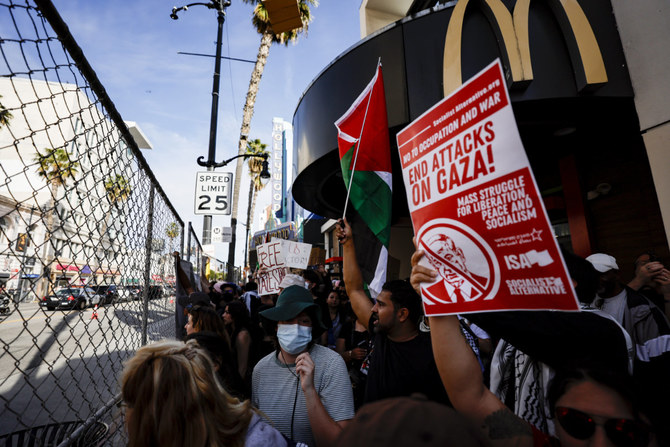
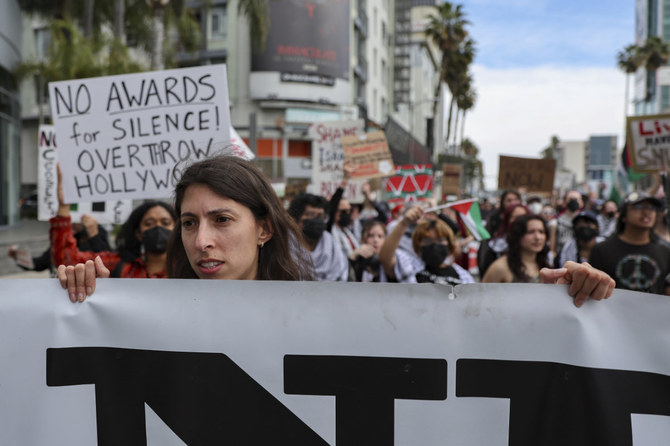

LOS ANGELES: Protest and politics intruded on an election-year Academy Awards on Sunday, where demonstrations for Gaza raged outside the Dolby Theatre in Los Angeles, and early awards went to “Poor Things,” “The Zone of Interest” and “The Boy and the Heron.”
Protests over Israel’s war in Gaza snarled traffic around the Academy Awards on Sunday, slowing stars’ arrival on the red carpet and turning the Oscar spotlight toward the ongoing conflict. Some protesters shouted “Shame!” at those trying to reach the Dolby Theatre.
Jonathan Glazer, the British filmmaker whose chilling Auschwitz drama “The Zone of Interest” won best international film, drew connections between the dehumanization depicted in his film and today.
“Right now, we stand here as men who refute their Jewishness and the Holocaust being hijacked by an occupation which has led to conflict for so many innocent people, whether the victims of October the 7th in Israel, or the the ongoing attack on Gaza, all the victims, this humanization, how do we resist?”

A Pro-Palestinian demonstrator speaks to members of security during a protest near the perimeter of the 96th Academy Awards in Los Angeles, California, on March 10, 2024. (REUTERS)
The war in Gaza was on the minds of many attendees, as was the war in Ukraine. A year after “Navalny” won the same award, Mstyslav Chernov’s “20 Days in Mariupol,” a harrowing chronicle of the early days of Russia’s invasion of Ukraine, won best documentary. The win, a first for The Associated Press and PBS’ “Frontline,” came as the war in Ukraine passed the two-year mark with no signs of abating.
Mstyslav Chernov, the Ukrainian filmmaker and AP journalist whose hometown was bombed the day he learned of his Oscar nomination, spoke forcefully about Russia’s invasion.
“This is the first Oscar in Ukrainian history,” said Chernov. “And I’m honored. But probably I will be the first director on this stage to say I wish I had never made this film.”
“Oppenheimer,” the blockbuster biopic, was widely expected to overpower all competition — including its release-date companion, “Barbie” — at an Oscars that could turn into a coronation for Christopher Nolan.
But it took more than 90 minutes into the show for “Oppenheimer” to win an award. Instead, Yorgos Lanthimos’ Frankenstein-riff “Poor Things” ran away with three prizes for its sumptuous craft, including awards for production design, makeup and hairstyling and costume design.
Robert Downey Jr. won best supporting actor at the Academy Awards, notching his first Oscar and handing the 58-year-old actor a crowning moment in an up-and-down career.
Downey’s illustrious second act culminated Sunday with a win for his supporting turn in Christopher Nolan’s “Oppenheimer.” Downey Jr., 58, had been nominated twice before (for “Chaplin” and “Tropic Thunder”).
“I’d like to thank my terrible childhood and the academy, in that order,” said Downey, the son of filmmaker Robert Downey Sr.
Jimmy Kimmel, hosting the ABC telecast for the fourth time, opened the 96th Academy Awards with a monologue that drew a few cold looks (from Robert Downey Jr., Sandra Hüller and Messi, the dog from best-picture nominee “Anatomy of a Fall”). But Kimmel, emphasizing Hollywood as “a union town” following 2023’s actor and writer strikes, drew a standing ovation for bringing out teamsters and behind-the-scenes workers — who are now entering their own labor negotiations.

TV host Jimmy Kimmel speaks onstage during the 96th Annual Academy Awards at the Dolby Theatre in Hollywood, California on March 10, 2024. (AFP)
The night’s first award was one of its most predictable: Da’Vine Joy Randolph for best supporting actress, for her performance in Alexander Payne’s “The Holdovers.” An emotional Randolph was accompanied to the stage by her “Holdovers” co-star Paul Giamatti.
“For so long I’ve always wanted to be different,” said Randolph. “And now I realize I just need to be myself.”
Though Randolph’s win was widely expected, an upset quickly followed. Hayao Miyazaki’s “The Boy and the Heron” won for best animated feature, a surprise over the slightly favored “Spider-Man: Across the Spider-Verse.” Miyazaki, the 83-year-old Japanese anime master who came out of retirement to make “The Boy and the Heron,” didn’t attend the ceremony. He also didn’t attend the 2003 Oscars when his “Spirited Away” won the same award.
Best original screenplay went to “Anatomy of a Fall,” which, like “Barbie,” was penned by a couple: director Justine Triet and Arthur Harari. “This will help me through my midlife crisis, I think,” said Triet.
In adapted screenplay, where “Barbie” was nominated — and where some suspected Greta Gerwig would win after being overlooked for director — the Oscar went to Cord Jefferson, who wrote and directed his feature film debut “American Fiction.” He pleaded for executives to take risks on young filmmakers like himself.
“Instead of making a $200 million movie, try making 20 $10 million movies,” said Jefferson, previously an award-winning TV writer.
The Oscars kicked off an hour early, due to daylight saving time. But aside from the time shift, this year’s show went for tried-and-true Academy Awards traditions. Kimmel is back as host. Past winners flocked back as presenters. And a big studio epic was poised for a major awards haul.
Yet Hollywood also has plenty of its own storm clouds to concern itself with.
The 2023 movie year was defined by a prolonged strike over the future of an industry that’s reckoning with the onset of streaming, artificial intelligence and shifting moviegoer tastes that have tested even the most bankable brands. The academy, while also widely nominating films like “Killers of the Flower Moon” and “Poor Things,” embraced both “Oppenheimer,” the lead nominee with 13 nods, and Greta Gerwig’s “Barbie,” the year’s biggest hit with more than $1.4 billion in ticket sales and eight nominations.
With the forecasted “Oppenheimer” romp, the night’s biggest drama is in the best actress category. Emma Stone (“Poor Things”) and Lily Gladstone (“Killers of the Flower Moon”) are nearly even-odds to win. While an Oscar for Stone, who won for her performance “La La Land,” would be her second statuette, an win for Gladstone would make Academy Awards history. No Native American has ever won a competitive Oscar.
While “Barbie” bested (and helped lift) “Oppenheimer” at the box office, it appears likely it will take a back seat to Nolan’s film at the Oscars. Gerwig was notably overlooked for best director, sparking an outcry that some, even Hillary Clinton, said mimicked the patriarchy parodied in the film.
Historically, having big movies in the mix for the Oscars’ top awards has been good for broadcast ratings. The Academy Awards’ largest audience ever came when James Cameron’s “Titanic” swept the 1998 Oscars.
Last year’s ceremony, where a very different best-picture contender in “Everything Everywhere All at Once” triumphed, was watched by 18.7 million people, up 12 percent from the year prior. ABC and the academy are hoping to continue the upward trend after a nadir in 2021, when 9.85 million watched a pandemic-diminished telecast relocated to Los Angeles’ Union Station.


