

Saudi Arabia, Muslim world gear up as Ramadan begins

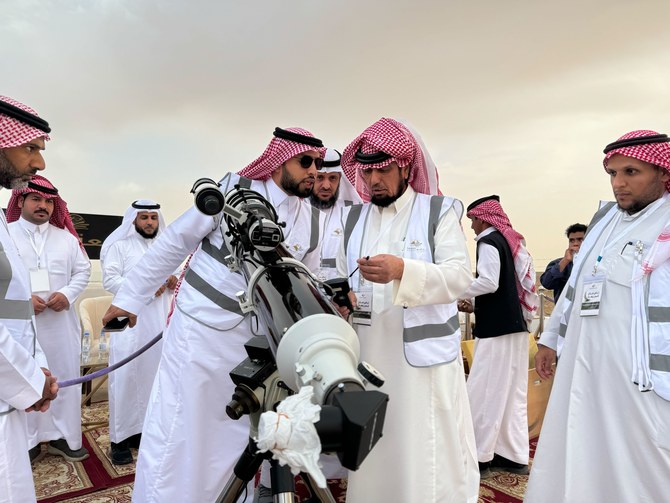
Observers at the Sudair Astronomical Observatory in Saudi Arabia check their equipment ahead of sunset when they will attempt to spot the Ramadan crescent moon. (AN photo)
Short Url
Updated 11 March 2024
Follow

Saudi Arabia, Muslim world gear up as Ramadan begins

  • Joining Saudi Arabia, Qatar and the UAE have also confirmed that Ramadan will begin on Monday
  • Oman, Pakistan, Indonesia, Australia, Malaysia, Brunei and Iran will follow a day later

RIYADH: Saudi Arabia is set to usher in Ramadan’s month-long journey of spiritual devotion, fasting and community on Monday after an official sighting of the new crescent moon in Hawtat Sudair.

The sighting by astronomers from the Majmaah University Astronomy Observatory Department in Riyadh signalled the start of the holy month for most of the almost 2 billion Muslims across the globe.

This significant event was led by prominent Saudi astronomer Abdullah Al-Khudairi, director of the Astronomy Observatory in Sudair.

The Saudi Supreme Court announced that Monday, March 11, will be the first day of Ramadan.

Joining Saudi Arabia, Qatar and the UAE have also confirmed that Ramadan will begin on Monday, with Oman, Pakistan, Indonesia, Australia, Malaysia, Brunei and Iran to follow a day later.

The determination of the starting date relies on both lunar calculations and physical sightings of the new moon, a practice steeped in Islamic tradition.

Al-Khudairi said: “Calculation and technology are complementing the sighting process. I say that the astronomical calculations and the naked eye sighting, like the human’s eyes, they need one another.”


Looking ahead, Majmaah University revealed plans to enhance its facilities and increase its team to further streamline the moon-sighting process.

Mohammed Al-Shehri, deputy director for postgraduate and scientific research at the university, said: “We have our strategic plans that we are going to expand our facilities, our tools, our manpower here (Hawtat Sudair).”

He added: “We want to build a big building here. It will be the center for Majmaah for seeing the moon.”

The decision regarding the start of Ramadan holds significant religious and cultural importance for Muslims around the world.

One of the holiest months in the Islamic calendar, Ramadan is observed with acts of fasting, prayer and charity as a time of spiritual devotion and self-discipline.

From dawn until sunset, Muslims abstain from eating, drinking, smoking and other physical needs as a demonstration of worship and obedience to the Almighty Allah.

Ramadan is one of the five pillars of Islam and is obligatory for all adult Muslims, with exceptions for those who are ill, elderly, pregnant, nursing, menstruating or traveling. It serves as a time for reflection not only for Muslims but also for people of all faiths, fostering understanding and mutual respect across diverse geographies, cultures and communities.


14 sculptures go on display at public spaces in Riyadh

Updated 11 December 2025
Follow

14 sculptures go on display at public spaces in Riyadh

  • The works were chosen by Riyadh Art from its international Tuwaiq Sculpture symposium to reflect its ‘vision of weaving beauty and intellect into the city’s fabric’
  • Initiative aligns with efforts to make art a key part of city’s identity that improves quality of life and promotes the cultural economy, says Royal Commission for Riyadh City’s Khalid Al-Hazani

RIYADH: Fourteen sculptures selected from the annual international Tuwaiq Sculpture symposium, a Riyadh Art program, went on display on Wednesday at three prominent public spaces across the Saudi capital: ROSHN Front, the SEDRA residential community, and Sports Boulevard.

The project is part of Riyad Art’s efforts to showcase artworks in public spaces, and the addition of more works in other places is expected later.

Khalid Al-Hazani, the executive vice president of the lifestyle sector at the Royal Commission for Riyadh City, said: “This step reflects (Riyadh Art’s) vision of weaving beauty and intellect into the city’s fabric, and creating vibrant and culturally rich public spaces, allowing art to become an integral part of people’s daily lives.”

It is also in line with Riyadh Art’s broader strategy for transforming the city into an open-air art gallery, he added, thereby “turning art into a central element of the city’s identity and a key contributor to improving quality of life and promoting the cultural economy.” 

The Riyadh Art Program installed on Wednesday 14 sculptures selected from the Tuwaiq International Sculpture Symposium at prominent locations in Riyadh, including the ROSHN Front, SEDRA Residential Community, and Sports Boulevard. (Supplied)

The three chosen locations were considered perfect places to host the artworks because of their vibrancy, strong community connections and accessibility, Al-Hazani noted.

“This provides residents and visitors with the opportunity to engage with the sculptures in their everyday lives,” he said.

Seven of the sculptures have been installed at ROSHN Front, considered a key urban hub. The artworks on display there form a thought-provoking artistic landscape that encourages interaction, organizers said, and explores a number of themes including the values of urban transformation, community spirit, and creative curiosity.

Three sculptures are on display at the SEDRA residential community. Chosen to complement its serene character and nature-integrated urban planning, they blend in with their surroundings to reflect the values of environmental harmony, contemplation and renewal, organizers explained.

The remaining four sculptures are at Sports Boulevard, known for its open, green spaces. These works reflect several concepts, in particular ideas of nature, balance and public health.

All of the sculptures are part of Riyadh Art’s permanent collection, which includes works created by local and international artists during the Tuwaiq Sculpture symposium.