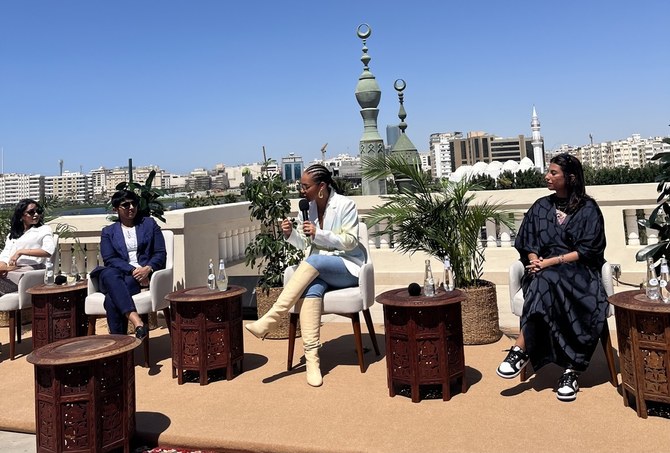
JEDDAH: American singer Alicia Keys took her place in the recent third “Women to Women” initiative in Jeddah, alongside influential Saudi women such as DJ Cosmicat (Nouf Sufyani); Mishaal Ashemimry, aerospace engineer and commercial pilot; visual artist Huda Beydoun; Noura bin Saidan, a street artist; and Raha Moharrak, the first Saudi woman to scale Mount Everest.
Organized by MDLBEAST on International Women’s Day, the event aimed to unite female leaders and focus on how they can drive cultural progress both in Saudi Arabia and globally.
The diverse group of women shared their experiences in their respective fields, while looking at the challenges they overcame for success.
They looked at what it means to be a woman challenging norms and overcoming obstacles, sharing the inspirations that drove their remarkable accomplishments.
Keys said: “(I’m) so excited to be together. What inspires me is humanity, people; real-life experiences inspire me. Those are the things I write songs about, those are the things that connect me and us.
“It’s all about experiencing life. Meeting new people in this event is such an inspiration (and) to be able to engage in the conversation. My journey has been unique: raised by a single mother who is a rock to me. The will to achieve and discover, to keep going, can happen by trusting yourself.
“The biggest lesson that I would like to share is to keep going. Learn from failure and grow from it.”
She added: “I always keep telling myself to keep trying, and even if it doesn’t work out, at least I tried. I would like to avoid the pressure that I placed on myself and instead believe in personally deciding what is important to me and what success means to me.
“Success, to me, is being an authentic, genuine person who is good-natured, good-hearted, and kind to people, bringing positivity to others. Even if I can positively impact just one person, that is most important to me. It’s all about spreading positivity.”
Keys, who has won 15 Grammys and sold 90 million records worldwide, is renowned for her achievements in music and her dedication to activism, entrepreneurship, and wellness initiatives. She is actively engaged with her beauty brand, Keys Soulcare.
Ashemimry, who draws inspiration from her birth city of Qassim and her childhood fascination with the stars, also shared her journey and insights during the event.
She said: “I wanted to learn deeper about space and the only way to do it was to build rockets. When you are a child, you don’t understand, and breaking stereotypes was very challenging.”
Encouraging others to pursue their own dreams, Ashemimry spoke about her unexpected path to becoming the first Saudi female aerospace engineer and commercial pilot. She added: “In my case, when I had inspiration, I never thought I would be the first. I had the passion to just follow it. When I knew that I was the first Saudi, I felt huge responsibility on my shoulders toward the public.
“So I started social media accounts talking about space and technology development. I had difficulty in Arabic. I had a fear that I wouldn’t be able to explain myself better. But, later on, I started to talk about space by simplifying it in Arabic ... when I spoke about my inspiration, hardships I went through, being away from my family, the struggles, sacrifices to be a rocket scientist, and the history of rockets.
“The impact I left with the content I created was really inspiring to the audience, which motivated me to keep encouraging people to aspire.”
Moharrak, reflecting on her journey and the challenges she faced, said: “The emotional and mental challenge that you don’t fit in is very challenging, and that’s something no one teaches.
“I am so proud that now more and more women are breaking the norm. In my story, the challenge was mentality and (that was) also the biggest driver. If we don’t change the narratives and the story, then who will?
“Yes, I have climbed Mount Everest, but every single woman has an Everest to climb in daily life. It’s about continually proving to yourself that you are capable of achieving extraordinary things and overcoming challenges. So don’t let anyone make you feel that you cannot climb your Everest.”
Other members of the panel shared their sources of inspiration and the paths they took to achieve success, while also discussing strategies for overcoming the negative opinions of others and people’s perceptions.
Rozana Al-Banawi, an entrepreneur specializing in professional training and coaching, conducted sessions with her team to engage the audience, facilitating activities focusing on leadership skills and self-development, creating an interactive and enriching experience for those attending.


![]()
![]()

American singer Alicia Keys joins Saudi trailblazers in ‘Women to Women’ initiative in Jeddah

Short Url
https://arab.news/bt4ph
American singer Alicia Keys joins Saudi trailblazers in ‘Women to Women’ initiative in Jeddah
- Organized by MDLBEAST on International Women’s Day, the event aimed to unite female leaders and focus on how they can drive cultural progress both in Saudi Arabia and globally
- The diverse group of women shared their experiences in their respective fields, while looking at the challenges they overcame for success


Latest updates


© 2026 SAUDI RESEARCH & PUBLISHING COMPANY, All Rights Reserved And subject to Terms of Use Agreement.