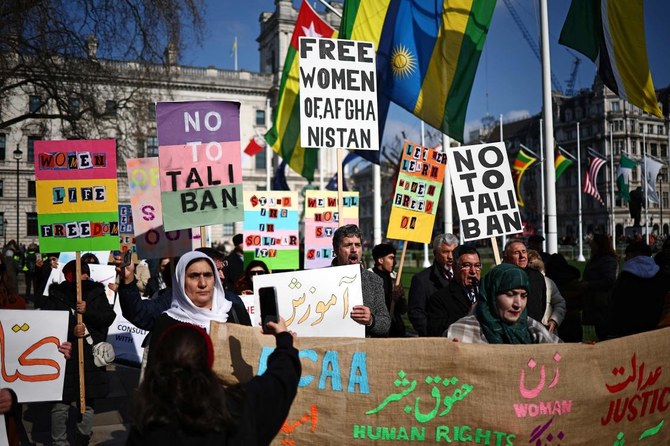
KABUL: Small groups of Afghan women on Friday staged rare demonstrations to mark International Women’s Day in private spaces, after a crackdown by Taliban authorities forced activists off the streets.
Since surging back to power in August 2021, Taliban authorities have imposed a strict interpretation of Islam, with women bearing the brunt of curbs the United Nations has labelled “gender apartheid.”
Women have been squeezed from public life, barred from traveling without a male relative and banned from certain jobs, secondary school and university, as well as from parks, fairs and gyms.
A handful of women in several provinces gathered to demand restrictions be lifted, according to activists from the Purple Saturdays group, which protests Taliban government curbs on women.
In northern Takhar province, images circulated by activists showed seven women holding papers obscuring their faces, reading “Rights, Justice, Freedom.”
“Our silence and fear is the biggest weapon of the Taliban,” a demonstrator whose face was covered said in a video.
In Balkh province, several women also held up signs saying, “Don’t give the Taliban a chance” in front of a banner reading “Save Afghanistan Women.”
On Thursday, around 20 women gathered at an office for an event organized by the Afghanistan Association of the Blind in northern Mazar-i-Sharif city.
“The gates of schools, universities and offices should be opened for all women,” said one attendee, who remained anonymous for security reasons, during the meeting.
“It is very painful that a woman has no value in our society today. She cannot use any of her rights.”
“Women make up half of human society as mothers, wives, sisters, daughters and teachers. The holy religion of Islam is not against women’s work and education,” another added.
Also on Thursday, the Independent Coalition of Afghanistan Women’s Protest Movement issued a statement demanding “immediate and serious action from the international community against the clear violation of human rights and obvious crimes the Taliban are committing against Afghan women.”
The UN mission in Afghanistan, UNAMA, on Friday urged the Taliban government to lift restrictions on women and girls, saying not doing so risked “further pushing the country into deeper poverty and isolation.”
“The space for Afghan women and girls continues to shrink at an alarming pace, and with it Afghanistan’s future prospects to escape a vicious cycle of war, poverty, and isolation,” said Alison Davidian, Special Representative for UN Women in Afghanistan, in a statement.
Taliban authorities have repeatedly dismissed such international criticism as propaganda.
On Friday, spokesman Zabihullah Mujahid said the Taliban government was committed to women’s rights within the framework of Islam, according to an interview with Tolo News.
Women have protested sporadically against rules handed down by the Taliban authorities, but often in small groups and indoors out of fear of reprisals, after several activists were detained for months.
On Friday, the UN Special Rapporteur for human rights in Afghanistan, Richard Bennett, called on the Taliban government “to immediately and unconditionally release all those who have been arbitrarily detained for defending human rights, especially the rights of women and girls.”
Street protests in Afghanistan have in the past been broken up by security forces firing guns into the air, including during a demonstration last summer after beauty salons were shut down.
Last March, about 20 women held a rare protest in the streets of Kabul for International Women’s Day.


![]()

Afghan women stage rare protests on International Women’s Day
Short Url
https://arab.news/y897m
Afghan women stage rare protests on International Women’s Day
- A handful of women in several provinces gathered to demand restrictions be lifted
- In northern Takhar province, images circulated by activists showed seven women holding papers obscuring their faces, reading “Rights, Justice, Freedom”


Latest updates


© 2026 SAUDI RESEARCH & PUBLISHING COMPANY, All Rights Reserved And subject to Terms of Use Agreement.