

UN says Taliban enforcing restrictions on single and unaccompanied Afghan women 

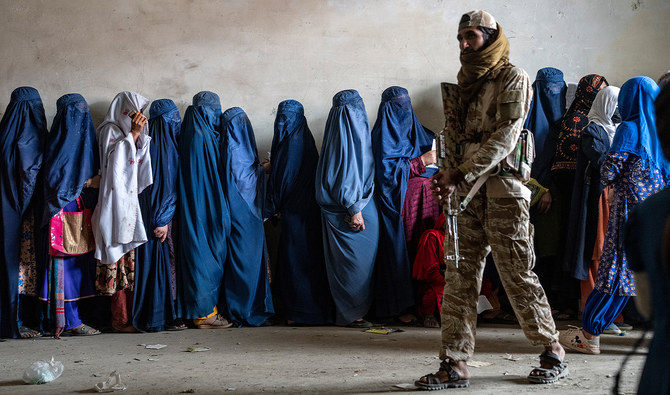
A Taliban fighter stands guard as women wait to receive food rations distributed by a humanitarian aid group, in Kabul, Afghanistan, on May 23, 2023. (AP/File)
Short Url
Updated 23 January 2024
Follow

UN says Taliban enforcing restrictions on single and unaccompanied Afghan women 

  • Taliban have barred women from most areas of public life and stopped girls from going to school beyond the sixth grade
  • Taliban say Islamic government in Afghanistan must “fully implement all aspects of Shariah for both men and women”

ISLAMABAD: The Taliban are restricting Afghan women’s access to work, travel and health care if they are unmarried or don’t have a male guardian, according to a UN report published Monday.

In one incident, officials from the Vice and Virtue Ministry advised a woman to get married if she wanted to keep her job at a health care facility, saying it was inappropriate for an unwed woman to work, it said.

The Taliban have barred women from most areas of public life and stopped girls from going to school beyond the sixth grade as part of harsh measures they imposed after taking power in 2021, despite initially promising more moderate rule.

They have also shut down beauty parlors and started enforcing a dress code, arresting women who don’t comply with their interpretation of hijab, or Islamic headscarf. In May 2022, the Taliban issued a decree calling for women to only show their eyes and recommending they wear the head-to-toe burqa, similar to restrictions during the Taliban’s previous rule between 1996 and 2001.

The UN spokesman, asked for Secretary-General Antonio Guterres’ reaction to the latest bans, replied: “Horror!” Stephane Dujarric added: “It must be unimaginable to have to live there.”

In its latest quarterly report, covering October to December last year, the UN Assistance Mission in Afghanistan said the Taliban are cracking down on Afghan women who are single or don’t have a male guardian, or mahram, accompanying them.

There are no official laws about male guardianship in Afghanistan, but the Taliban have said women cannot move around or travel a certain distance without a man who is related to her by blood or marriage.

Three female health care workers were detained last October because they were going to work without a mahram. They were released after their families signed a written guarantee that they would not repeat the act, the report said.

In Paktia province, the Vice and Virtue Ministry has stopped women without mahrams from accessing health facilities since December. It visits health facilities in the province to ensure compliance.

The ministry, which serves as the Taliban’s morality police, is also enforcing hijab and mahram requirements when women visit public places, offices and education institutes through checkpoints and inspections.

In December, in Kandahar province, ministry officials visited a bus terminal to ensure women were not traveling long distances without mahrams and instructed bus drivers not to permit women to board without one, the UN said.

Women have also been arrested for buying contraceptives, which the Taliban have not officially banned.

The Taliban’s chief spokesman, Zabihullah Mujahid, said the UN report was based mostly on misunderstandings and accused the mission of ignoring or criticizing Islamic law, or Shariah.

With an Islamic government in power in Afghanistan, it must “fully implement all aspects of Shariah for both men and women,” Mujahid said in a statement.

This means enforcing rules for the hijab, male guardianship and gender segregation for women in education and employment, he said.

“If UNAMA criticizes these cases or considers explicit Islamic rulings as an act against human rights, then it is an insult to the beliefs of a people,” he said.


European leaders expected to cement support for Ukraine amid Washington pressure to accept deal

Updated 41 min 55 sec ago
Follow

European leaders expected to cement support for Ukraine amid Washington pressure to accept deal

  • After Sunday’s talks in Berlin between U.S. envoys and Ukrainian President Volodymyr Zelenskyy, Ukrainian and European officials are set to continue a series of meetings

BERLIN: European leaders are expected to cement support for Ukraine Monday as it faces Washington’s pressure to swiftly accept a U.S.-brokered peace deal.
After Sunday’s talks in Berlin between U.S. envoys and Ukrainian President Volodymyr Zelenskyy, Ukrainian and European officials are set to continue a series of meetings in an effort to secure the continent’s peace and security in the face of an increasingly assertive Russia.
Zelenskyy sat down Sunday with U.S. President Donald Trump’s special envoy Steve Witkoff and Trump’s son-in-law Jared Kushner in the German federal chancellery in the hopes of bringing the nearly four-year war to a close.
Washington has tried for months to navigate the demands of each side as Trump presses for a swift end to Russia’s war and grows increasingly exasperated by delays. The search for possible compromises has run into major obstacles, including control of Ukraine’s eastern Donetsk region, which is mostly occupied by Russian forces.
Zelenskyy on Sunday voiced readiness to drop his country’s bid to join NATO if the U.S. and other Western nations give Kyiv security guarantees similar to those offered to NATO members. But Ukraine continued to reject the U.S. push for ceding territory to Russia.
Putin wants Ukraine to withdraw its forces from the part of the Donetsk region still under its control among the key conditions for peace.
The Russian president also has cast Ukraine’s bid to join NATO as a major threat to Moscow’s security and a reason for launching the full-scale invasion in February 2022. The Kremlin has demanded that Ukraine renounce the bid for alliance membership as part of any prospective peace settlement.
Zelenskyy emphasized that any Western security assurances would need to be legally binding and supported by the U.S. Congress.
‘Pax Americana’ is over
German Chancellor Friedrich Merz, who has spearheaded European efforts to support Ukraine alongside French President Emmanuel Macron and U.K. Prime Minister Keir Starmer, said Saturday that “the decades of the ‘Pax Americana’ are largely over for us in Europe and for us in Germany as well.”
He warned that Putin’s aim is “a fundamental change to the borders in Europe, the restoration of the old Soviet Union within its borders.”
“If Ukraine falls, he won’t stop,” Merz warned during a party conference in Munich.
Macron, meanwhile, vowed Sunday on social platform X that “France is, and will remain, at Ukraine’s side to build a robust and lasting peace — one that can guarantee Ukraine’s security and sovereignty, and that of Europe, over the long term.”
Putin has denied plans to attack any European allies.