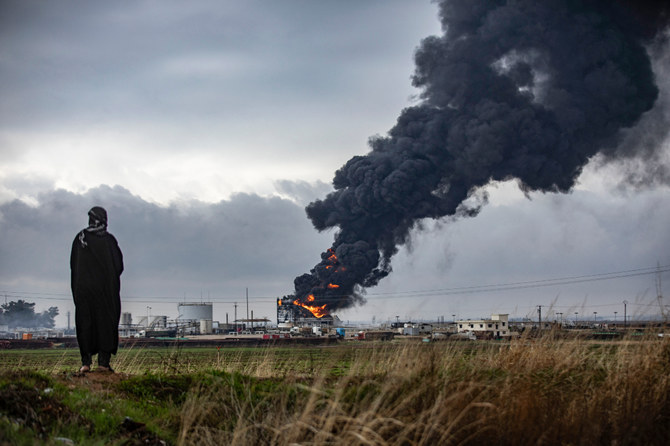
ANKARA: Two civilians have been killed in a Turkish air strike in the mountainous Sheladiz area of northern Iraq’s Duhok province, two Iraqi security sources said on Friday.
Turkiye’s defense ministry said its forces carried out two air strikes in northern Iraq and northern Syria overnight, killing six militants in Iraq and seven in Syria. Its post on social media platform X did not provide further information.
The ministry did not say which regions the attacks targeted and it was unclear whether the ministry was referring to the same incident in northern Iraq as the security sources.
Turkiye regularly carries out air strikes and cross-border operations in neighboring Iraq as part of its offensive against the outlawed Kurdistan Workers Party (PKK), which is mainly based in northern Iraq’s mountainous region.
The PKK, designated a terrorist group by Turkiye, the United States and the European Union, took up arms against the Turkish state in 1984. More than 40,000 people have been killed in the insurgency.
Turkiye has also staged a series of military offensives and bombing campaigns in northern Syria against the Syrian Kurdish YPG militia, which it regards as a wing of the PKK.


Two civilians killed in Turkish air strike in northern Iraq
https://arab.news/7ndgr
Two civilians killed in Turkish air strike in northern Iraq

- Turkiye’s defense ministry said its forces carried out two air strikes in northern Iraq and northern Syria overnight, killing six militants in Iraq and seven in Syria


Israel spied on US forces at Gaza aid base: Sources
- US commander summoned Israeli counterpart to say: ‘Recording has to stop here’
- Staff, visitors from other partner countries have also raised concerns about Israeli surveillance
LONDON: Israel conducted widespread surveillance of US forces involved in an aid mechanism for Gaza, The Guardian reported.
The Civil-Military Coordination Center in southern Israel was launched in October as a joint body to monitor the ceasefire and oversee the entry of aid into the war-torn Palestinian enclave.
But sources with knowledge of internal disputes told The Guardian that open and covert recordings of meetings at the CMCC had prompted disputes between the two partners.
Lt. Gen. Patrick Frank, the US commander of the center, summoned his Israeli counterpart to explain that “recording has to stop here.”
Other countries, including the UK and UAE, are also involved in the CMCC. Staff and visitors from partner countries have likewise raised concerns about Israeli surveillance activities at the center.
When the CMCC began operations, media in the US and Israel reported that the latter was handing over authority to American forces.
Yet Israel still retains effective control over what enters the territory despite Washington’s considerable leverage, according to one US official.
US forces who arrived at the CMCC, including logistics experts, were keen to increase the flow of aid into Gaza.
But they soon discovered that Israel had implemented a wide range of controls on purported “dual-use” goods, creating a larger impediment than any engineering challenge relating to aid delivery. These included basic goods such as tent poles and chemicals used for water purification.
Dutch Foreign Minister David van Weel has said he was briefed at the center on “one of the dual-use barriers that was being lifted as a result of the conversations (there).”
It came in response to growing awareness that Israeli restrictions on deliveries stood as the biggest barrier to the entry of aid into Gaza.
Israeli authorities had also restricted basic items such as pencils and paper — required by Palestinian students for school — without explanation.
There is widespread hesitancy among aid organizations and diplomats over joining the CMCC’s efforts, despite being invited to do so.
The center lacks any Palestinian representation, and even US efforts to schedule video calls with Palestinian officials were vetoed by Israeli staff there.


