Turkish opposition disarray lifts Erdogan’s hopes of winning back Istanbul

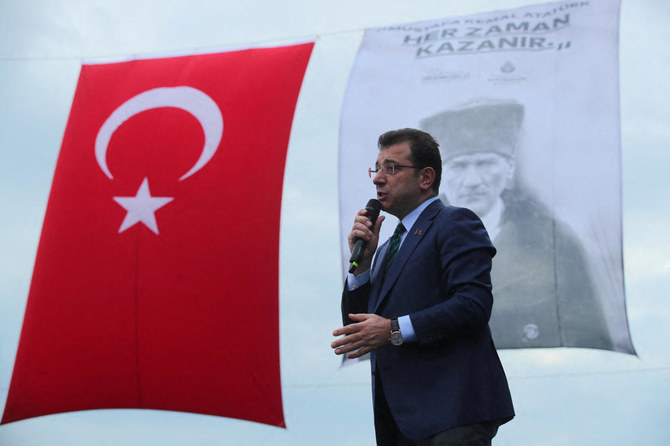
Istanbul’s mayor Ekrem Imamoglu, above, has been touted as a potential leader of the main opposition CHP and possibly a future president. (Reuters)
Short Url
Updated 07 March 2024
Follow

Turkish opposition disarray lifts Erdogan’s hopes of winning back Istanbul

  • The outcome of the March 31 election in Istanbul, Turkiye’s largest city, is seen as key in deciding the political fate of its mayor, Ekrem Imamoglu

ISTANBUL: Disunity among Turkiye’s opposition parties has boosted President Tayyip Erdogan’s hopes that his AK Party can regain control of Istanbul in this month’s municipal elections, pollsters say, following his victory in last year’s presidential vote.
The outcome of the March 31 election in Istanbul, Turkiye’s largest city, is seen as key in deciding the political fate of its mayor, Ekrem Imamoglu, 52, long touted as a potential leader of the main opposition CHP and possibly a future president.
Five years ago, Imamoglu and the secularist CHP dealt Erdogan a heavy blow in municipal elections by winning control of Istanbul, the president’s home city, and the capital Ankara after 25 years of rule by the AKP and its Islamist predecessors.
But Erdogan, who has dominated Turkish politics for nearly a quarter of a century, beat off a strong opposition challenge last May to win re-election as president, while the AKP and its allies secured another parliamentary majority.
The alliance that helped propel Imamoglu to victory in Istanbul has since collapsed, and his nationalist and pro-Kurdish allies are fielding their own candidates this month.
Recent polls point to a close race, with pollsters MAK this week showing 41.5 percent support for Imamoglu, just 1.5 points ahead of AKP candidate Murat Kurum. According to pollster Murat Gezici, Kurum had 44.1 percent support, ahead of Imamoglu’s 43.5 percent.
“The race is neck-and-neck, on a knife edge,” Ozer Sencar, chairman of pollsters Metropoll, told Reuters, emphasising the importance of Istanbul for future national politics.
“If Ekrem Imamoglu wins the election in Istanbul and this election is not canceled by objections in some way, he will become the president (of Turkiye) in 2028,” he said.
FRAGMENTED OPPOSITION
But Imamoglu’s hopes in Istanbul have been dented by the decision of the pro-Kurdish DEM Party and the Turkish nationalist IYI Party, whose voters supported him in 2019, to field their own candidates.
“The damage that the IYI and DEM parties will do to Ekrem Imamoglu must be taken seriously,” Sencar said.
Metropoll’s latest survey showed support for Imamoglu among Kurdish voters had declined to 32 percent last month from 35 percent in January. Support among IYI party voters fell to 45 percent from 64 percent.
Discord within the CHP itself, which elected a new leader this year, has added to Imamoglu’s challenge, with many in the party unhappy with the choice of election candidates.
“The biggest risk for the opposition in Istanbul is that it is becoming more fragmented than ever,” said Ertan Aksoy, head of Aksoy Research, whose survey conducted 40 days ago showed Imamoglu to be 3-4 percentage points ahead of his AKP rival.
Imamoglu has accused central government of hampering his delivery of services in Istanbul since 2019. Campaigning is now focused on solving traffic problems in a city of 16 million and the need for urban transformation, given earthquake risks in the region.
In election campaigning, Erdogan has made the opposition’s difficulties the focus of his speeches.
“No change has been able to cure the political exhaustion of the CHP. Everyone who comes and goes just makes things worse,” he told a rally this week.


‘Speed over scale’: Saudi Arabia positioned to shape future of industry, say experts

Updated 6 sec ago
Follow

‘Speed over scale’: Saudi Arabia positioned to shape future of industry, say experts

  • WEF p anelists also discussed how global industrial forces are evolving

DAVOS: Saudi Arabia is primed to position itself at the forefront of the global industrial transformation, leveraging its scale, strategic vision, and competitive energy infrastructure to become a leader in sectors such as clean industries and advanced technologies, experts said on Tuesday.
Speaking at a panel at the World Economic Forum in Davos, Rayan Fayez, deputy CEO at NEOM, highlighted how the Kingdom’s industrial city, Oxagon, is driving diversification and clean manufacturing.
The city is already home to several key sectors, including green hydrogen, renewable manufacturing and AI data centers.
The world’s largest green hydrogen project, a collaboration with ACWA Power and Air Products, is 90 percent complete and expected to be operational by 2027, Fayez said.
Renewable manufacturing partnerships are also taking off, with Chinese companies establishing solar and wind production outside China for the first time.
Fayez highlighted that NEOM’s success rests on four core competitive advantages: digital infrastructure, abundant renewable energy, ready-to-use land and strategic location.
“The location is not only strategic for the Kingdom, but also in connection to the rest of the world through the port of NEOM,” he said, adding that the city is poised to serve as a hub for both domestic and export-oriented industries.
Panelists also discussed how global industrial forces are evolving.
Frederico Torti from the WEF highlighted the structural volatility in supply chains, driven by geopolitics, technological change, natural disasters, cybersecurity risks and talent shortages.
He highlighted the importance of agility, collaboration and holistic operational transformation.
“The only way to make this happen is through collaboration, dialogue, and cooperation across public and private sectors,” he said.
Saudi Arabia’s strategic position, combined with its low-cost energy and infrastructure readiness, make it a magnet for industrial investment, Torti said.
“Countries that invest in the right factors will attract manufacturing investments and create value for the next decade,” he said, pointing to NEOM as a prime example of this approach.
ACWA Power CEO Marco Arcelli highlighted why Saudi Arabia is a compelling market for gigascale renewable energy and water desalination projects.
“In a world of uncertainty, Saudi Arabia is a country where you can really smell the hope,” he said.
“It speaks with China and the US, with Russia and Ukraine, with Europe and Southeast Asia and Africa, and looks to partner to solve problems and to develop domestically but also abroad.”
ACWA Power is now the largest water desalination company in the world, with operations across the Middle East and new projects in Azerbaijan, Senegal and China, he added.
Arcelli highlighted the water-energy nexus, where low-cost renewable power enables large-scale, sustainable desalination.
“Countries that are moving faster in these sectors are typically countries that will enjoy higher economic growth,” he said.
Looking ahead, panelists highlighted that the future of competitiveness will rely less on scale and more on speed and collaboration.
“You cannot be good at everything,” Arcelli said. “It’s going to be more about cooperation. It’s an economy of speed, not economy of scale anymore to thrive and be the best around.”
Torti reiterated the need for cross-border partnerships and dialogue, adding: “Open up, connect and make best use of forums like this to get different perspectives on solving problems. Collaboration is invaluable.”
Fayez added that investing in talent remains a critical element to drive industrial transformation in the Kingdom as well as globally, alongside infrastructure and technology.