

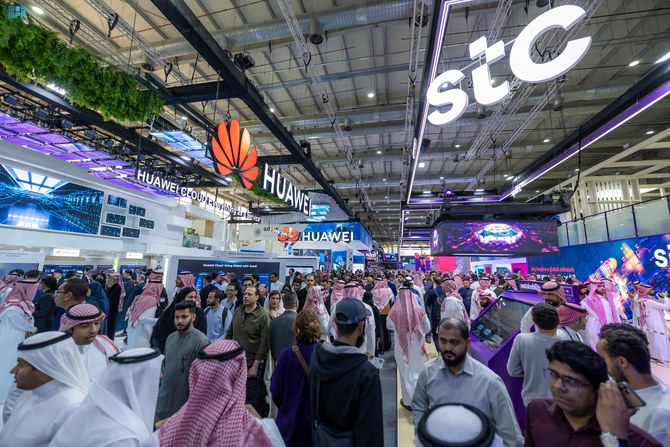

RIYADH: After three days of significant announcements, the LEAP conference saw major deals signed in artificial intelligence and innovation localization during its concluding sessions.
Inaugurating the final day of the event, Ahmed Al-Suwaiyan, governor of the Digital Government Authority, pointed out that the LEAP has surpassed its previous editions, with agreements worth more than $12 billion being inked.
Among them, the Saudi Data and Artificial Intelligence Authority, or SDAIA, signed three memorandums of understanding, including one with Samsung Electronics Co., focusing on the localization of digital technologies and innovations.
The collaboration will also potentially involve integrating Tawakkalna, the Saudi citizen’s digital companion system, into all Samsung devices in the Kingdom. Additionally, it encompasses providing training services and workshops on the latest technologies used in the field of mobile application development.
The authority also signed an agreement with PwC Middle East, with the aim of conducting pioneering research and experiments on the latest AI tools and large language models specifically designed for the Arabic language.
In an effort to establish an advanced virtual laboratory for AI and a center for Generative AI experiments, the agreement aims to leverage GenAi to enhance SDAIA’s operations and capabilities. This includes organizing ideation workshops and proposing use cases for adopting advanced GenAi tools.
In another boost to localization, the authority’s final agreement was with tech giant Intel. The partnership aims to build national capabilities in AI by providing programs to equip university students with knowledge and skills needed to utilize AI in various professional fields.
Demonstrating Saudi Arabia’s leadership in AI, and to address the worldwide shortage of semiconductors, King Abdulaziz City for Science and Technology, known as KACST, signed two strategic partnerships on the sidelines of the event.
The agreements seek to establish a center of excellence in AI technologies and develop the semiconductor industry in the Kingdom.
In the field of localization of emerging technologies, the body inked a deal with Sense Time Middle East and Africa to establish a joint center of excellence in both generative and general AI.
The center will implement research activities, develop generative and general AI projects and train human capabilities, as well as deploy market research and development products and design training programs.
Meanwhile, in order to serve the localization of the semiconductor industry – which has been gaining prominence with the launch of the Saudi Semiconductor Program – the body signed an agreement with CDT International.
This partnership seeks to establish a joint vision and action plan to support achieving the goals of the SSP, enhancing the Kingdom’s capabilities in the field of microchip manufacturing, and qualifying human cadres.
Also, following Saudi Arabia’s focus on localization, global telecommunications giant Huawei signed an MoU with King Khalid University to develop digital skills in the Kingdom.
The agreement, relying on the programs of the Huawei ICT Academy, aims to provide the university with the latest technologies to contribute to developing students and enhancing their abilities.
This comes as a testament to the important role that technical skills play in achieving digital transformation, which is one of the main components of Saudi’s Vision 2030.
Continuing the streak of major global players utilizing the LEAP platform, Hewlett Packard Enterprise also announced the introduction of HPE “Saudi-made” servers, following the opening of its new production facility in Riyadh.
HPE, in cooperation with Al Fanar, will produce thousands of servers annually from the HPE ProLiant computing portfolio, with the participation of the Ministry of Communications and Information Technology, the Ministry of Investment, and the Saudi Export Development Authority.
This comes as part the growing demand to produce technology that provides security and reliability.
On this occasion, Haytham Al-Ohali, the vice minister of communications and information technology, noted that this cooperative effort is an important step in highlighting the role of Saudi Arabia as a global leader in the field of technology manufacturing and a catalyst for the digital economy in the Kingdom.
Also on the sidelines of LEAP, TAWAL, one of Saudi Arabia’s leading providers of ICT infrastructure, signed an agreement to rent spaces in the holy sites for the construction and operation of telecommunications towers with Kidana Development Co.
The agreement includes renting 340 zones in the holy sites in order to provide advanced solutions to telecommunications service providers and enable them to accelerate the spread of technologies.
It takes into account aspects of visual identity, sustainability and raising digital performance.
This includes the enablement of future projects, such as the 5G network and the Internet of Things to further support the digital transformation program of the Kingdom’s Vision 2030.
In addition, it aims to enable communications service providers, government and private entities to develop communications networks, by providing a reliable, cost-effective digital infrastructure and operational efficiency.


