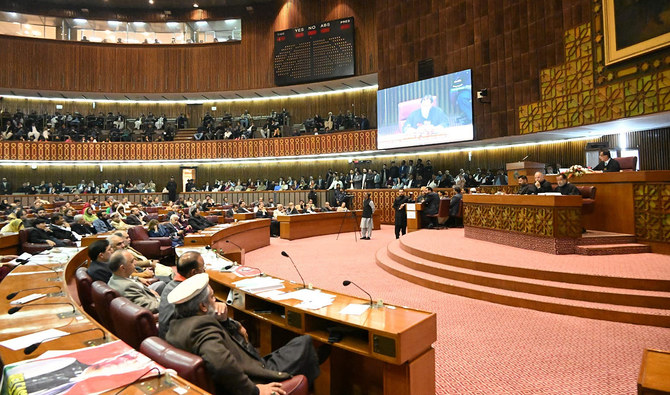
ISLAMABAD: A Pakistani court on Thursday extended the stay on the swearing-in of reserved seat members in parliament until March 13, as former prime minister Imran Khan’s Pakistan Tehreek-e-Insaf (PTI) party struggles to secure its share following last month’s general elections which the PTI candidates contested as independents.
The Election Commission of Pakistan (ECP) earlier this week rejected a petition to allocate the reserved seats for women and religious minorities to PTI lawmakers who joined a little-known party, the Sunni Ittehad Council (SIC), to organize themselves better in parliament. However, the election commission said the SIC had not submitted a list of candidates before the polls that it wanted to join the national legislature on these seats.
The PTI-SIC alliance challenged the matter in the Peshawar High Court that issued the stay order for a day on Wednesday after the ECP decided to distribute reserved seats among other parliamentary parties, including its rival factions of Pakistan Muslim League-Nawaz, Pakistan Peoples Party and Muttahida Qaumi Movement.
During a preliminary hearing on Wednesday, the court barred the reserved seat members from taking the oath for a day and referred the matter to the chief justice for a larger bench to adjudicate upon the intricate constitutional questions involved. A five-member larger bench led by Justice Ishtiaq Ibrahim took up the petition on Thursday and extended the stay order till March 13, as attorney general Mansoor Usman Awan failed to appear before the court due to his engagements in the Supreme Court.
“The presidential election is taking place and the party with 93 seats [in the National Assembly] has not been allotted the reserved seats,” PTI counsel Babar Awan argued, pointing out that one party that had won only a single general seat had been given two reserved seats.
The presidential election in Pakistan is scheduled to be held on March 9, with an incomplete electoral college as some reserved seat members have yet to take oath. The electoral college for the presidential election comprises members of the National Assembly, Senate and four provincial legislatures.
The counting of votes in the presidential election follows a unique formula, distinct from the general polls. While each citizen’s vote counts as one in general elections, the presidential election employs a weighted formula to ensure equal representation from all federal units.
Justice Ibrahim ordered the attorney general to appear before the court in the next hearing, extending the stay order till March 13.
Tahir Mehdi, an election expert, said the reserved seats, nominations of candidates and the party lists for women and non-Muslim lawmaker were introduced for the first time in 2002 under the former military ruler General (r) Pervez Musharraf when policymakers had not foreseen such challenges in the coming years.
“This is a matter of legal interpretation now as there are a lot of grey areas here which the high courts or the Supreme Court would ultimately decide on,” Mehdi told Arab News, adding the courts would ultimately see if submission of a prior list of candidates by a party before the elections was necessary in this case.
“The courts can decide either way … they may order to allocate the reserved seats to the PTI-SIC alliance or uphold the ECP’s decision,” he added.


![]()

Pakistani court extends stay on swearing-in of reserved seat members in national parliament
Short Url
https://arab.news/8dsy2
Pakistani court extends stay on swearing-in of reserved seat members in national parliament
- The court grants the stay until March 13 as ex-PM Khan’s party struggles to get its share of seats for women, minorities
- An election expert says the situation demands legal interpretation after a large number of independents won the polls
Latest updates




© 2026 SAUDI RESEARCH & PUBLISHING COMPANY, All Rights Reserved And subject to Terms of Use Agreement.