

US, China to resume military-to-military dialogue in ‘coming months’: Austin

1 / 2
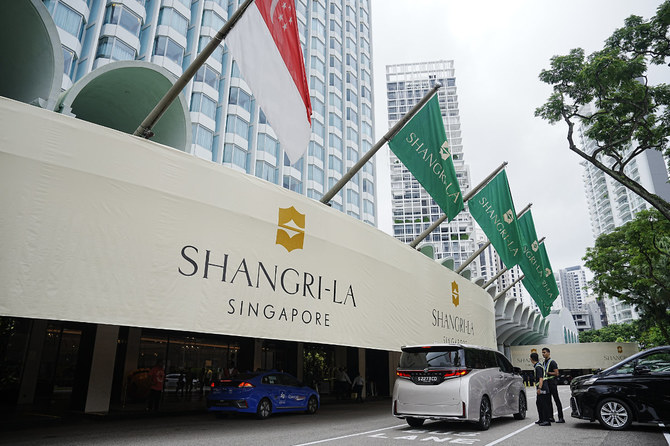
A front view of the Shangri-La Hotel, the venue for the 21th International Institute for Strategic Studies Shangri-La Dialogue, Asia's annual defense and security forum, in Singapore, on May 31, 2024. (AP)
2 / 2
Participants walk at the lobby of the Shangri-La Hotel, the venue for the 21th International Institute for Strategic Studies Shangri-La Dialogue, Asia's annual defense and security forum, in Singapore, on May 31, 2024. (AP)
Short Url
Updated 31 May 2024
Follow

US, China to resume military-to-military dialogue in ‘coming months’: Austin

  • China's growingly assertive actions in the South China Sea has led to an increasing number of direct conflicts with other countries in the region
  • This year’s conference comes just a week after China held massive military drills around Taiwan

SINGAPORE: The US and China will resume military-to-military communications “in the coming months,” US Defense Secretary Lloyd Austin said Friday, as Beijing hailed the “stabilizing” security relations between the countries.
Austin met with his Chinese counterpart Dong Jun on the sidelines of the Shangri-La Dialogue in Singapore in the first substantive face-to-face talks between the two defense chiefs in 18 months.
Dong and Austin met for over an hour at the luxury hotel hosting the security forum that is attended by defense officials from around the world and in recent years has become a barometer of US-China relations.
Austin said telephone conversations between US and Chinese military commanders would resume “in the coming months,” according to a readout released by the Pentagon.
He also welcomed plans for a “crisis-communications working group” with China by the end of the year, the statement said.
Describing the talks as “positive,” Chinese defense spokesman Wu Qian told reporters that military-to-military relations were “currently stopping their decline and stabilizing.”
But Wu cautioned that it was not possible for Beijing and Washington to solve all bilateral problems in one meeting, highlighting their thorniest dispute over Taiwan, which China considers part of its territory.
This year’s Shangri-La Dialogue comes a week after China held military drills around self-ruled Taiwan and warned of war over the US-backed island following the inauguration of President Lai Ching-te, who Beijing has described as a “dangerous separatist.”
“The Taiwan issue is purely China’s internal affairs, external forces have no right to interfere, and the United States’ actions seriously violate the one China principle,” Wu said, referring to Washington’s decision to congratulate Lai and send a delegation to the ceremony.
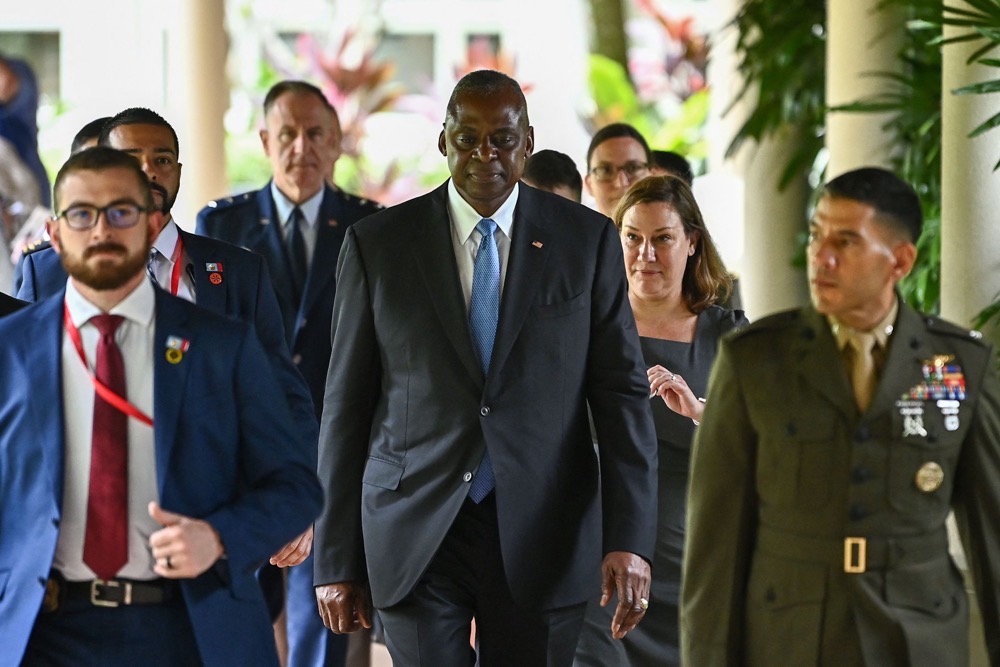


Austin and Dong will also give speeches in Singapore this weekend. (AFP)

Austin said China’s military exercises were “provocative” and insisted it should not use Taipei’s “political transition... as a pretext for coercive measures.”
US President Joe Biden’s administration and China have been stepping up communication to ease friction between the nuclear-armed rivals, with Secretary of State Antony Blinken visiting Beijing and Shanghai last month.
A key focus has been the resumption of military-to-military dialogue, which is seen as critical to preventing flashpoint disputes from spinning out of control.
China scrapped military communications with the United States in 2022 in response to then-US House Speaker Nancy Pelosi’s visit to Taiwan.
Tensions between Washington and Beijing were further stoked by issues including an alleged Chinese spy balloon that was shot down over US airspace, a meeting between Taiwan’s then-president Tsai Ing-wen and Pelosi’s successor Kevin McCarthy and American military aid for Taipei.
China is also furious over the US’ deepening defense ties in the Asia-Pacific, particularly with the Philippines, and its regular deployment of warships and fighter jets in the Taiwan Strait and South China Sea.
Beijing views this as part of a decades-long US effort to contain it.
The two sides agreed after a summit between Chinese leader Xi Jinping and Biden last November to restart high-level military talks, including over military operations near Taiwan, Japan and in the South China Sea.
Chinese and American forces have had a series of close encounters in the disputed waterway that China claims almost entirely.
While meeting Dong, Austin underscored the importance of “high seas freedom of navigation,” especially in the South China Sea, and insisted that the US would continue to “fly, sail and operate” wherever international law allowed, the Pentagon readout said.
Philippine President Ferdinand Marcos, who has sought to deepen defense cooperation with the US as he stands up to Chinese actions in waters off the Southeast Asia country, will deliver the Shangri-La Dialogue’s keynote speech on Friday.
Austin and Dong will also give speeches in Singapore this weekend in which they are expected to touch on a range of their nations’ pressure points.
Their meeting on Friday follows a phone call between them in April, and offers hope of further military talks to cool tensions.


Indian writer Arundhati Roy pulls out of Berlin Film Festival over Gaza row

Updated 4 sec ago
Follow

Indian writer Arundhati Roy pulls out of Berlin Film Festival over Gaza row

  • Writer pulls out after jury president Wim Wenders said cinema should 'stay out of politics' when asked about Gaza
  • Booker Prize winner describes Israel’s actions in Gaza as 'a genocide of the Palestinian people'
BERLIN: Award-winning Indian writer Arundhati Roy said Friday she was withdrawing from the Berlin Film Festival over jury president Wim Wenders’s comments that cinema should “stay out of politics” when he was asked about Gaza.
Roy said in a statement sent to AFP that she was “shocked and disgusted” by Wenders’s response to a question about the Palestinian territory at a press conference on Thursday.
Roy, whose novel “The God of Small Things” won the 1997 Booker Prize, had been announced as a festival guest to present a restored version of the 1989 film “In Which Annie Gives It Those Ones,” in which she starred and wrote the screenplay.
However, she said that the “unconscionable” statements by Wenders and other jury members had led her to reconsider, “with deep regret.”
When asked about Germany’s support for Israel at a press conference on Thursday, Wenders said: “We cannot really enter the field of politics,” describing filmmakers as “the counterweight to politics.”
Fellow jury member Ewa Puszczynska said it was a “little bit unfair” to expect the jury to take a direct stance on the issue.
Roy said in her statement that “to hear them say that art should not be political is jaw-dropping.”
She described Israel’s actions in Gaza as “a genocide of the Palestinian people by the State of Israel.”
“If the greatest film makers and artists of our time cannot stand up and say so, they should know that history will judge them,” she said.
Roy is one of India’s most famous living authors and is a trenchant critic of Prime Minister Narendra Modi’s government, as well as a firm supporter of the Palestinian cause.

Shying away from politics

The Berlinale traditionally has a reputation for topical, progressive programming, but so far this year’s edition has seen several stars shy away from taking a stance on the big political issues of the day.
US actor Neil Patrick Harris, who stars in the film “Sunny Dancer” being shown in the festival’s Generation section, was asked on Friday if he considered his art to be political and if it could help “fight the rise of fascism.”
He replied that he was “interested in doing things that are apolitical” and which could help people find connection in our “strangely algorithmic and divided world.”
This year’s Honorary Golden Bear recipient, Malaysian actor Michelle Yeoh, also demurred when asked to comment on US politics in a press conference on Friday, saying she “cannot presume to say I understand” the situation there.
This isn’t the first edition of the festival to run into controversy over the Gaza war.
In 2024 the festival’s documentary award went to “No Other Land,” a portrayal of the dispossession of Palestinian communities in the Israeli-occupied West Bank.
German government officials criticized “one-sided” remarks about Gaza by the directors of that film and others at that year’s awards ceremony.
The war in Gaza was sparked by Hamas’s October 7, 2023 attack on Israel, which resulted in the deaths of 1,221 people, according to an AFP tally based on official Israeli figures.
Israel’s retaliation has left at least 71,000 people dead in Gaza, according to the health ministry in the Hamas-run territory, whose figures the UN considers reliable.