

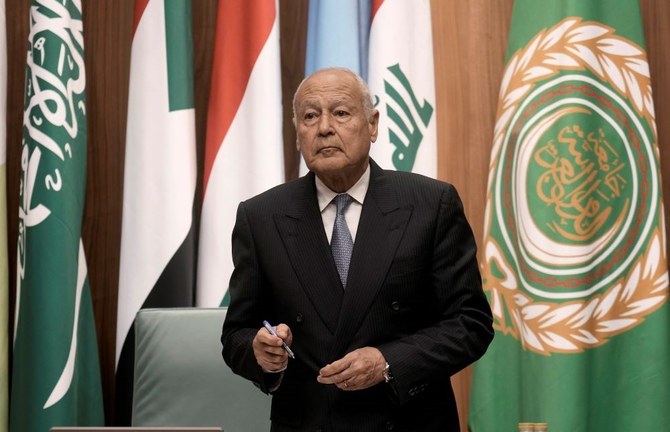
Arab League chief, Syrian foreign minister rue ‘double standards’ in dealing with Israel

Arab League Secretary-General Ahmed Aboul Gheit attends the regular session of the Council of the League of Arab States at the Arab League HQ in Cairo, Egypt, Wednesday, March 6, 2024. (AP Photo)
Short Url
Updated 06 March 2024
Follow

Arab League chief, Syrian foreign minister rue ‘double standards’ in dealing with Israel

  • Ahmed Aboul Gheit received Faisal Mekdad at the headquarters of the General Secretariat of the League of Arab States in Cairo
  • Arab League spokesman Jamal Rushdi: Meeting underscored ‘global inability to halt daily massacres in Gaza, revealing double standards in decision-making countries’

CAIRO: Arab League Secretary-General Ahmed Aboul Gheit’s talks with Syrian Foreign Minister Faisal Mekdad on Wednesday focused on Israeli aggression against civilians in the Gaza Strip.

Aboul Gheit received Mekdad at the headquarters of the General Secretariat of the League of Arab States.

The meeting underscored “the global inability to halt daily massacres in Gaza, revealing double standards in decision-making countries that continue to provide cover for Israel’s policies despite the exposed brutality and violation of fundamental standards of humanity and morality,” according to Jamal Rushdi, spokesman for the Arab League chief.

The Arab bloc’s chief emphasized the consensus among Arab countries on preserving Syria’s sovereignty, the integrity of its national territory, and the withdrawal of illegal foreign forces from its lands.

Meanwhile, Aboul Gheit received Mohamed Ali Omar, Somali acting foreign minister. Aboul Gheit affirmed the bloc’s supportive stance toward Somalia, Rushdi said.

“The League of Arab States stands in solidarity with Somalia in defending its sovereignty and territorial integrity, while rejecting the memorandum of understanding signed between Ethiopia and the ‘Somaliland’ region last January,” Aboul Gheit said.

The two parties discussed ways and procedures to implement League Council Resolution No. 8988, dated Jan. 17, regarding support for Somalia in confronting the attack on its sovereignty and territorial integrity.

Ethiopia signed an agreement last January granting it naval and commercial access to a port on Somaliland’s coast in exchange for recognition of the breakaway region’s independence.

Last January, during a meeting in Egypt with Somali President Hassan Sheikh Mohamud, Aboul Gheit described a memorandum of understanding signed between Ethiopia and the Somaliland region as null, void, and unacceptable.



Are water desalination plants the Gulf’s Achilles’ in the latest Middle East conflict?

Updated 5 sec ago
Follow

Are water desalination plants the Gulf’s Achilles’ in the latest Middle East conflict?

  • Iran strike on Bahrain desalination plant exposes how Gulf states depend on fragile coastal infrastructure for drinking water
  • Analysts warn attacks on water facilities risk catastrophic civilian disruption across Gulf economies and urban life

LONDON: Wars in the Middle East have long been measured in spikes to global oil prices, the sight of burning refineries, and missile trails crisscrossing over busy shipping lanes. Now, for the first time, it is also being measured at the tap.
Early on March 8, Bahrain’s Interior Ministry said an Iranian drone struck a desalination plant near Muharraq, causing material damage and injuring three people, labeling it an indiscriminate civilian attack.
It was the first time a Gulf government publicly acknowledged a strike on its drinking-water infrastructure — a red line analysts had long warned about.
Iran’s Foreign Minister Abbas Araghchi insisted Iran was only responding in kind, accusing the US of first hitting a plant on Qeshm Island and cutting off water to some 30 villages, although he did not provide evidence.
As both sides trade accusations, the Bahrain strike has turned a piece of civil engineering that few ever think about into an overt military target — with profound implications for a region that quite literally runs on seawater.
“It’s not about the damage to this one particular facility — it’s the precedent that this somehow (could) become normalized,” Michael Christopher Low, a history professor and director of the Middle East Center at the University of Utah, told Arab News.
“It’s very clear that attacking water infrastructures and water sources is an obvious human rights violation.”
The incident, he added, puts “a lot of strain on the region’s security that previously had been seemingly taboo.”
No place on Earth relies on desalination like the Gulf. Gulf Cooperation Council states operate more than 400 plants, accounting for 60 percent of global capacity and 40 percent of the world’s desalinated water.
In Kuwait it supplies 90 percent of drinking water, Oman 86 percent, Saudi Arabia 70 percent, and the UAE 42 percent.
This touches every sector, from households, agriculture and green spaces, to power plant cooling, data centers, and industrial hubs driving post-oil economies.
Around 100 million people across the wider Gulf depend on these facilities for most of their drinking water, a shift that began in the 1970s as oil wealth and the harsh climate outstripped meager aquifers.
In this sense, the Gulf states have become what Low dubbed “saltwater kingdoms” — global superpowers in the production of human-made freshwater drawn from the sea whose survival is tied less to rivers or rain than to the steady output of coastal mega-plants.
Eight of the world’s 10 largest desalination plants line the Arabian Peninsula (Israel’s Sorek plants take the other two spots). Without them, life as we know it in Kuwait, Qatar, the UAE, and much of Saudi Arabia would grind to a halt.
The Bahrain and the alleged Qeshm strikes “remind us of the fragility of desalination plants as a water supply infrastructure,” Kaven Madani, director of the UNU Institute for Water, Environment and Health, told Arab News.
Most plants share one vulnerability: geography. Clustered along the Gulf and Red Sea coasts near power stations and ports, they are easy to target with missiles or drones.
While coastal siting makes engineering sense — as intake pipes need sea access, and energy‑intensive operations require grid proximity — it leaves them exposed as the war blurs front lines and home fronts.
Analysts have long warned of this. In the Iran‑Iraq war of the 1980s, Baghdad eyed Gulf plants for sabotage. During the 1990 Kuwait invasion and 1991 Gulf War, Iraqi forces dumped millions of barrels of oil into the Gulf, threatening desalination intakes.
While Saudi Arabia managed to deploy protective booms around key facilities, including Riyadh’s main supplier, in Kuwait, Iraqi sabotage damaged or destroyed much of the country’s desalination capacity.
More recently, Houthi attacks targeted Saudi sites like Al‑Shuqaiq and Jizan, proving non‑state actors also see water as leverage.
The Bahrain strike confirmed that in a wider regional war, what once seemed a theoretical vulnerability can quickly become operational.
“A country like Saudi Arabia has a lot of backup capacity and ability to move reserves from one part of the country to the other,” said Low, who recently toured Shuaibah, one of the world’s largest integrated water‑power plants.
Smaller states like Bahrain and Qatar, he said, are more exposed, whereas larger states can lean on the “total system,” including underground reserves that can plug gaps in the short term.
Yet even the biggest Gulf states are not immune.
“I have a lot of confidence in the Gulf states to be able to keep up with population growth,” said Low. “But I don’t think there’s a way to get around dependency (on desalination plants). It’s a reality of 21st century life in the Arabian Peninsula.”
What happens if a major plant goes offline? Utilities can lean on storage tanks and network tweaks for the first 24 hours, blending in limited groundwater or imports where possible.
By 48-72 hours, however, prolonged outages trigger pressure drops, rationing or hospital prioritization over homes.
The pain would not be uniform. Cities like Dubai or Dammam — with multiple plants, ample storage and logistics — could absorb a single hit temporarily.
Smaller states like Bahrain, or more peripheral areas, would likely feel the pinch faster. Beyond household taps, outages could idle factories, crash data-center cooling and hobble power plants, many of which gulp desalinated water for their own operations.
Repairs are not quick either. Membranes, pumps, intakes and power links demand specialized parts and teams that can take days or weeks to be fixed in a conflict zone.
Climate stress adds another layer: the Gulf’s warming, saltier waters already push older plants to their limits, while shutdowns disrupt brine discharge and shorten lifespans.
“It all depends on the system and which part is impacted, whether it is an impact on a plant used for industrial or drinking purposes, which city or population group it is supplying water to, and then what else is available at their disposal,” said Madani.
“We don’t know how long the war (will last), and the level of damage we can expect. But what we know is that these systems are vulnerable to direct attacks.”
Pollutants — from oil spills to radioactive contamination — could compound the damage in the shared, semi-enclosed waters of the Persian Gulf, he added.
The Bahrain strike comes just weeks after a UN-backed report declared an era of “global water bankruptcy,” with Gulf countries viewed as textbook cases of living beyond their hydrological means.
Over-pumped fossil aquifers offer little buffer, with much of what is left being non-renewable or too saline for longer emergencies.
Gulf states are diversifying on paper: expanding wastewater reuse, cutting leaks, piloting solar-powered and inland modular plants, and linking grids for cross-city or border flows.
Yet interconnection risks spreading failures if multiple hubs fall, and no mix of groundwater, surface water or reuse can quickly replace big coastal output. In war, conservation — from slashing irrigation to prioritizing sectors — buys days, not solutions.
“Unfortunately, there are not many solutions to this,” said Madani. “Peace building and respecting the rules of the laws of war is the most effective solution in the short term.”
Over the longer term, he called for a serious reassessment of existing protection frameworks, “with rigorous evaluation of the risks that armed conflict and extreme events pose to water infrastructure.”
Many Gulf states had contingency plans, Madani noted, but “none were ready for this level of conflict.”
While the Bahrain and alleged Qeshm strikes mark desalination plants as new strategic targets alongside oil facilities and shipping lanes — with civilian fallout far beyond the battlefield — there is a striking irony.
Iran itself is grappling with water collapse. Depleting aquifers, the vanishing of Lake Urmia, and “day zero” scares in several cities have all been flagged in the UN’s water bankruptcy report.
Normalizing such attacks risks blowback on Tehran’s own fragile water infrastructures, hitting its civilians hardest.
“This is strategic self-harm,” said Low. “Attacking a desalination facility is, and should be, taboo. To me, it (is) analogous to using a nuclear weapon. These are things we shouldn’t be considering because they’re far too dangerous and disastrous.
“And so it sets a very dangerous precedent that this could be normalized,” he added, warning that this only hands states like Israel a pretext to target civilian infrastructure.
Indeed, Article 54 of Additional Protocol I to the Geneva Conventions prohibits attacks on civilian water facilities.
Whether Iran can wield water as leverage, in the same way it is exploiting the Strait of Hormuz and oil prices, remains an open question.
Desalination plants are dispersed, not a single chokepoint, and Gulf states are already hardening defenses with Western support.
Yet analysts warn that even a handful of successful strikes could escalate quickly, with effects that would reach homes, hospitals and workplaces almost immediately, complicating the rules of engagement and raising the cost of miscalculation.
For now, Gulf taps are still flowing. But the Bahrain strike offers a stark preview. In one of the world’s driest regions, the front line now runs through the very plants that make life possible.