- Pakistani feminist group advocates for rights of women, oppressed communities in the country
- Aurat March Islamabad organizers condemn West for supporting Israel during its war on Gaza
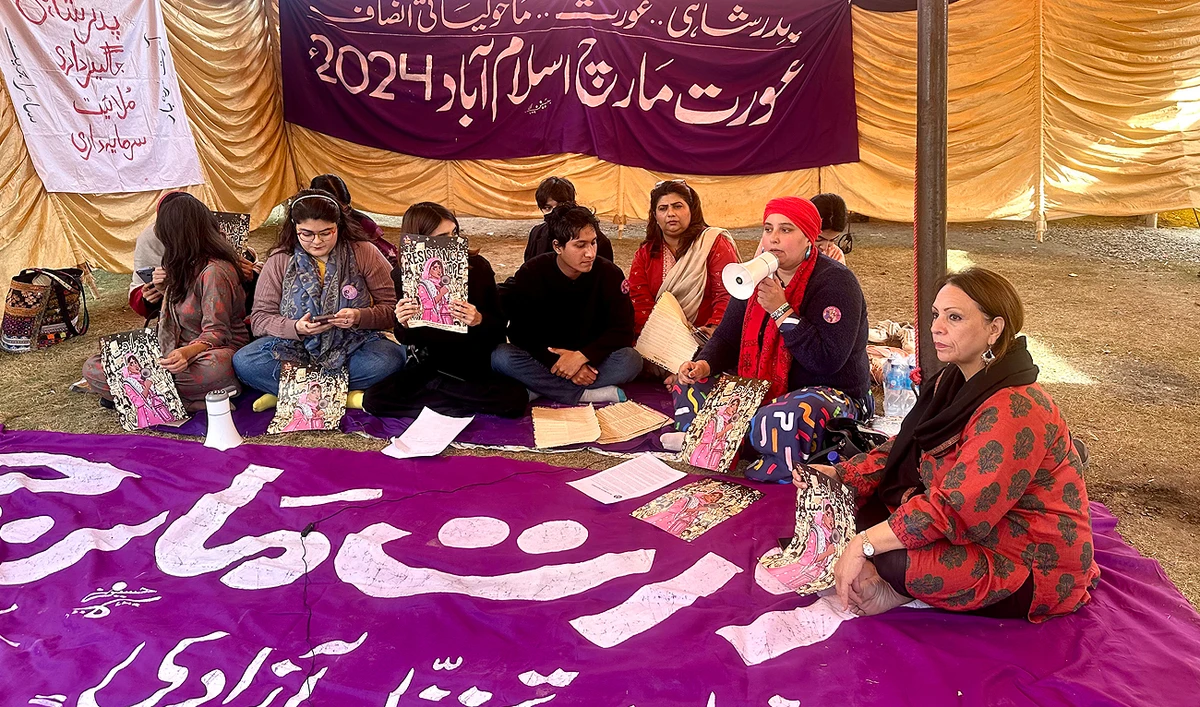
ISLAMABAD: Organizers of a leading women’s rights group in Pakistan on Wednesday demanded the Pakistani government play an “active role” in ending Israel’s war on Gaza, condemning the West for supporting the Jewish state as it continues its military offensives in Palestine.
Israel has killed over 30,000 Palestinian men, women, and children since October 2023, according to the Gaza Health Ministry. Over 72,100 Palestinians have been injured in the war, which Israel refuses to call off despite growing calls from Muslim states, the United Nations and global peace activists.
The Aurat March — Urdu for “women’s march” — began in 2018 as a single march for International Women’s Day held in Pakistan’s southern port city of Karachi. However, it has become an annual event held in multiple cities. The marches face opposition from religious conservatives who allege the group receives Western funding as part of a plot to promote obscenity in Pakistan. The organizers deny this, saying the marches are locally funded, with grassroots participation.
Organizers of the Islamabad chapter of the Aurat March held a press conference at the National Press Club in Islamabad on Wednesday, with less than two days to go before the world marks International Women’s Day.
“Given the ongoing humanitarian crisis in Palestine, we demand that the Pakistani government should play an active role in ending the genocidal war in Gaza and advocate for the liberation of Palestine,” Nishat Anjum, an organizer of the Aurat March Islamabad, told reporters.
Anjum said feminist politics was not limited to the rights of Pakistani women but that it transcended beyond borders. She denounced Washington and other Western countries for standing by Israel as it continues to bomb Palestine.
“We also condemn the support of the imperialist West to Israel’s war on innocent Palestinians and call for an end to wars, genocides, and crimes against humanity carried out for imperialist gains, which affect women, and children the most,” she added.
Organizers also presented their demands to the Pakistani government for local women, which covered a range of issues from human rights violations to economic justice, gender-based violence, political rights, and rights of religious minorities.
Syeda Bariya Shah, another march organizer, demanded the state declare gender-based violence a national emergency in Pakistan and take strategic measures to foster a zero-tolerance approach toward all forms of patriarchal violence.
“The march also calls for the end of underage marriages, rigorous enforcement of laws against gender-based violence, and the implementation of the Transgender Rights Protection Act,” Shah said.
Women in Pakistan are often deprived of their basic rights. According to the Human Rights Commission of Pakistan (HRCP), about 500 women are killed each year by their family members over accusations that their “honor” has been violated, which are often triggered when women marry by choice.
Punjrush, a women’s rights activist, said the state should recognize and incorporate the economic contribution of women’s reproductive and domestic labor into the country’s gross domestic product.
“Formalization of the informal sector, action against child labor, regularizing daily wage workers, and granting the right to unionize are among the economic justice demands,” she said.