Pakistan 2024 election fairness score plummets to lowest since 2013 – PILDAT

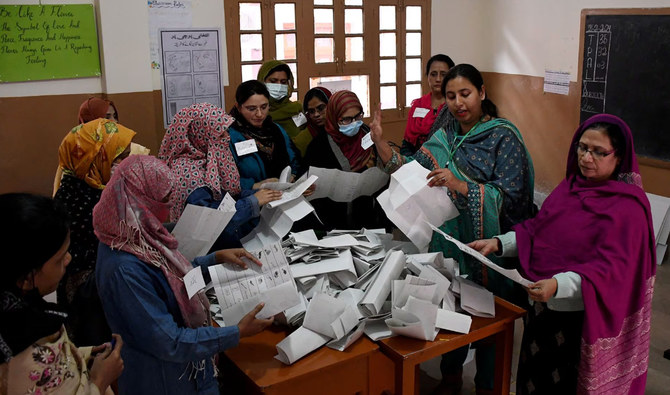
Polling staff count ballots after the end of the voting at a polling station during a general election, in Hyderabad, Pakistan, February 8. (REUTERS/File)
Short Url
Updated 06 March 2024
Follow

Pakistan 2024 election fairness score plummets to lowest since 2013 – PILDAT

  • The organization demands the election commission to investigate the deficiencies observed during the national polls
  • Political parties in Pakistan have resorted to street protests against election results, but the authorities deny vote fraud

ISLAMABAD: A Pakistani non-profit organization, which seeks to strengthen democratic governance by focusing on policy research and legislative development, said on Wednesday the recent elections received the lowest election fairness score in nearly a decade while asking the relevant authorities to investigate the deficiencies observed during the electoral contest.
The Pakistan Institute of Legislative Development and Transparency (PILDAT) has been publishing election assessments since 2002.
PILDAT’s recent report, released nearly a month after Pakistan’s general elections, which were marred by a countrywide cellphone service shutdown and delays in announcing election results, has created widespread suspicion of vote fraud, a claim denied by the country’s election authorities.
The organization’s assessment of the 2024 polls indicates a concerning decline in fairness scores compared to previous election cycles.
“Overall fairness of the 2024 General Election in Pakistan received a score of 49 percent which is three percentage points lower than the score received for the 2018 General Election,” PILDAT informed. “Fairness assessment scores for the 2013 and 2018 elections stood at 57 percent and 52 percent, respectively.” X
It observed there were considerable delays in the scheduling of the elections during the pre-poll phase, which also witnessed a lack of impartiality within the temporary caretaker setup.
Additionally, the suspension of cellphone and Internet services not only compromised the election management system but also hindered public participation on election day.
Following the completion of voting, the report further highlighted, the announcement of provisional results occurred beyond the deadline stipulated in Section 13(3) of the Elections Act, 2017, casting doubts on the credibility of the electoral process.
“PILDAT calls on the Election Commission of Pakistan (ECP) to conduct a thorough investigation into the delays and deficiencies observed during the 2024 General Election, particularly in result compilation, transmission and consolidation,” it added.
Political parties in Pakistan have raised objections to the election results and resorted to street protests.
The outcome of the polls has also prompted former prime minister Imran Khan’s party to question the legitimacy of the present National Assembly itself.


Pakistan blocks ‘thousands’ of passports in crackdown on overseas begging in Gulf countries

Updated 5 sec ago
Follow

Pakistan blocks ‘thousands’ of passports in crackdown on overseas begging in Gulf countries

  • Authorities impose five- to 10-year passport restrictions on deported offenders, report sharp decline in cases
  • Government links enforcement drive to broader push for skilled labor exports and record remittance inflows

ISLAMABAD: Pakistan has blocked “several thousand passports” and imposed long-term travel restrictions on citizens involved in begging abroad, the country’s overseas minister said on Wednesday, reporting a sharp decline in such cases following enforcement reforms.

Last August, the government announced a sweeping crackdown on what it described as a “beggar mafia” accused of exploiting visas to solicit money in Saudi Arabia and other Middle Eastern states. The practice had drawn complaints from Riyadh, prompting Islamabad to direct the Federal Investigation Agency (FIA) to curb the trend.

Federal Minister for Overseas Pakistanis Chaudhry Salik Hussain said authorities were targeting individuals who misuse Umrah and other visit visas to beg overseas, particularly in Gulf countries.

“We are not sending the beggars abroad,” he said at the Pakistan Governance Forum 2026 in the federal capital. “It is not written on the face of the beggar that he is a beggar. They go through the normal process of getting a visa for Umrah and then start this work on the side.”

Hussain said passports of deported individuals involved in begging or criminal activity were being blocked to prevent repeat travel.

“For that we can only do that if someone is involved in this work and he is caught and when he is deported, then at least we block his passport, which is happening,” he said. “Believe me, there has been a drastic drop in this.”

“There is no visa for begging. They go on a normal visa. Every document is 100 percent correct,” he added.

According to Hussain, the FIA is imposing passport restrictions of five to 10 years on offenders, preventing them from obtaining new travel documents.

He added that “several thousand passports” had so far been blocked.

Pakistan, which relies heavily on remittances from its overseas workforce, is also seeking to improve the quality of labor exports following meetings with labor ministers in Qatar, Bahrain, Saudi Arabia and the United Arab Emirates.

“We want our workforce to go there. The quantity is increasing but the quality element is very important,” he said, adding that the government plans to make soft skills training compulsory for Pakistanis going abroad “from the labor class to the undergraduates” so they better understand local norms and regulations.

The minister said exporting skilled labor helps ease unemployment pressures driven by Pakistan’s growing youth population while boosting remittances, which recently hit an all-time high.

“I think this is one of the reasons because our youth bulge is very high in Pakistan and local industries are not enough to cater to that. So we should at least find good jobs in foreign countries and send them there,” he said, adding that overseas workers “not only get employed but also send valuable remittances back home.”

Hussain said broader reforms were also under way to digitize overseas employment processes and reduce corruption.

“We are moving toward maximum digitization,” he said. “Problems and issues arise where humans interact with humans. We are moving toward digitization very quickly.”