

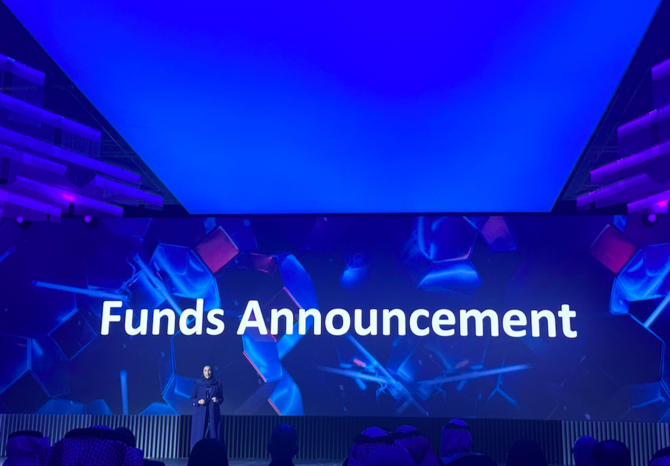

RIYADH: Saudi Arabia’s international technology conference, LEAP, sets the stage for a thriving startup and venture capital ecosystem in the region, announcing seven new funds worth $848 million.
Following in the footsteps of its previous years, the third edition of the event continues to witness several significant announcements that seek to transform the technology sector locally and globally.
Kicking off the day, InvestCorp announced the establishment of a $500 million fund in Saudi Arabia, which includes a $35 million investment from Saudi Venture Capital Co. The fund will focus on investing in Saudi companies in their growth stages.
In another boost to emerging companies, Saudi Arabia’s Takamol Holding announced its $53 million venture capital arm, Takamol Ventures.
The VC is established to support early-stage technology companies in the Middle East and African markets.
Similarly, Oasis Capital unveiled their “Oasis Fund II,” a $100 million venture dedicated to empowering international tech founders in their early stages.
Plug and Play, a major startup accelerator, announced a $50 million fund, making it its first in the region.
P&P intends to invest in Saudi, Middle Eastern, and North African startups with a focus on software and technology development.
X by Unifonic, a startup itself, also unveiled its new seed fund worth $15 million investment, focusing on software as a service and business-to-business ventures in the MENA region, Pakistan, and Turkiye.
During the forum, the National Development Fund, Social Development Bank, Ignite, and the Saudi E-Sports Federation partnered to announce an $80 million accelerator VC fund managed by Merck Capital and a $40 million VC investment fund managed by Impact46.
The funds will focus on accelerating the growth of the local gaming industry and attracting VC investment in the sector.
Taking to the main stage in Riyadh, the CEO of Saudi Arabia’s National Technology Development Program, Ibrahim Neyaz, announced the launch of five new products, marking another boost to the Kingdom’s technology, VC, and startup divisions.
Equipped with a $266 million budget, the entity’s first initiative, “Fuel,” seeks to support VC funds investing in deep tech and emerging tech from pre-seed to pre-initial public offering stages.
Its targeted technologies include generative AI, space tech, quantum computing, smart cities, and biotech.
Also, with a $266 million budget, NTDP’s second unveiled venture, “Artificial Intelligence Mission,” is a platform that provides access to research and development infrastructure, talent development, data, and venture building.
The CEO highlighted that the program’s intended outcomes over the next five years include 800 to 1,000 individuals trained in AI and machine learning, as well as 70-100 new AI-native ventures.
Neyaz outlined NTDP’s third announcement, Source Tech, a grant-based product designed to incentivize IT and outsourcing firms to establish and expand their services in the Kingdom. It will be equipped with a $15 million budget.
The initiative seeks to boost women’s participation in the information and communication technology sector, create upwards of 2,000 jobs, and provide grants up to SR5 million ($1.33 million) per company.
The body also announced another grant-based product, “Transform+,” which is designed to bridge the technology gap for startups and accelerate cloud adoption. It holds a $33 million budget.
Transform+ will mainly target startups as well as small and medium enterprises, with a grant possibility of up to SR 1 million per company and a target of over 1,000 tech companies adopting state-of-the-art cloud technology.
Marking its final announcement, the CEO unveiled a $26 million investment in “Fund Swift,” which aims to provide bridge financing for startups that close early-stage investments to be repaid after VC capital deployment.
The fund’s target beneficiaries are early-stage startups, which will be able to acquire financing amounting to 50 percent of VC’s commitment, up to SR5 million per startup.
Continuing the ongoing bid to “digitize” the Kingdom, Minister of Transport and Logistics Saleh Al-Jasser utilized the LEAP platform to announce two new initiatives to bring future technologies to the sector.
On the sidelines of the forum, the minister launched the new “Logistic 2” platform, which will replace multiple platforms with a unified window that includes more than 140 logistical services.
The initiative aims to unify the beneficiary experience, provide all logistical services through a smooth journey for beneficiaries, increase the quality and efficiency of logistical services, and improve operations.
This comes as part of the efforts to consolidate the Kingdom’s position as a global logistics center and enhance Saudi Arabia’s position in the Logistics Performance Index issued by the World Bank.
The minister also unveiled the new version of the Mawani community platform, which will automate all operational processes in the ports sector and connect all stakeholders from the government and private sectors on a unified platform, aiming to raise the ports’ competitiveness.
Mawani’s new framework seeks to facilitate the exchange of data between the government and private sectors via a secure interface, reduce the time spent on procedures by 50 percent, contribute to a 30 percent increase in port sector productivity, and lead to annual financial savings of SR10 million.
Continuing LEAP’s streak of significant investments in Saudi Arabia’s tech sector, global giant and leading provider of global hybrid cloud, AI, and consulting expertise, IBM, announced its plans to invest over $200 million in talent and infrastructure in a new IBM Software Lab in the Kingdom’s capital, Riyadh.
The lab will focus on accelerating digital innovation and product development, management, and design.
The IBM Software Lab’s goal will be to accelerate skills building and help create high-quality jobs for skilled young IT professionals in Saudi Arabia’s technology ecosystem, co-creating solutions to export globally.


