

Pakistani court issues notices to information ministry, telecom authority over X ban

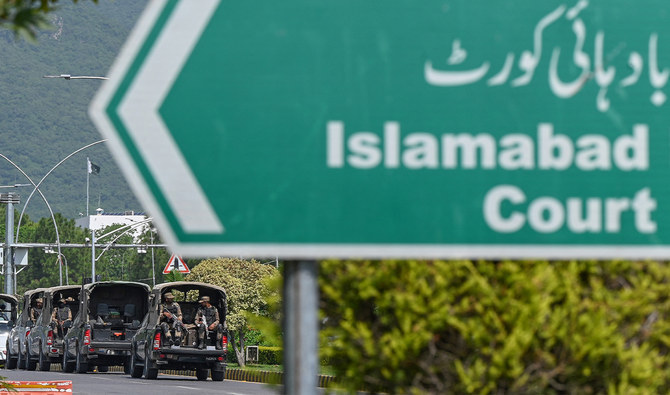
A convoy of Pakistani army passes the Islamabad High Court building in Islamabad on August 29, 2023. (AFP/File)
Short Url
Updated 05 March 2024
Follow

Pakistani court issues notices to information ministry, telecom authority over X ban

  • X first went down on Feb. 17 when a government official confessed to manipulating votes in last month’s election
  • The unannounced ban has raised widespread concerns about the state of democratic freedoms in the country

ISLAMABAD: A Pakistani high court on Tuesday issued notices to the country’s information ministry and its telecommunication authority on a plea challenging the ban on social media platform X, local media widely reported. 

X first went down on Feb. 17 when a government official confessed to manipulating votes in Pakistan’s Feb. 8 general election. The admission came as former prime minister Imran Khan’s Pakistan Tehreek-e-Insaf (PTI) and other political parties staged protests countrywide, alleging the Election Commission of Pakistan (ECP) had rigged elections, which it denies. 

Pakistani authorities remain tight-lipped about the ban, with Caretaker Information Minister Murtaza Solangi saying last week the government did not impose any ban on the platform. 

X’s disruption has raised widespread concerns about the state of democratic freedoms in the country, with the United States and several international organizations urging Pakistan to provide unhindered Internet access and leading digital rights activists calling the blockade a “blatant violation” of civil liberties. 

Islamabad High Court (IHC) Chief Justice Aamer Farooq took up a plea challenging X’s restriction, Pakistani English language newspaper Dawn reported. Lawyers Sardar Masroof and Amna Ali appeared before the court on behalf of the petitioner, an Islamabad resident named Ehtisham Abbasi. The judge asked if X was accessible for Pakistani users to which Masroof responded that it has been banned since Feb. 17. 

“Subsequently, the IHC issued notices to the respondents, including the information ministry and the Pakistan Telecommunication Authority (PTA), and adjourned the hearing till next week,” Dawn said. Other Pakistani media also widely reported on the development. 

The ban continues to remain in force despite a Sindh High Court (SHC) order on Feb. 21, in which the court ordered the PTA to restore X and other social media platforms in the country. The SHC is holding a contempt of court hearing against the PTA for allegedly violating the high court’s orders on restoring X. 

Before the latest blockade, Pakistan experienced multiple Internet disruptions in recent weeks that made social media platforms such as Facebook, YouTube, X and Instagram inaccessible. Recent occurrences were on Jan. 20, Jan. 7, and Dec. 17, when Khan’s PTI party was holding virtual events. The government had blamed those disruptions on “technical glitches.”

Such shutdowns have previously had a devastating impact on Pakistan’s economy. The day after Khan’s arrest in May last year, Reuters reported that point-of-sale transactions routed through Pakistan’s main digital payment systems fell by around 50 percent according to the region’s two largest payments system operators, 1LINK and Habib Bank Limited.

According to the Internet Society’s monitor Pulse, it is becoming an increasingly common tactic for governments to shut down the Internet on a national or sub-national level to either control civil unrest, stem the flow of misinformation, sway the results of general elections or to gain strategic advantages in territories with ongoing wars.


Pakistan defense minister discusses regional, global developments with counterparts in Munich

Updated 14 February 2026
Follow

Pakistan defense minister discusses regional, global developments with counterparts in Munich

  • The high-powered meeting of government leaders, diplomats comes shortly before Russia’s war on Ukraine enters its fifth gruelling year
  • Bruised by President Donald Trump’s comments, European leaders at summit have pledged to shoulder more of the burden of shared defenses

ISLAMABAD: Pakistan’s Defense Minister Khawaja Asif on Friday met his Italian and Albanian counterparts to discuss bilateral cooperation and regional and global developments on the sidelines of the Munich Security Conference, the Pakistani embassy in Germany said.

The high-powered Munich meeting of government leaders, diplomats, defense and intelligence chiefs comes shortly before Russia’s full-scale war on Ukraine is set to enter its fifth gruelling year.

Bruised by President Donald Trump’s designs on Greenland and his often hostile comments about America’s traditional bedrock allies, European leaders at the conference have pledged to shoulder more of the burden of shared defenses.

Asif met his Italian counterpart Guido Crosetto during the conference, running from Feb. 13 till Feb. 15, with both sides agreeing to enhance bilateral ties, according to the Pakistani embassy.

“Asif met the Defense Minister of Republic of Albania, Mr. Pirro Vengu, on the sidelines of the 62nd Munich Security Conference,” the Pakistani embassy said on X.

“Discussed matters related to enhancing bilateral cooperation in the wake of recent regional and international developments.”

The development came as US Secretary of State Marco Rubio was set to address European leaders on Saturday as they try to step up their autonomy in defense while salvaging transatlantic ties badly strained under President Trump.

German Chancellor Friedrich Merz acknowledged a “rift” had opened up between Europe and the United States, fueled by culture wars, but issued an appeal to Washington: “Let’s repair and revive transatlantic trust together.”

“In the era of great power rivalry, even the United States will not be powerful enough to go it alone,” said the conservative leader, who has ramped up defense spending in the top EU economy.

Macron said a new framework was needed to deal with “an aggressive Russia” once the fighting in Ukraine ends.

Ukrainian President Volodymyr Zelensky, who has been in Munich since Friday and meeting multiple allies, was expected to address the meeting on Saturday. No Russian officials have been invited.

Kremlin critic Mikhail Khodorkovsky said he feared “a new cold war” between Europe and Russia in the coming decade, making reopening dialogue with Moscow essential.

“If it makes sense to talk, we are willing to talk,” said Merz, but he also charged that “Russia is not yet willing to talk seriously.”