ISLAMABAD: Prime Minister Shehbaz Sharif has directed his team to prepare an action plan to revive Pakistan’s economy and proceed with talks on an Extended Fund Facility (EFF) with the International Monetary Fund (IMF), state-media reported on Tuesday, as the South Asian country scrambles to avoid a macroeconomic crisis by clinching a long-term bailout program with the international lender.
One of the foremost challenges facing Sharif and his government would be to negotiate a long-term bailout program with the IMF, as Pakistan’s short-term program expires this month. Pakistan’s fragile $350-billion economy is in desperate need of external financing to shore up its foreign exchange reserves and escape a looming macroeconomic crisis.
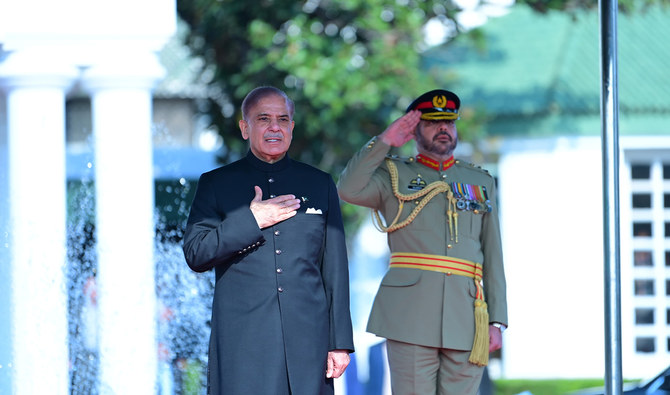
Hours after he was swearing-in ceremony, the Pakistani premier chaired an hours-long meeting in which he tasked authorities to devise an action plan to revive Pakistan’s economy, the Associated Press of Pakistan (APP) said in a report. The finance secretary provided a detailed briefing of the country’s economic situation in the meeting.
“We have got the mandate to improve the economy and this is the top priority of our government,” Sharif was quoted as saying by the Associated Press of Pakistan (APP) in a report. “PM Shehbaz directed for immediate initiation of talks with the International Monetary Fund (IMF) regarding its Extended Fund Facility,” the report said.
Sharif said Pakistan’s loss-making state-owned institutions would be privatized so that they do not become a “burden” on the economy.
“PM Shehbaz asked all the banks and financial institutions to prepare strategies for the promotion of small and medium businesses so that the youth could be helped stand on their own feet,” the report said. The prime minister also directed reducing the size of the government by merging or closing institutions that were “no longer needed.”
The prime minister described the Special Investment Facilitation Council (SIFC), a hybrid government body established to attract international investment in Pakistan’s key economic sectors, as a “very important step” in bringing about economic stability in the country. He said the SIFC would be further strengthened by his government.
For Pakistan, committing to a new IMF program, however, will mean committing to steps needed to stay on a narrow path to recovery. This would limit policy options to provide relief to a deeply frustrated population and cater to industries that are looking for government support to spur growth.
Inflation touched a high of 38 percent with record depreciation of the rupee currency under Sharif’s last government from April 2022 to August 2023, mainly due to structural reforms necessitated by the IMF program. Pakistan continues to be enmeshed in economic crisis with inflation remaining high, hovering around 30 percent, and economic growth slowing to around 2 percent.
PM Sharif will have to contend with Pakistan’s economic crisis at a time when the country is wracked with political instability. Pakistan’s controversial Feb. 8 national polls were marred by controversy and allegations of vote-rigging, denied by the country’s election regulator. Former prime minister Imran Khan’s Pakistan Tehreek-e-Insaf (PTI) party has led nationwide protests against the alleged rigging. The PTI has vowed to continue protests across the country until its mandate is not recognized.
Meanwhile, the South Asian country faces mounting attacks from militant outfits in the country, especially the Pakistani Taliban or the Tehreek-e-Taliban Pakistan (TTP). The TTP have increased attacks in Pakistan since a fragile truce between them and the state broke down in November 2022.