

Pakistan deputy PM to head to China on Monday for talks on trade, economic cooperation

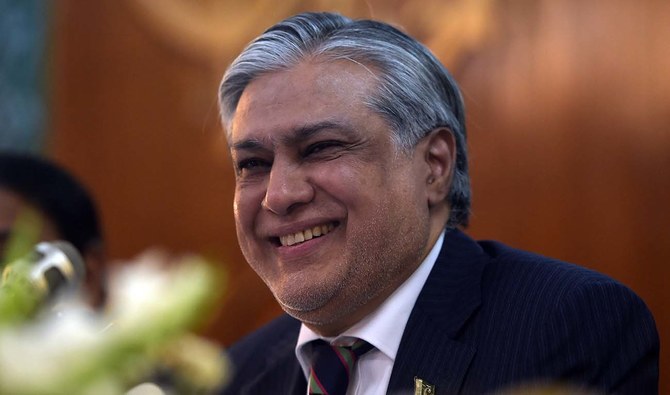
Pakistan’s Deputy Prime Minister and Foreign Minister Ishaq Dar smiles as he speaks after the launch of the "Pakistan Economic Survey 2015-16" report during a press conference in Islamabad on June 2, 2016. (AFP/File)
Short Url
Updated 12 May 2024
Follow

Pakistan deputy PM to head to China on Monday for talks on trade, economic cooperation

  • Deputy PM Ishaq Dar to co-chair strategic dialogue with Chinese Foreign Minister Wang Yi, says state media
  • Beijing has been one of Islamabad’s most reliable partners in recent years, providing financial aid to its fragile economy

ISLAMABAD: Pakistan’s Deputy Prime Minister and Foreign Minister Ishaq Dar will leave for China next week to hold important discussions on bilateral trade, cooperation and upgradation of multi-billion-dollar infrastructure corridor, state-run media reported on Sunday. 

Beijing has been one of Islamabad’s most reliable foreign partners in recent years, readily providing financial assistance to bail out its often-struggling neighbor. In July last year, China granted Pakistan a two-year rollover on a $2.4 billion loan, giving the debt-saddled nation much-needed breathing space as it tackled a balance-of-payments crisis.

Dar will leave for Beijing on Monday for a four-day official trip during which he would also co-chair the 5th Pakistan-China Foreign Ministers’ Strategic Dialogue with Chinese Foreign Minister Wang Yi.

“The two sides will comprehensively review Pakistan-China bilateral relations including economic and trade cooperation, high-level exchanges and visits; upgradation of China-Pakistan Economic Corridor and future connectivity initiatives,” the state-run Radio Pakistan said. 

China has invested over $65 billion in energy and infrastructure projects as part of the China-Pakistan Economic Corridor (CPEC). The project is part of President Xi Jinping’s ambitious Belt and Road Initiative. CPEC is designed to provide China with a shorter and safer trading route to the Middle East and beyond through Pakistan. 

Since its initiation in 2013, CPEC has seen tens of billions of dollars funneled into massive transport, energy and infrastructure projects. But the undertaking has also been hit by Pakistan struggling to keep up its financial obligations as well as attacks on Chinese targets by militants.

“They will also exchange views on the unfolding regional geopolitical landscape and bilateral cooperation at the multilateral fora,” the state-run media reported. 

Foreign Office Spokesperson Mumtaz Zahra Baloch said Dar’s visit to the country reflects the importance the two countries attach to deepening their “All-Weather Strategic Cooperative Partnership.”

Dar’s visit to China takes place in the backdrop of Pakistan’s moves to seek foreign investment from its allies as it tries to navigate an economic crisis that has seen its reserves dip to low levels and its currency weaken against the dollar. 

Islamabad has seen visits by diplomatic and business delegations from Saudi Arabia, Japan and Uzbekistan in recent weeks. Prime Minister Shehbaz Sharif has vowed to ensure an enabling business environment in Pakistan for foreign investors and traders. 


Pakistan to launch 5G pilot in some cities next week — IT minister

Updated 4 sec ago
Follow

Pakistan to launch 5G pilot in some cities next week — IT minister

  • Government says 5G services to reach provincial and federal capitals within six to eight months
  • Rollout follows $507 million spectrum auction aimed at expanding mobile broadband capacity

ISLAMABAD: Pakistan will begin pilot launches of fifth-generation (5G) mobile services in some cities next week, Information Technology Minister Shaza Fatima Khawaja said on Thursday, marking the country’s first concrete timeline for introducing the next generation of high-speed mobile Internet.

The announcement follows a spectrum auction earlier this week in which Pakistan sold 480 megahertz (MHz) of telecom frequencies for about $507 million, a key step toward deploying 5G networks in a country of more than 240 million people where most mobile infrastructure still runs on fourth-generation (4G) technology.

Pakistan has more than 190 million mobile phone users, making it one of the world’s largest telecom markets by population, but the rollout of 5G has been delayed for years by regulatory hurdles, economic constraints and spectrum-allocation issues.

“I was very happy to hear the day before yesterday that some of our operators are ready for 5G services,” Khawaja told a news conference with telecom operators in Islamabad.

“So, its pilot will start in some cities next week. And in the next six to eight months, in five of our capitals of all provinces and in the federal capital, 5G services will be available to all of you people.”

Khawaja described Internet connectivity as increasingly critical for economic activity, industry and national security, saying reliable and resilient digital infrastructure would play a central role in Pakistan’s future growth.

Officials have said the government is also encouraging wider adoption of 5G-compatible devices to support the transition to faster mobile networks, noting that a large share of phones used in Pakistan are locally manufactured while premium models are imported.