Pakistan deputy PM to head to China on Monday for talks on trade, economic cooperation

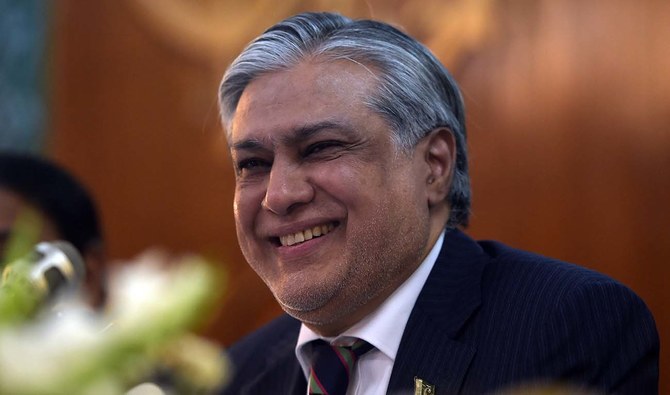
Pakistan’s Deputy Prime Minister and Foreign Minister Ishaq Dar smiles as he speaks after the launch of the "Pakistan Economic Survey 2015-16" report during a press conference in Islamabad on June 2, 2016. (AFP/File)
Short Url
Updated 12 May 2024
Follow

Pakistan deputy PM to head to China on Monday for talks on trade, economic cooperation

  • Deputy PM Ishaq Dar to co-chair strategic dialogue with Chinese Foreign Minister Wang Yi, says state media
  • Beijing has been one of Islamabad’s most reliable partners in recent years, providing financial aid to its fragile economy

ISLAMABAD: Pakistan’s Deputy Prime Minister and Foreign Minister Ishaq Dar will leave for China next week to hold important discussions on bilateral trade, cooperation and upgradation of multi-billion-dollar infrastructure corridor, state-run media reported on Sunday. 

Beijing has been one of Islamabad’s most reliable foreign partners in recent years, readily providing financial assistance to bail out its often-struggling neighbor. In July last year, China granted Pakistan a two-year rollover on a $2.4 billion loan, giving the debt-saddled nation much-needed breathing space as it tackled a balance-of-payments crisis.

Dar will leave for Beijing on Monday for a four-day official trip during which he would also co-chair the 5th Pakistan-China Foreign Ministers’ Strategic Dialogue with Chinese Foreign Minister Wang Yi.

“The two sides will comprehensively review Pakistan-China bilateral relations including economic and trade cooperation, high-level exchanges and visits; upgradation of China-Pakistan Economic Corridor and future connectivity initiatives,” the state-run Radio Pakistan said. 

China has invested over $65 billion in energy and infrastructure projects as part of the China-Pakistan Economic Corridor (CPEC). The project is part of President Xi Jinping’s ambitious Belt and Road Initiative. CPEC is designed to provide China with a shorter and safer trading route to the Middle East and beyond through Pakistan. 

Since its initiation in 2013, CPEC has seen tens of billions of dollars funneled into massive transport, energy and infrastructure projects. But the undertaking has also been hit by Pakistan struggling to keep up its financial obligations as well as attacks on Chinese targets by militants.

“They will also exchange views on the unfolding regional geopolitical landscape and bilateral cooperation at the multilateral fora,” the state-run media reported. 

Foreign Office Spokesperson Mumtaz Zahra Baloch said Dar’s visit to the country reflects the importance the two countries attach to deepening their “All-Weather Strategic Cooperative Partnership.”

Dar’s visit to China takes place in the backdrop of Pakistan’s moves to seek foreign investment from its allies as it tries to navigate an economic crisis that has seen its reserves dip to low levels and its currency weaken against the dollar. 

Islamabad has seen visits by diplomatic and business delegations from Saudi Arabia, Japan and Uzbekistan in recent weeks. Prime Minister Shehbaz Sharif has vowed to ensure an enabling business environment in Pakistan for foreign investors and traders. 


Pakistan condemns Sudan attack that killed Bangladeshi UN peacekeepers, calls it war crime

Updated 14 December 2025
Follow

Pakistan condemns Sudan attack that killed Bangladeshi UN peacekeepers, calls it war crime

  • Six peacekeepers were killed in a drone strike in Kadugli as fighting between Sudan’s army and the RSF grinds on
  • Pakistan, a major troop contributor to the UN, says perpetrators of the attack must be identified, brought to justice

ISLAMABAD: Pakistan on Sunday extended condolences to the government and people of Bangladesh after six United Nations peacekeepers from the country were killed in a drone strike in southern Sudan, condemning the attack and describing it as a war crime.

The attack took place amid a full-scale internal conflict that erupted in April 2023 between the Sudanese Armed Forces (SAF) and the Rapid Support Forces (RSF), a powerful paramilitary group, following a power struggle after the collapse of Sudan’s post-Bashir political transition.

Omar Al-Bashir, who ruled Sudan for nearly three decades, was ousted by the military in 2019 after months of mass protests, but efforts to transition to civilian rule later faltered, plunging the country back into violence that has since spread nationwide.

The drone strike hit a logistics base of the United Nations Interim Security Force for Abyei (UNISFA) in Kadugli, the capital of South Kordofan state, on Saturday, killing the Bangladeshi peacekeepers. Sudan’s army blamed the RSF for the attack, though there was no immediate public claim of responsibility.

“Pakistan strongly condemns the attack on @UNISFA in Kadugli, resulting in the tragic loss of 6 Bangladeshi peacekeepers & injuries to several others,” the country’s permanent mission to the UN said in a social media message. “We honor their supreme sacrifice in the service of peace, and express our deepest condolences to the government and people of #Bangladesh.”

“Such heinous attacks on UN peacekeepers amount to war crimes,” it added. “Perpetrators of this horrific attack must be identified and brought to justice. As a major troop-contributing country, we stand in complete solidarity with all Blue Helmets serving the cause of peace in the perilous conditions worldwide.”

According to Pakistan’s UN mission in July, the country has deployed more than 235,000 peacekeepers to 48 UN missions across four continents over the past eight decades.

Pakistan also hosts one of the UN’s oldest peacekeeping operations, the United Nations Military Observer Group in India and Pakistan (UNMOGIP), and is a founding member of the UN Peacebuilding Commission.

More than 180 Pakistani peacekeepers have lost their lives while serving under the UN flag.

Pakistan and Bangladesh have also been working in recent months to ease decades of strained ties rooted in the events of 1971, when Bangladesh — formerly part of Pakistan — became independent following a bloody war.

Relations have begun to shift following the ouster of former Bangladeshi prime minister Sheikh Hasina last year amid mass protests.

Hasina later fled to India, Pakistan’s neighbor and arch-rival, creating space for Islamabad and Dhaka to rebuild their relationship.