RIYADH: Saudi Arabia’s international technology conference LEAP is set to witness $11.9 billion of investment deals over its three-day duration — eclipsing last year’s figure of $9 billion, according to a senior minister.
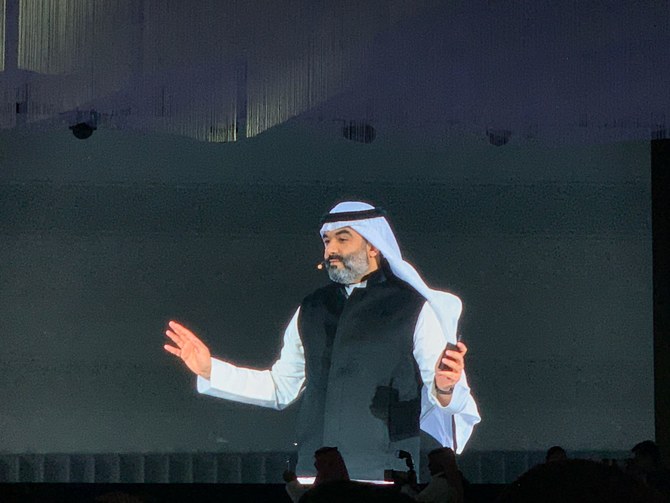
During the opening remarks at the event, Minister of Communications and Information Technology Abdulla Al-Swaha highlighted that investments in generative artificial intelligence acceleration and cloud infrastructure sectors are set to be key benefactors from the funding blitz.
The minister told those at the Riyadh-based gathering, which runs from March 4 to 7 and is the third edition of the event, that the Kingdom’s digital economy is “the most bold and audacious success story of the 21st century.”
He added: “When it comes to resilience, while the whole world was facing headwinds when it comes to VC (venture capital) funding with negative 30 to 40 percent, the Kingdom, under His Royal Highness’s leadership, we adjusted the sail and changed the headwinds into tailwinds and we grew by 33 percent.”
Al-Swaha highlighted a significant investment in regional cloud infrastructure in the preceding year, marking it as one of the sector’s most substantial and notable investments.
Alongside this, he announced the introduction of Amazon Web Services in Saudi Arabia, establishing the Kingdom as the sole nation in the region hosting all key hyperscalers.
Furthermore, AWS plans to establish an infrastructure region within the Kingdom by 2026, with the objective of providing support to developers, startups, entrepreneurs, and enterprises, as well as entities in healthcare, education, gaming, and nonprofit sectors.
The minister also underlined the ongoing efforts, led by Crown Prince Mohammed bin Salman, and in collaboration with Saudi Aramco, to advance the diffusion of technologies and industries in the Kingdom.
He announced Aramco’s largest industrial laboratory guidance model, METABRAIN, which aims to provide guidance and support to all industries in the Kingdom.
“This LLM is powered by more than data — data for more than 90 years, with seven tokens of public and proprietary data. We aim to reach 1 trillion parameters by the end of today, starting with 250 parameters,” Al-Swaha stated.
He continued: “Aramco is joining hands with one of the revolutionary technologies. I think it’s best to hear from the founders in this specific interview about how they’re doing that, aiming to build one of the largest AI inference capabilities for the industrial age.”
In his keynote address, Aramco’s President and CEO Amin Nasser stressed his belief that METABRAIN will serve to increase productivity and growth as well as transform “the way we work.”
Equipped with 90 years of exclusive data, the large language model is helping to analyze plans, get data as well as “historically drilling down cost and recommending options for downstream.”
Last week, the energy giant announced a significant upward revision in the estimated reserves of gas and condensate in its Jafurah reserves. The CEO underscored that “this was made possible by combining advanced machine learning system together with the data gathered by our in-house experts.”
During the event, Aramco also announced the establishment of the Saudi Accelerated Innovations Lab, or SAIL, a market-driven digital innovation engine with the first hub in Saudi Aramco and plans for national and global expansions.
Commenting on this announcement, the CEO said: “Our goal is to create new digital products and digital ventures. An example is the Aramco IBM innovation strategic partnership, which through SAIL, is expected to be operational in early 2026.”
According to the executive, Aramco and IBM will collaborate in areas such as cybersecurity, sustainability, circular economy, and material science.
The global tech leader also unveiled plans for a software development lab to operate in Saudi Arabia.
Arvind Krishna, chairman and CEO of IBM, said: “We have decided to open a software development lab where we are going to be harnessing the talent of the local population. We are going to build AI-based technologies here that we are then going to take into our global market. I think that is incredibly exciting.”
As part of a series of announcements, Dell Technologies revealed plans to open a new merge and logistics fulfillment center, incorporating a second touch manufacturing facility in the Kingdom.
The new center, based out of Riyadh, will handle all Dell product lines in Saudi Arabia, including notebooks, desktops, and servers, as well as, storage, and networking.
Dell is also relocating its Flat Panel Monitor Hub to Riyadh, ensuring stocked inventory is delivered directly to customers with same-day or next-day shipments.
The event also saw several announcements from international companies in the field of up-skilling, education, and training.
Among them, UiPath, a global software company, announced the establishment of the “Saudi School of Automation,” the first in the region, aimed at training skills and nurturing Saudi talents.
UiPath will cover automation fundamentals through advanced developments, culminating in a professional certificate.
Similarly, an American cloud-scale company unveiled a partnership with the Saudi Digital Academy to establish a new academy in the Kingdom.
Datadog’s Academy focuses on the latest trends and regional priorities, offering a range of programs, including certifications, in-person workshops, and online training, as highlighted by Alexis Le Quoc, the company’s CEO during the forum.
Marking the third announcement of a new academy in the nation, ServiceNow’s CEO Bill McDermott revealed that the company will be opening a ‘ServiceNow Academy’ in the Kingdom.
The institute aims to train thousands of Saudis in “digital skills related to this new generation platform,” he said.
The company also emphasized that it will be launching its ServiceNow platform in Arabic later this month, featuring domain-specific LLMs capable of operating in the Arabic language.


![]()

LEAP24 to witness $11.9bn tech investment deals, says minister
Short Url
https://arab.news/wyskc
LEAP24 to witness $11.9bn tech investment deals, says minister

Latest updates


Recommended


© 2026 SAUDI RESEARCH & PUBLISHING COMPANY, All Rights Reserved And subject to Terms of Use Agreement.