


London: A reappraisal of an ancient astronomical device in Italy has sparked new interest in the medieval interaction between Muslim and Jewish scientists, The Times reported on Monday.
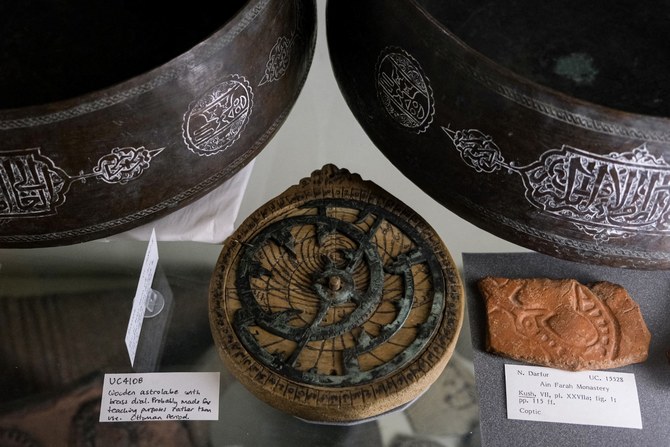
The astrolabe, an instrument once used by astronomers to measure time and distance based on the position of stars, has been on display at a museum in Verona for decades.
But a historian’s chance online encounter with the device, long thought to be a fake, has opened new theories about social and scientific interactions between the Islamic and Jewish faiths in medieval Europe.
Federica Gigante from Cambridge University came across an image of the astrolabe in an online post, and traveled to the museum to investigate the object.
The device is believed to have been produced in Al-Andalus, the Muslim-ruled kingdom of the Iberian Peninsula that encompassed much of modern-day Spain and Portugal.
At the museum, Gigante held the astrolabe in the sunlight and discovered a series of hidden Arabic, Hebrew and modern Western etchings.
She said: “The museum didn’t know what it was and thought it might be fake. It’s now the single most important object in their collection.”
The device is said to be from 11th-century Toledo, during a period known as the Convivencia, or Coexistence, when members of all three Abrahamic faiths lived in relative harmony.
The first markings on the astrolabe are in Arabic and denote the times of Muslim prayers in Toledo and Cordoba.
A brass plate later added to the device allowed the user of the astrolabe to determine prayer times in North Africa.
Further Arabic etchings contain two Jewish names, suggesting that the device was later used by Sephardic Arabic-speaking communities in Al-Andalus.
Hebrew text is also inscribed on the astrolabe, implying that “at a certain point the object left Spain or North Africa and circulated among the Jewish diaspora in Italy,” Gigante said.
Further Hebrew etchings translate the Arabic terms for the astrological signs Scorpio, Sagittarius, Capricorn, Aquarius, Pisces and Aries.
Gigante believes that the astrolabe may have reached Italy in the 12th century. Once in medieval Verona, Western numerals are believed to have been added to the device by a Latin or Italian speaker.
A 17th-century Veronese nobleman, Ludovico Moscardo, is thought to have obtained the astrolabe, before it was passed to the prominent aristocratic Miniscalschi family which, in 1990, founded the museum where the device remains today.
Gigante said: “The Verona astrolabe stands out, attesting to the contacts and exchanges between Arabs, Jews and Europeans in the medieval and early modern periods.”


