

Over 50% Pakistanis currently overweight, report says on World Obesity Day

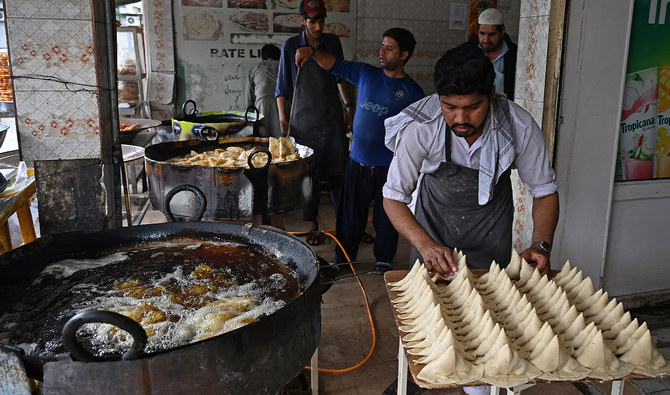
Bakers fry Iftar food for Muslim devotees to break their fast on the first day of the Islamic holy month of Ramadan, at a shop in Islamabad on March 23, 2023. (AFP/File)
Short Url
Updated 04 March 2024
Follow

Over 50% Pakistanis currently overweight, report says on World Obesity Day

  • 58.1% Pakistanis classified as overweight and 43.9% fall into category of obesity, Transform Pakistan says 
  • World Obesity Day marked each year on March 4 to raise awareness, advocate solutions for global obesity crisis

ISLAMABAD: Over 50% of Pakistan’s population is overweight, the national Transform Pakistan campaign said in a press release on World Obesity Day being observed internationally on Monday.

World Obesity Day is marked internationally each year on Mar. 4 to raise awareness and advocate for practical solutions in addressing the global obesity crisis. It is organized by the non-profit World Obesity Federation, affiliated with the World Health Organization, and a collaborating body on the Lancet Commission on Obesity. The Federation says it aims to “lead and drive global efforts to reduce, prevent and treat obesity.”

The Transform Pakistan campaign includes the Ministry of National Health Services Regulations and Coordination, Pakistan Youth Change Advocates (PYCA), Center for Peace and Development Initiative (CPDI), and Global Health Advocacy Incubator (GHAI), among others. 

Since last year, the Transform campaign has been advocating for the regulation of industrial trans fats (iTFA) in Pakistan, which are created by adding hydrogen to oil. They have no known health benefits and are a major contributor to cardiovascular disease and stroke worldwide, estimated to cause around 540,000 deaths every year.

“58.1% of Pakistanis are classified as overweight, and 43.9% fall into the category of obesity,” Afshar Iqbal, Director of Communications and Advocacy at PYCA, was quoted as saying by the state-run APP news agency. “The estimated annual cost of managing obesity in Pakistan was a staggering Rs428 billion in 2015.”

“There is a strong connection between rising obesity rates and the prevalence of industrially produced Trans-Fatty Acids (iTFAs) in Pakistani dietary sources,” said Dr. Saba Amjad, the CEO of Heartfile, a health focused non-profit. 

Munawar Hussain, the in-country coordinator of the Global Health Advocacy Incubator, said industrial trans fats were linked to a range of health issues, including obesity, cardiovascular diseases, and other metabolic disorders.

Experts have called for a “government-mandated regulatory framework” among important steps to reduce the rising tide of obesity and related diseases in Pakistan.

“Such a framework should ensure that the prevalence of iTFAs in all food items is limited to two percent or less of their total fat content,” said Mukhtar Ahmed, the Executive Director of the Center for Peace and Development Initiative (CPDI).

Pakistan’s ministry of health, a patron of the Transform Pakistan campaign, said it was actively engaged with various stakeholders, including the Pakistan Standards and Quality Control Authority (PSQCA), to ensure that a government-led mandatory standard was “soon put into place.”

 “In 2023, Pakistan was successfully able to regulate iTFA content in several dietary sources including cooking oils, Vanaspati ghee, bakery shortenings and bakery wares,” Dr. Khawaja Masuood Ahmed, the ministry of health’s national coordinator for nutrition, said. 

“We are, however, aware that many notable food items such as ultra-processed items, dairy products such as chocolates and ice-creams and street food still remain outside the ambit of this regulation. The ministry of health is committed to ensuring that all food items across Pakistan soon come under one unified regulation to limit the prevalence of iTFAs in our dietary sources.”


Pakistan, UK launch £10 million higher education partnership

Updated 5 sec ago
Follow

Pakistan, UK launch £10 million higher education partnership

  • Pak-UK Education Gateway second phase expands climate research, scholarships, university exchanges
  • First phase was launched in 2018 and delivered 165 partnerships, 2,000 joint studies and £5 million in grants

ISLAMABAD: Pakistan’s Higher Education Commission (HEC) and the British Council have launched the £10 million second phase of the Pak-UK Education Gateway, the HEC said on Monday, a joint initiative aimed at deepening collaboration between universities in both countries on research, mobility and higher-education reform.

The program, funded equally by the HEC and the British Council, builds on a partnership launched in 2018 and seeks to strengthen institutional ties between Pakistani and British universities, focusing on shared challenges including climate change, skills development and economic growth.

Education cooperation has become an increasingly important pillar of broader Pakistan-UK relations, as both countries look to expand academic mobility, research collaboration and international recognition of qualifications at a time when higher-education systems face pressure to respond to climate risks, labor-market shifts and funding constraints.

“This £10 million partnership is set to deepen collaboration between UK and Pakistani universities on critical issues like Climate Change and Mobility. A true system-to-system commitment,” the HEC said in an X post. 

According to the British Council and HEC, the first phase of the Pak-UK Education Gateway supported 165 institutional partnerships, generated around 2,000 joint research papers and awarded £5 million in research grants. Officials say the second phase aims to build on that foundation as part of a longer-term effort to internationalize Pakistan’s higher-education sector.

“Education is the building block of growth and prosperity. Our work on education in Pakistan supports people throughout their lives: from helping reform education policy at the school level, to our strong partnership in higher education,” British High Commissioner Jane Marriott said in a statement.

“This next phase builds on our already strong relationship, and will unlock opportunities to help both our higher education sectors thrive.”

Opportunities under the second phase include increased funding for scholarships, joint research grants and faculty exchanges, alongside a Start-Up Challenge Fund to support Pakistan-UK university collaborations pursuing commercial opportunities and access to new markets.

The program will also focus on leadership and governance reforms within Pakistan’s higher-education system, including quality assurance, improved campus accessibility for people with disabilities, and greater participation of women in senior leadership roles. It further aims to expand opportunities for Pakistani students to study UK-accredited courses without leaving their home cities, alongside a commitment to mutual recognition of qualifications.

Pakistan’s Minister for Federal Education and Professional Training Khalid Maqbool Siddiqui said the initiative had already delivered concrete results since its launch in 2018, calling education “the bridge that connects people, cultures, and futures.”

Acting HEC Chairperson Nadeem Mahbub described the Gateway as a system-to-system partnership rather than a stand-alone program, noting that it had benefited institutions and students in both countries.