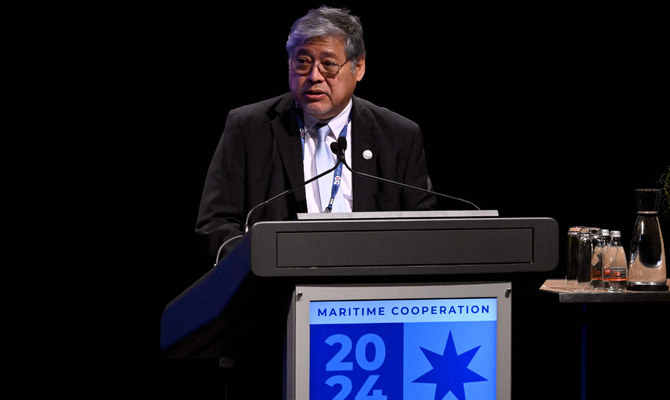
Philippines foreign minister urges China: ‘stop harassing us’

Philippines’ Foreign Secretary Enrique Manalo speaks during the opening of the Australia-ASEAN (Association of Southeast Asian Nations) summit in Melbourne on March 4, 2024. (AFP)
Short Url
Updated 04 March 2024
Follow

Philippines foreign minister urges China: ‘stop harassing us’

  • China claims almost the entire South China Sea as its territory, brushing aside claims from a host of Southeast Asian nations

MELBOURNE: Philippine foreign minister Enrique Manalo told AFP on Monday that his country wants to solve maritime disputes with China peacefully — but delivered a simple message to Beijing: “stop harassing us.”
Speaking on the sidelines of an ASEAN-Australia summit in Melbourne, Manalo defended his government’s policy of publicizing Chinese maneuvers in contested maritime territory — including the recent passage of warships near Scarborough Shoal.
“It’s merely trying to inform the people of what’s going on,” Manalo said. “And some countries or one country at least has some difficulty with that.”
“But our simple explanation is if you would stop harassing us and, and perhaps performing other actions, there wouldn’t be any news to report.”
China claims almost the entire South China Sea as its territory, brushing aside claims from a host of Southeast Asian nations.
Scarborough Shoal — a triangular chain of reefs and rocks in the disputed South China Sea — has been a flashpoint between the countries since China seized it from the Philippines in 2012.
Philippine governments have tried to rally international and regional support to their cause — with mixed results.
“The Philippines is committed to a peaceful resolution of disputes through diplomatic means, or peaceful means,” Manalo said, while insisting “this will not be done at the expense of our national interest.”
“We are reaching out to partners in like-minded countries with similar issues and similar concerns.”
But Manalo acknowledged there were was at least a small question mark over support from the Philippines’ most important security partner — the United States.
The two countries are treaty allies, meaning Washington has formally pledged to come to Manila’s defense in the event of a military conflict.
Ask about the November election — which will pit incumbent Joe Biden against Republican firebrand Donal Trump, he said it was a topic of frequent debate behind closed doors.
“Every country in the world is probably thinking of that, of course. The United States is a major, it’s a treaty ally of the Philippines. So obviously, any differences or changes in US policy from existing policies would most likely have some kind of effect.”
“At this stage it’s fairly difficult to assess how it would happen, or what would happen,” he said.
“But all I can say is we are, of course, carefully monitoring the election season in the United States, but I’ve had talks with many of my other colleagues from other countries, and I think everybody is doing the same.”
“So certainly all eyes will be riveted on that election this year.”


Only 4% women on ballot as Bangladesh prepares for post-Hasina vote

Updated 5 sec ago
Follow

Only 4% women on ballot as Bangladesh prepares for post-Hasina vote

  • Women PMs have ruled Bangladesh for over half of its independent history
  • For 2026 vote, only 20 out of 51 political parties nominated female candidates

DHAKA: As Bangladesh prepares for the first election since the ouster of its long-serving ex-prime minister Sheikh Hasina, only 4 percent of the registered candidates are women, as more than half of the political parties did not field female candidates.

The vote on Feb. 12 will bring in new leadership after an 18-month rule of the caretaker administration that took control following the student-led uprising that ended 15 years in power of Hasina’s Awami League party.

Nearly 128 million Bangladeshis will head to the polls, but while more than 62 million of them are women, the percentage of female candidates in the race is incomparably lower, despite last year’s consensus reached by political parties to have at least 5 percent women on their lists.

According to the Election Commission, among 1,981 candidates only 81 are women, in a country that in its 54 years of independence had for 32 years been led by women prime ministers — Hasina and her late rival Khaleda Zia.

According to Dr. Rasheda Rawnak Khan from the Department of Anthropology at Dhaka University, women’s political participation was neither reflected by the rule of Hasina nor Zia.

“Bangladesh has had women rulers, not women’s rule,” Khan told Arab News. “The structure of party politics in Bangladesh is deeply patriarchal.”

Only 20 out of 51 political parties nominated female candidates for the 2026 vote. Percentage-wise, the Bangladesh Socialist Party was leading with nine women, or 34 percent of its candidates.

The election’s main contender, the Bangladesh Nationalist Party, whose former leader Zia in 1991 became the second woman prime minister of a predominantly Muslim nation — after Pakistan’s Benazir Bhutto — was the party that last year put forward the 5 percent quota for women.

For the upcoming vote, however, it ended up nominating only 10 women, or 3.5 percent of its 288 candidates.

The second-largest party, Jamaat-e-Islami, has not nominated a single woman.

The 4 percent participation is lower than in the previous election in 2024, when it was slightly above 5 percent, but there was no decreasing trend. In 2019, the rate was 5.9 percent, and 4 percent in 2014.

“We have not seen any independent women’s political movement or institutional activities earlier, from where women could now participate in the election independently,” Khan said.

“Real political participation is different and difficult as well in this patriarchal society, where we need to establish internal party democracy, protection from political violence, ensure direct election, and cultural shifts around female leadership.”

While the 2024 student-led uprising featured a prominent presence of women activists, Election Commission data shows that this has not translated into their political participation, with very few women contesting the upcoming polls.

“In the student movement, women were recruited because they were useful, presentable for rallies and protests both on campus and in the field of political legitimacy. Women were kept at the forefront for exhibiting some sort of ‘inclusive’ images to the media and the people,” Khan said.

“To become a candidate in the general election, one needs to have a powerful mentor, money, muscle power, control over party people, activists, and locals. Within the male-dominated networks, it’s very difficult for women to get all these things.”