

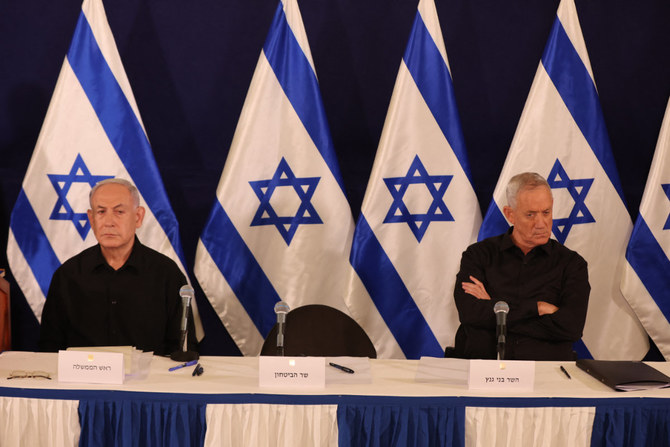

TEL AVIV, Israel: Prime Minister Benjamin Netanyahu rebuked a top Cabinet minister arriving in Washington on Sunday for talks with US officials, according to an Israeli official, signaling widening cracks within the country’s leadership nearly five months into its war with Hamas.
The trip by Benny Gantz, a centrist political rival who joined Netanyahu’s wartime Cabinet following Hamas’ Oct. 7 attack, comes as friction between the US and Netanyahu is rising over how to alleviate the suffering of Palestinians in Gaza and what the postwar plan for the enclave should look like.
An official from Netanyahu’s far-right Likud party said Gantz’s trip was planned without authorization from the Israeli leader. The official, who spoke on condition of anonymity, said Netanyahu had a “tough talk” with Gantz and told him the country has “just one prime minister.”
Gantz is scheduled to meet on Monday with US Vice President Kamala Harris and national security adviser Jake Sullivan and on Tuesday with Secretary of State Antony Blinken, according to his National Unity Party. A second Israeli official speaking on condition of anonymity said Gantz’s visit is intended to strengthen ties with the US, bolster support for Israel’s war and push for the release of Israeli hostages.
In Egypt, talks were underway to broker a ceasefire before the Muslim holy month of Ramadan begins next week.
Israel did not send a delegation because it is waiting for answers from Hamas on two questions, according to a third Israeli government official who spoke on condition of anonymity. Israeli media reported that the government is waiting to learn which hostages are alive and how many Palestinian prisoners Hamas seeks in exchange for each.
All three Israeli officials spoke anonymously because they weren’t authorized to discuss the disputes with the media.
On Saturday, the US airdropped aid into Gaza. The airdrops came after dozens of Palestinians rushing to grab food from an Israel-organized convoy were killed last week, and they circumvented an aid delivery system that has been hobbled by Israeli restrictions, logistical issues and fighting in Gaza. Aid officials say airdrops are far less effective than deliveries made by trucks.
US priorities in the region have increasingly been hampered by Netanyahu’s Cabinet, which is dominated by ultranationalists. Gantz’s more moderate party at times acts as a counterweight.
Netanyahu’s popularity has dropped since the war broke out, according to most opinion polls. Many Israelis hold him responsible for failing to stop the Oct. 7 cross-border raid by Hamas, which killed 1,200 people, mostly civilians, and took roughly 250 people as hostages into Gaza, including women, children and older adults, according to Israeli authorities.
More than 30,000 Palestinians have been killed since the war began, around two-thirds of them women and children, according to Gaza’s Health Ministry, which does not distinguish between civilians and fighters. Around 80 percent of the population of 2.3 million have fled their homes, and UN agencies say hundreds of thousands are on the brink of famine.
Israelis critical of Netanyahu say his decision-making has been tainted by political considerations, a charge he denies. The criticism is particularly focused on plans for postwar Gaza. Netanyahu wants Israel to maintain open-ended security control over Gaza, with Palestinians running civilian affairs.
The US wants to see progress on the creation of a Palestinian state, envisioning a revamped Palestinian leadership running Gaza with an eye toward eventual statehood.
That vision is opposed by Netanyahu and the hard-liners in his government. Another top Cabinet official from Gantz’s party has questioned the handling of the war and the strategy for freeing the hostages.
Netanyahu’s government, Israel’s most conservative and religious ever, has also been rattled by a court-ordered deadline for a new bill to broaden military enlistment of ultra-Orthodox Jews. Many of them are exempted from military service so they can pursue religious studies. Hundreds of Israeli soldiers have been killed since Oct. 7, and the military is looking to fill its ranks.
Gantz has remained vague about his view of Palestinian statehood. Polls show he would earn enough support to become prime minister if a vote were held today.
A visit to the US, if met with progress on the hostage front, could further boost Gantz’s support.
Israel has essentially endorsed a framework of a proposed Gaza ceasefire and hostage release deal, and it is now up to Hamas to agree to it, a senior US official said Saturday. He spoke on condition of anonymity under ground rules set by the White House to brief reporters.
Israelis, deeply traumatized by Hamas’ attack, have broadly backed the war effort as an act of self-defense, even as global opposition to the fighting has increased.
But a growing number are expressing their dismay with Netanyahu. Some 10,000 people protested late Saturday to call for early elections, according to Israeli media. Such protests have grown in recent weeks, but remain much smaller than last year’s demonstrations against the government’s judicial overhaul plan.
If the political rifts grow and Gantz quits the government, the floodgates will open to broader protests by a public that was already unhappy with the government when Hamas struck, said Reuven Hazan, a professor of political science at Hebrew University in Jerusalem.
Israeli strikes late Saturday in Rafah and in the Jabaliya refugee camp killed more than 30 people, including women and children, according to local health officials. And on Sunday two Israeli strikes southwest of Deir Al-Balah in central Gaza killed at least five people and destroyed an aid truck, according to witnesses and staff at Al Aqsa hospital.
Amid concerns about the wider regional conflict, White House senior adviser Amos Hochstein was going to Lebanon on Monday to meet officials, according to an administration official who was not authorized to comment. White House officials want Lebanese and Israeli officials to prevent tensions along their border from worsening.


