


DUBAI: Sunday’s FIFA World Cup final has been billed as a showdown pitting Lionel Messi against Lamine Yamal, defending champions Argentina against European champions Spain; and perhaps the final appearance of football’s greatest player in the sport’s premier showcase.
Yet one of the most intriguing stories behind the match has little to do with the players.
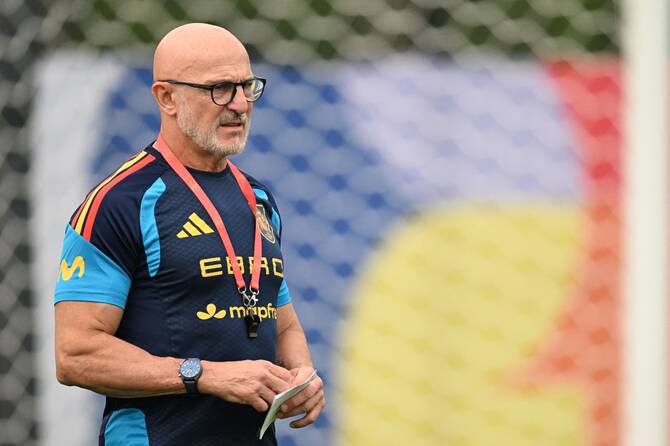
Before Luis de la Fuente and Lionel Scaloni became two of international football’s most respected coaches, the Spain manager found himself teaching the Argentine during UEFA Pro License coaching courses organized by the Spanish Football Federation.
As an instructor, De la Fuente taught subjects including the evolution of football and team building, with Scaloni among the aspiring coaches who attended his classes before embarking on his own managerial career.
“I’ve been lucky enough to teach various coaching courses,” De la Fuente recalled during Euro 2024.
“We taught this generation of footballers like Xavi Hernandez, Xabi Alonso and Raul, football stars who wanted to become coaches, and I had the luck to train Lionel Scaloni among them.”
De la Fuente has continued to speak warmly of Scaloni over the years, describing him as a friend and admitting before the semifinal that he would relish the opportunity to meet Argentina in the final.
That possibility became reality after Messi inspired Argentina’s dramatic comeback victory over England, setting up a meeting between two coaches whose paths crossed long before they reached football’s biggest stage.
The connection adds another dimension to what already promises to be one of the most compelling World Cup finals in recent memory.
Both coaches inherited national teams facing questions about their future, both arrived with relatively limited experience at senior international level, and both responded by building united squads capable of competing with the world’s best.
Their teams, however, have reached the final in very different ways.
Spain have been the tournament’s great neutralizers. Their 2-0 semifinal victory over France extended an unbeaten run of 37 matches, equaling Italy’s European record in men’s international football, and reinforced the belief that De la Fuente’s side have become the benchmark in world football.
After eliminating France, the Spain coach said his players were “feeling unbeatable” and insisted Les Bleus had faced “the best team in the world.”
The results support that confidence. Spain have conceded only once while eliminating Portugal, Belgium and France, repeatedly limiting some of the tournament’s strongest attacks.
De la Fuente’s influence also goes beyond tactics. Before taking charge of the senior team in 2022, he spent over a decade in Spain’s youth system, winning the European under-19 and under-21 titles and Olympic silver in Tokyo.
Several key players, including Rodri, Pedri, Dani Olmo, Mikel Merino and Mikel Oyarzabal, had already played under him before reaching the senior side. Rather than simply inheriting this generation, he helped shape many of the players now driving Spain’s success.
Argentina’s journey to the final has followed a different script. While Spain have imposed control over matches, Argentina have repeatedly found ways to survive them.
The defending champions needed extra time to overcome Cape Verde, Egypt and Switzerland before producing another dramatic comeback against England in Wednesday’s semifinal.
Trailing 1-0 entering the closing stages, Argentina scored twice after the 85th minute, with Messi creating both goals, to secure a second consecutive World Cup final.
After the match, Scaloni revealed his players sensed England becoming vulnerable as they attempted to protect their lead. “There was blood in the water, and we went for it,” he said.
For Scaloni, adversity has become one of Argentina’s defining strengths.
“I think that this team plays the best when we are facing adversity,” he said after the semifinal. “Everything we believe in was reflected during those final 40 minutes.”
That resilience has become the hallmark of this Argentina side. Messi remains the tournament’s leading scorer and the emotional leader.
But Julian Alvarez, Enzo Fernandez, Alexis Mac Allister, Rodrigo De Paul, Lautaro Martinez and Cristian Romero have all made decisive contributions throughout another demanding World Cup campaign.
The contrast between the finalists could hardly be greater. Spain have spent the tournament imposing their identity on opponents and gradually taking away the qualities that make them dangerous.
Argentina, meanwhile, have shown an ability to adapt to almost any situation, remaining calm under pressure before producing decisive moments when they matter most.
That contrast is what makes Sunday’s final feel like football’s ultimate chess match. De la Fuente has built a team that thrives on control, structure and tactical discipline, while Scaloni has created one that embraces adversity and trusts its collective resilience.
PleaseYears after sharing a classroom, De la Fuente and Scaloni will stand on opposite touchlines in New York, each hoping to outthink the other with the World Cup on the line.


