

Militant attacks spiked by 72 percent in Pakistan’s Balochistan province during February— report 

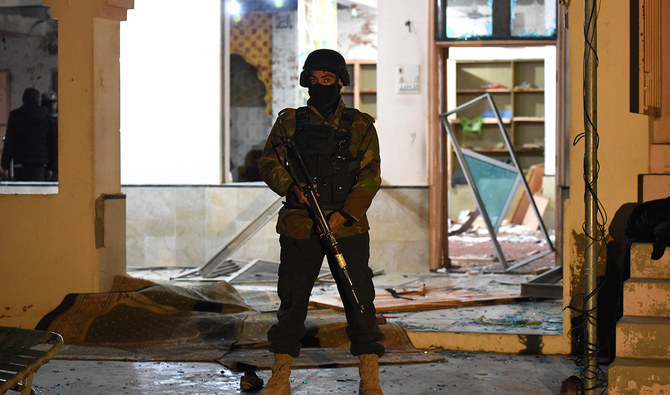
A soldier stands guard at the premises of a mosque after a bomb blast in Quetta on January 10, 2020. (AFP/File)
Short Url
Updated 03 March 2024
Follow

Militant attacks spiked by 72 percent in Pakistan’s Balochistan province during February— report 

  • Report by Islamabad-based think tank states 57 attacks took place in Balochistan during February 
  • Fifty of those attacks occurred from Feb. 1-8, showing militants wanted to disrupt polling process, says report 

KARACHI: Pakistan’s southwestern Balochistan province saw a 72 percent increase in militant attacks during February, mostly as banned outfits targeted political parties’ election activities in days leading up to the polls, the managing director of a Pakistani think tank said on Sunday.

The security situation in Pakistan’s restive southwestern province remained precarious in February, especially in the days before the Feb. 8 polls. Twin blasts in Balochistan killed at least 28 people and injured scores of others on election eve, triggering security fears ahead of polls. 

In a report released on March 1, the Pakistan Institute for Conflict and Security Studies (PICSS) said 57 attacks in total took place in Balochistan during February, which resulted in 42 deaths and 72 injuries. January had witnessed 33 attacks, leading to 31 fatalities and 50 injuries in the province, the report said. It added that 30 out of the 57 attacks last month were directed at election activities. 

“As you may recall, the Tehreek-e-Taliban Pakistan (TTP) had announced that it would not target election activities while the terrorist groups active in Balochistan had openly threatened that they would target the election process,” Abdullah Khan, managing director of the PICSS, told Arab News.

The report pointed out that 50 out of the 57 attacks in Balochistan occurred from February 1-8 while only seven attacks were reported after the elections, “underscoring the militants’ primary focus on disrupting the election process, considering political participation in Pakistan a threat to their cause.”

The report said that in contrast, the security situation “improved” in the rest of the country during February, with a 54 percent drop in violence in the former FATA (Federally Administered Tribal Areas) and a 23 percent reduction in mainland Khyber Pakhtunkhwa (KP) province. 

“In the tribal districts of KP, 11 attacks resulted in seven deaths and 17 injuries, compared to 24 attacks, 36 deaths, and 57 injuries in January,” the PICSS said. 

“Mainland KP witnessed 23 attacks with 35 deaths and 28 injuries, showing a decrease in attacks but an increase in human losses compared to January.”

Khan said militant attacks had decreased in KP due to the TTP’s decision to refrain from election violence. 

“ISKP was keen to carry out attacks against the election process but its operational capabilities in Pakistan are still no match to TTP,” Khan explained. 

Balochistan is Pakistan’s largest province by land yet its most sparsely populated and poor province. It has been the scene of a low-lying insurgency for the past two decades. Ethnic Baloch nationalists accuse the state of denying them a share in Balochistan’s mineral resources and now demand independence from the center. 

The state rejects these allegations and has vowed to quash any armed rebellion. 


Pakistan says repaid over $13.06 billion domestic debt early in last 14 months

Updated 29 January 2026
Follow

Pakistan says repaid over $13.06 billion domestic debt early in last 14 months

  • Finance adviser says repayment shows “decisive shift” toward fiscal discipline, responsible economic management
  • Says Pakistan’s total public debt has declined from over $286.6 billion in June 2025 to $284.7 billion in November 2025

KARACHI: Pakistan has repaid Rs3,650 billion [$13.06 billion] in domestic debt before time during the last 14 months, Adviser to the Finance Minister Khurram Schehzad said on Thursday, adding that the achievement reflected a shift in the country’s approach toward fiscal discipline. 

Schehzad said Pakistan has been repaying its debt before maturity, owed to the market as well as the State Bank of Pakistan (SBP), since December 2024. He said the government had repaid the central bank Rs300 billion [$1.08 billion] in its latest repayment on Thursday. 

“This landmark achievement reflects a decisive shift toward fiscal discipline, credibility, and responsible economic management,” Schehzad wrote on social media platform X. 

Giving a breakdown of what he said was Pakistan’s “early debt retirement journey,” the finance official said Pakistan retired Rs1,000 billion [$3.576 billion] in December 2024, Rs500 billion [$1.78 billion] in June 2025, Rs1,160 billion [$4.150 billion] in August 2025, Rs200 billion [$715 million] in October 2025, Rs494 billion [$1.76 billion] in December 2025 and $1.08 billion in January 2026. 

He said with the latest debt repaid today, the July to January period of fiscal year 2026 alone recorded Rs2,150 billion [$7.69 billion] in early retirement, which was 44 percent higher than the debt retired in FY25.

He said of the total early repayments, the government has repaid 65 percent of the central bank’s debt, 30 percent of the treasury bills debt and five percent of the Pakistan Investment Bonds (PIBs) debt. 

The official said Pakistan’s total public debt has declined from over Rs 80.5 trillion [$286.6 billion] in June 2025 to Rs80 trillion [$284.7 billion] in November 2025. 

“Crucially, Pakistan’s debt-to-GDP ratio, around 74 percent in FY22, has declined to around 70 percent, reflecting a broader strengthening of fiscal fundamentals alongside disciplined debt management,” Schehzad wrote. 

Pakistan’s government has said the country’s fragile economy is on an upward trajectory. The South Asian country has been trying to navigate a tricky path to economic recovery under a $7 billion loan from the International Monetary Fund.