

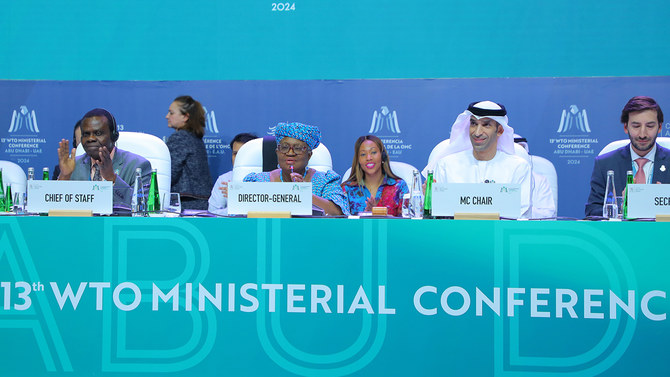

RIYADH: The least developed countries are set to benefit from the Abu Dhabi Declaration at the 13th WTO Ministerial Conference, improving global supply chain access.
Trade deals, aimed at fostering new agreements, will extend international trading system benefits to more nations, following intensive negotiations, as reported by the UAE’s official news agency, WAM.
Members have agreed to implement Special and Preferential Treatment for Sanitary and Phytosanitary Measures and Technical Barriers to Trade. This effort supports producers in the least developed countries, facilitating their global supply chain access, the WAM report stated.
The report added that the current measures of SPS constitute a staggering 90 percent of non-tariff trade barriers, posing a significant obstacle for smaller nations and being viewed as discriminatory.
In a significant development for developing countries, ministers approved a decision responding to a 23-year-old mandate. The aim is to revamp special and differential treatment provisions for improved precision, effectiveness, and operational functionality.
The UAE Minister of State for Foreign Trade and MC13 Chair, Thani Al-Zeyoudi, described the declaration as a significant milestone for the UAE and global trade.
“It has been a momentous week for Abu Dhabi, for the UAE, and for global trade. I would like to thank the delegations from every member for their diligence and dedication to the negotiation and for their ceaseless efforts in making the global trading system more robust, more efficient and, most importantly, more accessible,” he said.
The minister added that even in areas where final agreements have not been reached, issues that previously seemed unsolvable can now be unlocked — clearing the way for further progress in the coming months.
Substantial progress has also been achieved in dispute resolution, as there is now an agreement to fulfill the MC12 mandate by establishing a comprehensive and efficient Dispute Settlement system by the end of 2024. This entails the adoption of various reform pathways by the participating members.
Regarding e-commerce, members have agreed to extend the moratorium on customs duties for electronic transmissions for an additional two years. This decision implies that trade involving purely digital products and services will remain tariff-free until MC14 in Cameroon.
Ministers also adopted a ministerial decision to extend the moratorium on non-violation and situation complaints related to the agreement on Trade-related Aspects of Intellectual Property Rights until MC14.
“Delivering the Abu Dhabi Declaration of outcomes is a true testament to the value that members continue to attach to the WTO and its pivotal role in ensuring an orderly global system of trade rules,” said Al-Zeyoudi.
“With the adopted Abu Dhabi Declaration, we have demonstrated that we can deliver to ensure the global trading system remains a vital engine of growth and development for nations around the world. We must build on these significant achievements and remain united for global trade,” he added.
The WAM report quoted Ngozi Okonjo-Iweala, director-general of the World Trade Organization, stating that the global body serves as a foundation of stability and resilience in an economic and geopolitical landscape filled with uncertainties and exogenous shocks.
“Trade remains a vital force for improving people’s lives, and for helping businesses and countries cope with the impact of these shocks. Let us get some rest, then regroup and resume,” she said.
MC13, hosted by the UAE’s Ministry of Economy and the Abu Dhabi Department of Economic Development, took place at the Abu Dhabi National Exhibition Center from Feb. 26 to March 2.


