

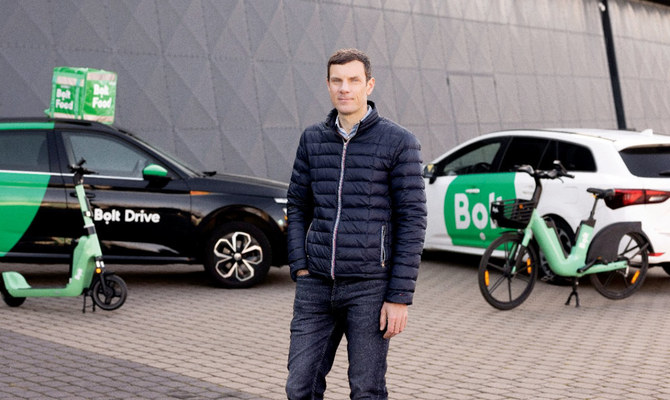

RIYADH: Saudi Arabia’s dynamic business environment is continuously drawing attention from international companies, and now Estonian ride-hailing giant Bolt is looking to expand its operations in the Kingdom.
Established in 2013, the company has become a prominent player in the global mobility industry, operating in 45 countries and 500 cities, with a current valuation of €7.4 billion ($8 billion).
In an interview with Arab News, Martin Villig, chairman and co-founder of Bolt, expressed his firm’s keen interest in the rapidly growing Saudi market.
“We have operated in Saudi Arabia since 2017 completing millions of trips with hundreds of thousands of drivers signed up to the platform. Our business in Saudi Arabia has grown 10 times over in the past three years and we now have operations in all cities across the country,” Villig told Arab News.
“However, we still see room for growth. Our short-term objective is to continue on that growth trajectory and increase both the number of trips completed and the number of drivers signed up to the platform,” he added.
Supporting a national vision
Looking toward the future, Bolt’s vision aligns closely with Saudi Arabia’s Vision 2030, particularly in the development of smart cities and sustainable transportation systems.Villig said the company is “already part of this Vision,” adding: “This includes investments in public transportation, as well as the promotion of alternative modes of transportation, including shared mobility services.”
He added: “However, with demand growing for shared mobility services in Saudi Arabia in recent years, we see huge opportunity to grow our operations in Saudi Arabia providing a convenient, affordable and environmentally friendly way for people to move around.”
Villig claimed this will help alleviate some of the problems cities in Saudi Arabia are facing due to over-reliance on private cars, such as increased travel time, congestion, accidents and pollution. Expanding its presence within the Kingdom remains a priority for Bolt, with Villig emphasizing the importance of growing the driver base to improve service availability.
“Our belief is that this will reduce the reliance on private car usage which will help alleviate some of the problems facing cities in Saudi Arabia today,” he stated.
Bolt is also actively engaging with government entities in the Kingdom to integrate ride-hailing services within the public transport ecosystem. The company’s collaboration with Saudi authorities has been notably successful, including its role as a mobility partner for Riyadh Season 2022, showcasing Bolt’s commitment to enhancing transportation solutions in the Kingdom.
In terms of new offerings, Villig indicates that the focus remains on expanding the reach of its core ride-hailing service.
A strategic Kingdom
The expansion into the Saudi market is strategic for Bolt due to the Kingdom’s burgeoning tourism sector and the proliferation of business and entertainment hubs, presenting a significant growth opportunity for the ride-hailing industry.
“In 2023 alone, Saudi Arabia welcomed over 27 million foreign tourists, with Bolt playing a vital role in facilitating their mobility across the Kingdom,” Villig said.
Our business in Saudi Arabia has grown 10 times over in the past three years and we now have operations in all cities across the country.
Martin Villig, Bolt chairman
He believes that private companies like his are instrumental in supporting Vision 2030 by aligning their operations with the Kingdom’s strategic goals.
By leveraging its extensive experience in addressing urban mobility challenges across the globe, Bolt aims to be a key partner for Saudi government entities in enhancing the country’s transport infrastructure.
A regulatory leader
Gaining experience from over 45 jurisdictions, Bolt is adept at navigating varying regulatory landscapes, from highly regulated environments to those still shaping their frameworks.
Villig emphasizes the company’s commitment to collaborating with regulators in every market to foster competition and meet customer needs effectively.
“Bolt was one of the main supporters of the internal policies promoted by the Saudi government and we fulfilled all the job localization program requirements,” he said.
“We have also committed to sharing data with the Saudi authorities to ensure the most appropriate mobility solutions are implemented,” he added.
A multi-billion-dollar company
Since its inception in 2013, Bolt has managed to secure large investment rounds, amassing over €1 billion to fund its growth.
“While I cannot disclose an exact figure, we view Saudi Arabia as an attractive investment opportunity and I am a strong believer that healthy competition is good for all parties, including the population of Saudi Arabia,” Villig stated.
Bolt is tackling the significant challenges posed by rapid urbanization and increased car ownership in cities across the Kingdom and the wider Middle East and North Africa region.
“This has led to various environmental and social problems such as increased travel time, congestion, accidents and pollution. Riyadh highlights the problem — at the start of 2022 it was expected that 18 million cars would be on Saudi Arabia’s roads, 30 percent of which would be in Riyadh,” Villig explained.
By expanding its services, Bolt aims to reduce reliance on private car usage, thereby alleviating urban congestion and environmental impact.
The company operates on a global shared mobility platform, efficiently connecting suppliers and consumers across various services, including ride-hailing, food delivery, and micromobility.
The company earns revenue by charging a small commission for facilitating these connections, with its micromobility service offering a direct-to-consumer model.
Despite facing macroeconomic challenges such as inflation and rising interest rates, Bolt achieved significant revenue growth and profitability gains last year, with plans to continue this positive trajectory towards break-even while balancing growth with profitability, Villig stated. The inception of Bolt was influenced by several factors, including the burgeoning Estonian tech ecosystem, the vast potential within the transportation industry, rising smartphone adoption, existing ride-hailing systems, and the poor quality of local taxi services.
Villig explained that these elements combined to inspire his brother, Markus Villig, the CEO of Bolt, to launch a company aimed at revolutionizing transportation through technology. “In every city we operate, the ultimate goal is to introduce our services in a way that enhances the existing transport infrastructure, making it easier and more affordable for people to move around in more environmentally friendly modes of transport,” Martin Villig said.
“Bolt has also generated working opportunities for hundreds of Saudi people in our Riyadh office who have been able to increase their income and use the ride-hailing industry to develop their personal business skills,” he added.
Martin Villig is scheduled to speak at Saudi Arabia’s largest startup and technology event, LEAP 2024, set to take place in Riyadh from March 4 to 7.


