In former haven, Sudanese terrified by paramilitaries

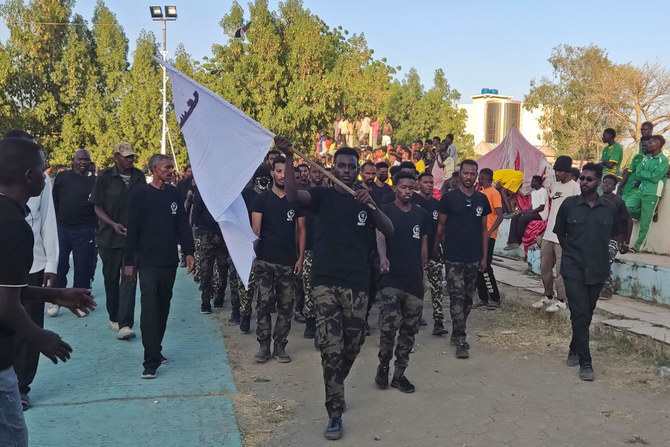
A communications blackout has made information scarce from Sudan’s Al-Jazira state, which paramilitaries pushed into in December, but rare interviews with residents have detailed grim conditions in the former safe haven. (AFP/File)
Short Url
Updated 02 March 2024
Follow

In former haven, Sudanese terrified by paramilitaries

  • One resident told AFP that Mohamed Hamdan Dagalo’s Rapid Support Forces shot at dozens of people in the village of Baranko last week
  • Al-Jazira, in central Sudan, had become a refuge for those fleeing the fighting in and around the capital Khartoum

PORT SUDAN, Sudan: A communications blackout has made information scarce from Sudan’s Al-Jazira state, which paramilitaries pushed into in December, but rare interviews with residents have detailed grim conditions in the former safe haven.
One resident, who requested anonymity for their safety, told AFP that Mohamed Hamdan Dagalo’s Rapid Support Forces (RSF) shot at dozens of people in the village of Baranko last week.
The testimony adds to a litany of abuses during more than 10 months of war between Dagalo’s forces and Sudan’s army led by Abdel Fattah Al-Burhan.
The United Nations human rights chief on Friday said Sudanese civilians are living in “sheer terror” and both sides had consistently acted with impunity for multiple rights violations.
“On February 22, the militia fired on dozens of residents who were protesting against the arrest of several young people guarding the houses,” said the resident of Baranko, about halfway between state capital Wad Madani and Khartoum to the north.
Multiple local sources reported 18 wounded in the shooting, a few of whom managed to reach a hospital in Shendi, 250 kilometers to the north, by taking side roads.
Breaking the communications siege via a rare satellite phone call, the anonymous resident told AFP that young men have been taking turns guarding houses at night.
It is a modest attempt to protect the homes from pillage, a signature RSF tactic.
The paramilitary force is the descendant of the Janjaweed militia, which began a scorched earth campaign in Sudan’s western Darfur area more than two decades ago under strongman Omar Al-Bashir.
Washington has accused both sides of war crimes, and said the RSF also carried out ethnic cleansing and crimes against humanity.
Al-Jazira, in central Sudan, had become a refuge for those fleeing the fighting in and around the capital Khartoum.
But in December, the RSF swept into the former breadbasket and proceeded to kill and plunder, witnesses told AFP at the time.
The war has killed thousands, uprooted eight million people and led the country to the edge of famine, aid agencies have warned.
According to UN figures, nearly half a million people had sought refuge in Al-Jazira, including in Wad Madani, but the fighting eventually caught up with them there too, sending thousands fleeing again.
Then on February 7, the Internet and telephones were cut off.
Many residents hope to leave Al-Jazira for somewhere safe, but getting away is not easy, said another Al-Jazira resident, Al-Samani, who only gave his first name out of fear of reprisal.
He lives in the village of Tabet, 80 kilometers northwest of Wad Madani, and spoke to AFP during a brief window of phone signal.
Buses have either been stolen or run out of fuel in a country where service stations have not been resupplied because of closed roads or challenges moving between areas under rival control.
Even for those lucky enough to find a bus and fuel, they need funds but “leaving is difficult because you have to pay, but online payment applications are paralyzed” without Internet, said Samani.
In the past 10 months in Sudan, the economy has gone mostly virtual, after a rise in cash thefts that often ruined families.
The mobile app for the country’s main bank allows users to wire money, to collect tickets and pay for purchases in stores. But it requires an Internet connection, which is no longer functioning.
“For a week, militiamen have been attacking houses and terrorizing women to steal their gold jewelry,” an essential dowry in Sudan, Samani told AFP.
“And there is not a tractor or agricultural tool they have not looted.”
In the nearby village of Abu Adara, “five inhabitants were killed by the RSF on February 25,” a local group, known as a resistance committee, reported.
The resistance committees used to organize pro-democracy protests but now provide aid during the war.
Throughout Al-Jazira during the past week, the resistance committee recorded 86 deaths, as well as others wounded, in 53 villages hit by RSF violence.
Amid the blackout, prices are constantly rising, residents say.
One liter of fuel now costs 25,000 Sudanese pounds, or about $20.
One kilogram (2.2 pounds) of meat, once priced at 6,000 Sudanese pounds before the RSF arrived, has doubled in cost.
RSF fighters took over swathes of land in Al-Jazira, leaving farmers unable to tend their crops, and accelerating economic damage on top of the looting.
With Sudan having lost “80 percent of its income because of the war,” according to Finance Minister Gibril Ibrahim, an army loyalist, imports have nearly disappeared, compounding the struggle for survival in Al-Jazira state.


Syrian army pushes into Aleppo district after Kurdish groups reject withdrawal

Updated 10 January 2026
Follow

Syrian army pushes into Aleppo district after Kurdish groups reject withdrawal

  • Two Syrian security officials told Reuters the ceasefire efforts had failed and that the army would seize the neighborhood by force

ALEPPO, Syria: The Syrian army said it would push into the last Kurdish-held district of Aleppo ​city on Friday after Kurdish groups there rejected a government demand for their fighters to withdraw under a ceasefire deal.
The violence in Aleppo has brought into focus one of the main faultlines in Syria as the country tries to rebuild after a devastating war, with Kurdish forces resisting efforts by President Ahmed Al-Sharaa’s Islamist-led government to bring their fighters under centralized authority.
At least nine civilians have been killed and more than 140,000 have fled their homes in Aleppo, where Kurdish forces are trying to cling on to several neighborhoods they have run since the early days of the war, which began in 2011.

HIGHLIGHTS

• Standoff pits government against Kurdish forces

• Sharaa says Kurds are ‘fundamental’ part of Syria

• More than 140,000 have fled homes due to unrest

• Turkish, Syrian foreign ministers discuss Aleppo by phone

ِA ceasefire was announced by the defense ministry overnight, demanding the withdrawal of Kurdish forces to the Kurdish-held northeast. That would effectively end Kurdish control over the pockets of Aleppo that Kurdish forces have held.

CEASEFIRE ‘FAILED,’ SECURITY OFFICIALS SAY
But in a statement, Kurdish councils that run Aleppo’s Sheikh Maksoud and Ashrafiyah districts ‌said calls to leave ‌were “a call to surrender” and that Kurdish forces would instead “defend their neighborhoods,” accusing government forces ‌of intensive ⁠shelling.
Hours ​later, the ‌Syrian army said that the deadline for Kurdish fighters to withdraw had expired, and that it would begin a military operation to clear the last Kurdish-held neighborhood of Sheikh Maksoud.
Two Syrian security officials told Reuters the ceasefire efforts had failed and that the army would seize the neighborhood by force.
The Syrian defense ministry had earlier carried out strikes on parts of Sheikh Maksoud that it said were being used by the Kurdish-led Syrian Democratic Forces (SDF) to launch attacks on the “people of Aleppo.” It said on Friday that SDF strikes had killed three army soldiers.
Kurdish security forces in Aleppo said some of the strikes hit a hospital, calling it a war crime. The defense ministry disputed that, saying the structure was a large arms depot and that it had been destroyed in the resumption of strikes on Friday.
It ⁠posted an aerial video that it said showed the location after the strikes, and said secondary explosions were visible, proving it was a weapons cache.
Reuters could not immediately verify the claim.
The SDF is ‌a powerful Kurdish-led security force that controls northeastern Syria. It says it withdrew its fighters from ‍Aleppo last year, leaving Kurdish neighborhoods in the hands of the Kurdish ‍Asayish police.
Under an agreement with Damascus last March the SDF was due to integrate with the defense ministry by the end of 2025, ‍but there has been little progress.

FRANCE, US SEEK DE-ESCALATION
France’s foreign ministry said it was working with the United States to de-escalate.
A ministry statement said President Emmanuel Macron had urged Sharaa on Thursday “to exercise restraint and reiterated France’s commitment to a united Syria where all segments of Syrian society are represented and protected.”
A Western diplomat told Reuters that mediation efforts were focused on calming the situation and producing a deal that would see Kurdish forces leave Aleppo and provide security guarantees for Kurds who remained.
The diplomat ​said US envoy Tom Barrack was en route to Damascus. A spokesperson for Barrack declined to comment. Washington has been closely involved in efforts to promote integration between the SDF — which has long enjoyed US military support — and Damascus, with which the ⁠United States has developed close ties under President Donald Trump.
The ceasefire declared by the government overnight said Kurdish forces should withdraw by 9 a.m. (0600 GMT) on Friday, but no one withdrew overnight, Syrian security sources said.
Barrack had welcomed what he called a “temporary ceasefire” and said Washington was working intensively to extend it beyond the 9 a.m. deadline. “We are hopeful this weekend will bring a more enduring calm and deeper dialogue,” he wrote on X.

TURKISH WARNING
Turkiye views the SDF as a terrorist organization linked to the outlawed Kurdistan Workers’ Party and has warned of military action if it does not honor the integration agreement.
Turkish Foreign Minister Hakan Fidan, speaking on Thursday, expressed hope that the situation in Aleppo would be normalized “through the withdrawal of SDF elements.”
Though Sharaa, a former Al-Qaeda commander who belongs to the Sunni Muslim majority, has repeatedly vowed to protect minorities, bouts of violence in which government-aligned fighters have killed hundreds of Alawites and Druze have spread alarm in minority communities over the last year.
The Kurdish councils in Aleppo said Damascus could not be trusted “with our security and our neighborhoods,” and that attacks on the areas aimed to bring about displacement.
Sharaa, in a phone call with Iraqi Kurdish leader Masoud Barzani on Friday, affirmed that the Kurds were “a fundamental part ‌of the Syrian national fabric,” the Syrian presidency said.
Neither the government nor the Kurdish forces have announced a toll of casualties among their fighters from the recent clashes.