Iran election turnout hits historic low

1 / 3
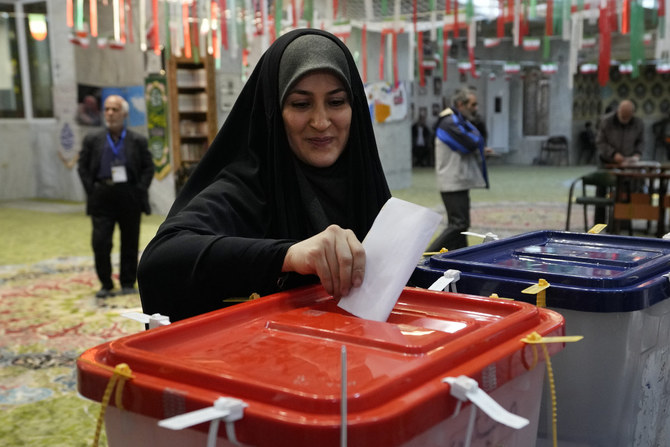
A woman casts her ballot during the parliamentary and Assembly of Experts elections at a polling station in Tehran on March 1, 2024. (AP Photo/Vahid Salemi)
2 / 3
People queue to vote during the parliamentary and Assembly of Experts elections at a polling station in Tehran on March 1, 2024. (AP Photo/Vahid Salemi)
3 / 3
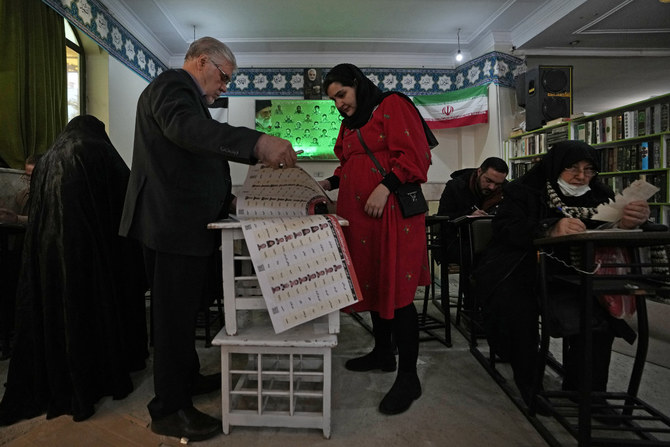
Voters fill out their ballots during the parliamentary and Assembly of Experts elections at a polling station in Tehran on March 1, 2024.(AP Photo/Vahid Salemi)
Short Url
Updated 03 March 2024
Follow

Iran election turnout hits historic low

  • Total voter turnout but may be at lowest since the 1979 Islamic Revolution
  • Under Iranian law, the parliament has a variety of roles, including overseeing the executive branch

TEHRAN: Turnout for Iran’s parliamentary election, seen as a test of the clerical establishment’s legitimacy, appears to have hit a historic low of around 40 percent, according to unofficial reports in Iranian media on Saturday.
Heavyweight moderates and conservatives stayed away from Friday’s election and reformists called it unfree and unfair as it was mainly a contest between hard-liners and low-key conservatives loyal to Islamic revolutionary ideals.
Mohammad Khatami, Iran’s first reformist president, was among the critics who did not vote on Friday.
Imprisoned Nobel Peace Prize laureate Narges Mohammadi, a women’s rights advocate, in a statement shared by her family with Reuters, called the election a “sham.”
The Hamshahri and Kayhan newspapers both reported that turnout was estimated at about 40 percent, in line with official surveys ahead of the poll estimating about 41 percent of eligible Iranians would vote.
The Hamshahri called the turnout “a 25-million slap” to calls for an election boycott, in a front-page headline next to a depiction of a ballot paper smacking US President Joe Biden in the face.
Iran’s Supreme Leader Ayatollah Ali Khamenei accused Iran’s “enemies” — a term he normally uses for the United States and Israel — of trying to create despair among Iranian voters.
“The Silent Majority” was the front page headline in Ham Mihan, a pro-reform newspaper, which also put the turnout at about 40 percent.
The interior ministry may announce the official turnout later on Saturday. If the turnout figure is officially confirmed, it would be the lowest turnout since Iran’s Islamic revolution in 1979.
Iran’s turnout fell to 42.5 percent in 2020 parliamentary elections from about 62 percent in 2016.
The election follows anti-government protests in 2022-23 that spiralled into some of Iran’s worst political turmoil since the revolution and coincided with growing frustration over the country’s economic woes.
Over 15,000 candidates ran for the 290-seat parliament on Friday.
The parliamentary election was twinned with a vote for the 88-seat Assembly of Experts, an influential body that has the task of choosing 84-year-old Khamenei’s successor.
Hard-line President Ebrahim Raisi was re-elected to the Assembly of Experts with 82.5 percent of the vote, the interior ministry announced on Saturday.
Hassan Rouhani, a pragmatist who was elected president in landslide wins in 2013 and 2017 promising to reduce Iran’s diplomatic isolation, was banned from running, drawing criticism from moderates.


Fledgling radio station aims to be ‘voice of the people’ in Gaza

Updated 15 February 2026
Follow

Fledgling radio station aims to be ‘voice of the people’ in Gaza

  • The electricity crisis is one of the most serious and difficult problems in the Gaza Strip, says Shereen Khalifa Broadcaster

DEIR EL-BALAH: From a small studio in the central city of Deir El-Balah, Sylvia Hassan’s voice echoes across the Gaza Strip, broadcast on one of the Palestinian territory’s first radio stations to hit the airwaves after two years of war.

Hassan, a radio host on fledgling station “Here Gaza,” delivers her broadcast from a well-lit room, as members of the technical team check levels and mix backing tracks on a sound deck. “This radio station was a dream we worked to achieve for many long months and sometimes without sleep,” Hassan said.

“It was a challenge for us, and a story of resilience.”

Hassan said the station would focus on social issues and the humanitarian situation in Gaza, which remains grave in the territory despite a US-brokered ceasefire between Israel and Hamas since October.

“The radio station’s goal is to be the voice of the people in the Gaza Strip and to express their problems and suffering, especially after the war,” said Shereen Khalifa, part of the broadcasting team.

“There are many issues that people need to voice.” Most of Gaza’s population of more than 2 million people were displaced at least once during the gruelling war.

Many still live in tents with little or no sanitation.

The war also decimated Gaza’s telecommunications and electricity infrastructure, compounding the challenges in reviving the territory’s local media landscape. “The electricity problem is one of the most serious and difficult problems in the Gaza Strip,” said Khalifa.

“We have solar power, but sometimes it doesn’t work well, so we have to rely on an external generator,” she added.

The station’s launch is funded by the EU and overseen by Filastiniyat, an organization that supports Palestinian women journalists, and the media center at the An-Najah National University in Nablus, in the occupied West Bank.

The station plans to broadcast for two hours per day from Gaza and for longer from Nablus. It is available on FM and online.

Khalifa said that stable internet access had been one of the biggest obstacles in setting up the station, but that it was now broadcasting uninterrupted audio.

The Gaza Strip, a tiny territory surrounded by Israel, Egypt, and the Mediterranean Sea, has been under Israeli blockade even before the attack on Oct. 7, 2023, which sparked the war. Despite the ceasefire, Israel continues to strictly control the entry of all goods and people to the territory.

“Under the siege, it is natural that modern equipment necessary for radio broadcasting cannot enter, so we have made the most of what is available,” she said.