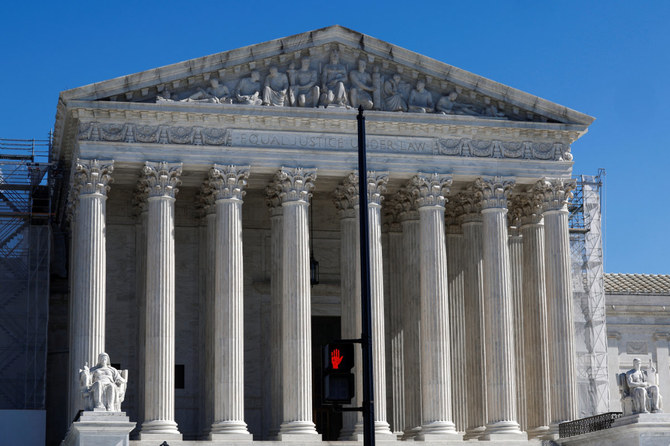

WASHINGTON: The US Supreme Court appears likely to reject Donald Trump’s claim of immunity from prosecution for trying to undo his 2020 election loss, according to legal experts, but its decision to spend months on the matter could aid his quest to regain the presidency by further delaying a monumental criminal trial.
Trump’s lawyers have argued that he should be shielded from prosecution for his effort to reverse President Joe Biden’s election victory over him because he was president when he took those actions, a sweeping assertion of immunity firmly rejected by lower courts.
But the Supreme Court’s decision not to schedule its arguments on the issue until late April reduces the chances that a trial on election subversion charges brought by Special Counsel Jack Smith could be finished before the Nov. 5 US election. Trump is cruising toward the Republican nomination to challenge Biden, a Democrat.
Some legal experts criticized the Supreme Court, whose 6-3 conservative majority includes three Trump appointees, for undue delay.
“They could have set a more aggressive briefing and argument schedule, as Smith requested,” University of Michigan law professor Leah Litman said. “The immunity claims are also outlandish. They could have been rejected on the papers (legal briefs) if they wanted to be the one to decide it.”
“They’ll reject his immunity bid,” Litman added, but forecast that the soonest a decision would come is May.
Legal experts said the justices would need to rule by about June 1 to leave enough time for Trump’s trial on the charges to wrap up before Election Day.
Smith, seeking to avoid trial delays, had asked the justices on Dec. 11 to launch a fast-track review of the immunity claim. Trump asked the justices to not expedite the review, and on Dec. 22 they did what he requested, opting to let the matter play out in a lower court rather than resolving it right away.
The US Court of Appeals for the District of Columbia Circuit on Feb. 6 upheld US District Judge Tanya Chutkan’s Dec. 1 ruling rejecting the immunity claim. Trump on Feb. 12 asked the Supreme Court to freeze the D.C. Circuit ruling. On Feb. 14, Smith asked the justices to reject Trump’s bid to further delay the matter. It took the court two more weeks before it announced it would hear arguments in the matter, which it scheduled for the week of April 22.
The trial had been scheduled to start on March 4 before the delays over the immunity issue. Now no trial date is set.
Four prosecutions
The case is one of four criminal prosecutions Trump faces. A March 25 trial date has been set on charges in state court in New York involving hush money paid to porn star Stormy Daniels before the 2016 election. It is unclear when the other criminal cases will go to trial.
Trump has pleaded not guilty in all four cases, seeking to portray them as politically motivated.
“I should not have to go through any fake prosecutions before the election,” Trump wrote on social media on Feb. 19.
A criminal conviction could harm Trump’s election chances. In Reuters/Ipsos opinion polls, a quarter of Republicans and half of independents said they would not vote for Trump if a jury convicted him of a felony.
If he is elected and becomes president again next January, he could order an end to this case and a second brought by Smith concerning Trump’s handling of classified documents — or seek to pardon himself for any federal convictions.
Republican strategist Ford O’Connell, who worked with Trump during the 2020 campaign, said of the delays in the trial timeline as the Supreme Court resolves the immunity matter: “It’s hard to overstate what a victory this is politically for the Trump legal team and for Donald Trump.”
“This is a great benefit to Trump in terms of the timeline of these cases, and how they may interact with the election, particularly in the fall,” O’Connell said.
Slowing things down
University of Michigan law professor Barbara McQuade, a former senior federal prosecutor appointed by President Barack Obama, said that a time frame for the election subversion trial “is manageable as long as the Supreme Court acts promptly, and remains mindful of the public’s right to a speedy trial.”
McQuade added that “it seems likely that the court will uphold the D.C. Circuit ruling against Trump.”
“I think that Trump’s arguments are pretty thin,” added Georgetown University law professor Erica Hashimoto.
Chutkan has promised to give Trump about 90 days to prepare for trial once the case returns to her courtroom, with a trial expected to last six to eight weeks. For a verdict to come before the election, the trial would need to start by around Sept. 1, McQuade said.
UCLA School of Law elections expert Richard Hasen said that if the Supreme Court’s ruling comes in late June, “it is not at all clear that there could be a trial before the election.”
“I’m also skeptical the judge would make Trump go to trial if he’s the general election candidate on the Republican side,” Hasen added.
Hasen forecast that the Supreme Court “is likely to reject Trump’s immunity argument on the merits.”
Delaying the trial gives Trump more time to rally supporters around his claim that the charges were politically motivated, an assertion that Reuters/Ipsos polls show is broadly held by Republican voters.
Some experts cite Trump’s long-established record of making strategic use of court delays for legal and political advantage.
Hasen noted that “given the weakness of Trump’s position, it’s reasonable to ask whether this is simply an attempt, now more likely to be successful, to run out the clock.”