MOSCOW: Russian opposition politician Alexei Navalny will be buried in Moscow later on Friday amid tight security and fears of a police crackdown two weeks after he suddenly died at the age of 47 in an Arctic penal colony.
Navalny’s allies — who have promised to livestream the day’s events online — have accused President Vladimir Putin of having him murdered because the Russian leader could allegedly not tolerate the thought of Navalny being freed in a potential prisoner swap.
They have not published proof to back up that accusation, but have promised to set out how he was murdered and by whom.
The Kremlin has denied state involvement in his death and has said it is unaware of any agreement to free Navalny. His death certificate — according to allies — said he died of natural causes.
Navalny, a former lawyer, mounted the most determined political challenge against Putin since the Russian leader came to power at the end of 1999, organizing street protests and publishing high-profile investigations into the alleged corruption of some in the ruling elite.
But a series of criminal charges for fraud and extremism — which Navalny said were politically-motivated — saw him handed jail sentences of over 30 years and most of his supporters have either fled the country or are in jail.
Navalny decided to return to Russia from Germany in 2021 after being treated for what Western doctors said was poisoning with a nerve agent only to be immediately taken into custody.
Putin, who controls all the levers of state and is expected to be comfortably re-elected for another six-year term in two weeks, has yet to comment on Navalny’s death and has for years avoided mentioning him by name.
Though Navalny is well known in the West, state TV inside Russia did not mention him for years either and when it did it was brief and in a negative light.
A religious service for Navalny is due to be held at 1400 local time in the Church of the Icon of the Mother of God in the Moscow district of Maryino where Navalny used to live.
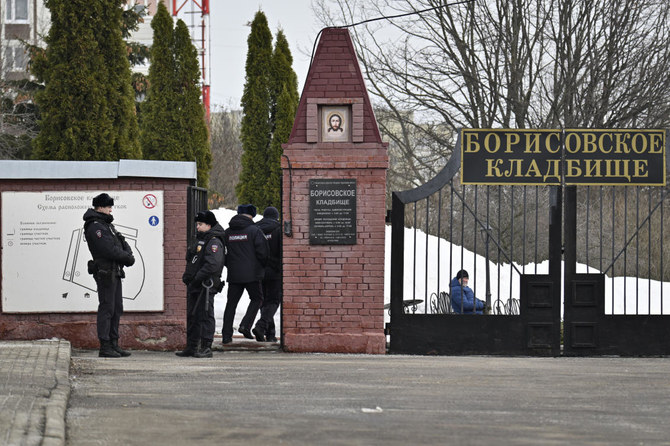
He is then scheduled to be buried at the Borisovskoye cemetery, around 2.5 km (1.5 miles) away on the other side of the Moskva River two hours later.
Navalny’s allies, who are outside Russia and have been designated as US-backed extremists by the authorities, have called on people who want to honor his memory but cannot attend his funeral service to instead go to certain landmarks in their own towns on Friday evening at 7 p.m. local time.
The Kremlin has dismissed statements by his allies as provocative and warned that the police will uphold the law.
Judging from previous gatherings of Navalny supporters, a heavy police presence is likely and the authorities will break up anything they deem to resemble a political demonstration under protest laws.
Navalny’s wife Yulia, with whom he had two children, has said she is unsure whether the funeral itself will pass off peacefully or whether police will arrest attendees. She is outside Russia.
Navalny’s mother Lyudmila, 69, is expected to attend his funeral. It is unclear who else will be allowed into the church for the service.
Navalny was a Christian who condemned Putin’s decision to send tens of thousands of troops into Ukraine as a crazy enterprise built on lies. But the church that will host his funeral has donated to the Russian army and enthusiastically advertised its backing for the war.
In the run-up to his funeral, his allies accused the authorities of blocking their plans to hold a bigger civil memorial service and said unknown individuals had even managed to thwart their attempts to hire a hearse to transport him to his own funeral.
The Kremlin has said it has nothing to do with Navalny’s funeral arrangements.


![]()

Alexei Navalny to be buried in Moscow amid uncertainty, tight security
Short Url
https://arab.news/wzy3h
Alexei Navalny to be buried in Moscow amid uncertainty, tight security
- The Kremlin has denied state involvement in his death


Latest updates


© 2026 SAUDI RESEARCH & PUBLISHING COMPANY, All Rights Reserved And subject to Terms of Use Agreement.