

Saudi surgeons successfully complete complex 16-hour operation separating Nigerian conjoined twins

1 / 3
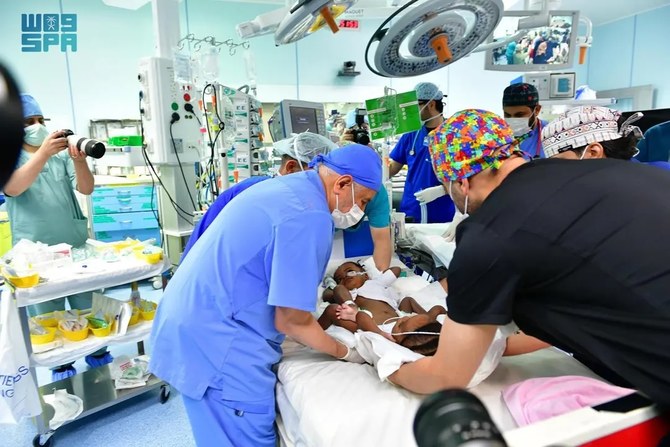
The twins, who arrived in Saudi Arabia last October, share areas in the lower abdomen, pelvis, lower spine, and lower spinal nerves (SPA)
2 / 3
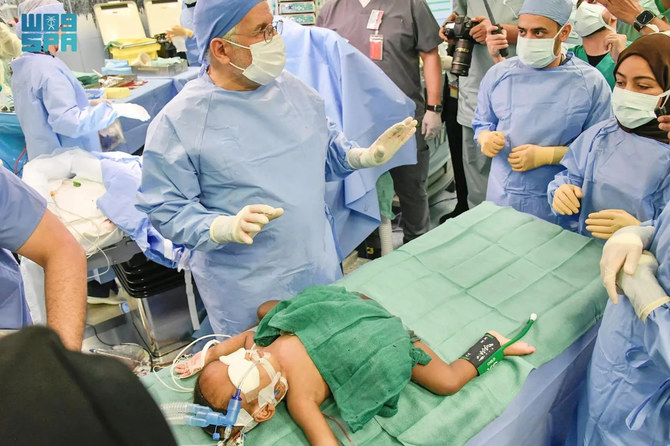
The twins, who arrived in Saudi Arabia last October, share areas in the lower abdomen, pelvis, lower spine, and lower spinal nerves (SPA)
3 / 3
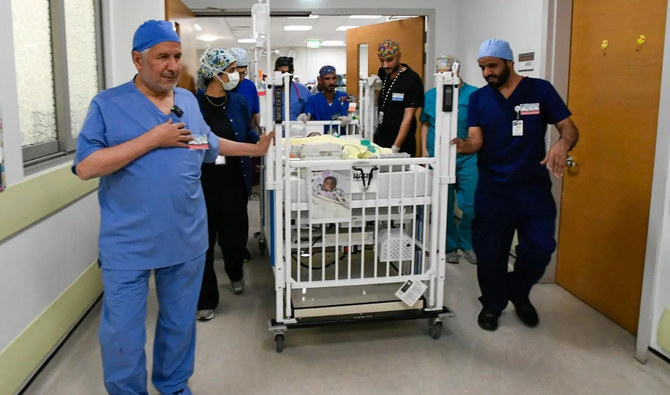
The twins, who arrived in Saudi Arabia last October, share areas in the lower abdomen, pelvis, lower spine, and lower spinal nerves (SPA)
Short Url
Updated 06 March 2024
Follow

Saudi surgeons successfully complete complex 16-hour operation separating Nigerian conjoined twins

Riyadh: Surgeons in Saudi Arabia on Thursday successfully completed a complex procedure of separating Nigerian conjoined twins Hassana and Hasina at King Abdullah Specialist Children’s Hospital in King Abdulaziz Medical City in Riyadh.

The twins, who arrived in Saudi Arabia last October, share areas in the lower abdomen, pelvis, lower spine, and lower spinal nerves.

The separation surgery took about 16 and a half hour and involved 39 consultants, specialists, technical, nursing, and support staff.

Head of the medical team Dr. Abdullah Al-Rabeeah said the operation has a 70 percent success rate and involved nine stages.

“All the doctors who have participated are Saudi colleagues. We take pride in ensuring that young cadres have participated and thus secured the continuous exchange of experience, he told Al-Ekhbariya.

“Some 38 individuals, including consultants, specialists, and nursing and technical staff, participated. There are also fresh graduates in pediatric surgery, as well as other fields of surgery.

“They are contributing with us to ensure that experience is not limited to certain people, but rather continues for years to come in a country where achievement is constant and giving is permanent,” he added.

This is the 60th operation performed by the Saudi program for separating conjoined twins. Over the past 34 years, the program has cared for 135 sets of twins from 25 countries.

Dr. Al-Rabeeah emphasized the Kingdom’s pioneering role in humanitarian work in general and medical work in particular. 

He extended his sincere thanks to his fellow medical team members for their great efforts, pointing out that this medical achievement is an embodiment of Saudi medical excellence, which falls within the objectives of the Saudi Vision 2030. 

He also extended his thanks and appreciation to King Salman and Crown Prince Mohammed bin Salman for their support and follow-up of the Saudi program for separating conjoined twins.

The parents of the twins expressed thanks to King Salman and Crown Prince Mohammed bin Salman and praised the Kingdom’s great humanitarian role.


Separation of Somali conjoined twins Rahma and Ramla begins in Riyadh

Updated 14 sec ago
Follow

Separation of Somali conjoined twins Rahma and Ramla begins in Riyadh

  • Surgery to take 14 hours in 8 stages with 37-member team
  • Initiative is led by leading surgeon Dr. Abdullah Al-Rabeeah

RIYADH: Surgery to separate Somali conjoined twins Rahma and Ramla is underway at the King Abdullah Specialized Children’s Hospital of the Ministry of the National Guard in Riyadh.

The children came with their parents to Saudi Arabia upon King Salman’s directives in May last year and were transferred to the hospital for tests to determine whether the operation would be safe.

An official of the Saudi Conjoined Twins Program told Arab News that in addition to the complexity of the intervention, there was also a waiting list of other children.

Dr. Abdullah Al-Rabeeah, who heads the SCTP’s teams and is also supervisor-general of the Saudi aid agency KSrelief, said the 13-month-old girls who arrived on May 6 were joined at the lower abdomen and pelvis. 

“Each twin has two complete lower limbs, and they share a pelvic bone, colon and rectum, with overlaps in the urinary and reproductive systems,” said Al-Rabeeah.

He explained that Ramla suffers from complete atrophy of both kidneys and would need immediate dialysis after separation.

Rahma suffers from complete atrophy of her left kidney, and there are cysts in her right kidney, which is currently functioning adequately but would require close monitoring following surgery to ensure its continued function, he added. 

Al-Rabeeah said the risk was 40 percent due to the case’s medical challenges. The situation was explained in detail to the twins’ parents, who accepted the plan to separate the girls, he added.

He said the procedure is expected to take about 14 hours in eight stages, and would involve 37 consultants, specialists, nurses and staff in the fields of anesthesia, pediatrics, orthopedics and plastic surgery.

He said Rahma and Ramla will be the 68th pair of conjoined twins to be separated under the program, which began 35 years ago. 

Al-Rabeeah thanked the Saudi leadership for supporting the initiative over the years. He prayed for the success of the separation, which he said would give the girls the best chance to live happy and healthy lives.