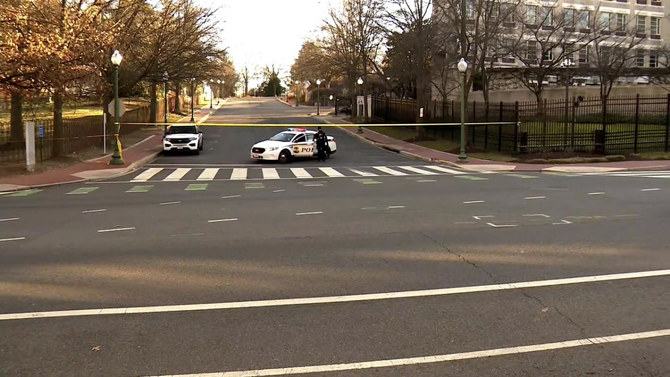
US airman sets himself on fire outside Israeli embassy in Washington

Police are deployed outside the Israeli Embassy in Washington, Sunday, Feb. 25, 2024, after an active-duty member of the US Air Force was critically injured after setting himself ablaze outside the diplomatic compound. (AP)
Short Url
Updated 27 February 2024
Follow

US airman sets himself on fire outside Israeli embassy in Washington

  • The man had filmed himself shouting “Free Palestine” as he lit himself on fire, according to footage shared on social media
  • In the video, the man is seen wearing military fatigues and declaring he will “not be complicit in genocide” before dousing himself in liquid

WASHINGTON: An active member of the US Air Force has died after setting himself on fire outside the Israeli embassy in Washington over the weekend in protest of the war in Gaza, the Pentagon said Monday.
Emergency responders on Sunday had rushed to the scene just before 1:00 p.m. (1800 GMT) in response to a “call for person on fire outside the Israeli Embassy,” according to a message on X, formerly Twitter, by the capital city’s fire department.
They arrived to find that officers from the Secret Service — the US law enforcement agency tasked with protecting embassies in Washington — had already extinguished the fire.
The man had filmed himself shouting “Free Palestine” as he lit himself on fire, according to footage shared on social media.
He was initially transported to hospital with “critical life-threatening injuries,” the fire department said.
An Air Force spokeswoman told AFP Monday morning that the unnamed “individual involved in yesterday’s incident succumbed to his injuries and passed away last night.”
“We will provide additional details 24 hours after next-of-kin notifications are complete.”
A spokesperson for the Israeli embassy said no staff were injured in the incident, and that the man was “unknown” to them.
In the video shared on social media, the man is seen wearing military fatigues and declaring he will “not be complicit in genocide” before dousing himself in liquid.
He then lights himself on fire while yelling “Free Palestine!” until he falls on the ground.
The video was reportedly first shared in a livestream on the social platform Twitch.
The shocking act came as protests are increasing across the United States against Israel’s actions in Gaza, where it is waging a retaliatory war for an attack on October 7 by Hamas militants.
With the death toll in Gaza nearing 30,000, according to the Hamas-run health ministry there, international pressure has been increasing on the United States to rein in its ally Israel and call for a ceasefire.


Syrian Alawites protest in coastal heartland after mosque bombing

Updated 5 sec ago
Follow

Syrian Alawites protest in coastal heartland after mosque bombing

  • Syrian Alawites took to the streets on Sunday in the coastal city of Latakia to protest after a mosque bombing that killed eight people in Homs two days before
LATAKIA: Syrian Alawites took to the streets on Sunday in the coastal city of Latakia to protest after a mosque bombing that killed eight people in Homs two days before.
The attack, which took place in an Alawite area of Homs city, was the latest against the religious minority, which has been the target of several episodes of violence since the December 2024 fall of longtime ruler Bashar Assad, himself an Alawite.
Security forces were deployed in the area, and intervened to break up clashes between demonstrators and counter-protesters, an AFP correspondent witnessed.
“Why the killing? Why the assassination? Why the kidnapping? Why these random actions without any deterrent, accountability or oversight?” said protester Numeir Ramadan, a 48-year-old trader.
“Assad is gone, and we do not support Assad... Why this killing?“
Sunday’s demonstration came after calls from prominent spiritual leader Ghazal Ghazal, head of the Islamic Alawite Council in Syria and Abroad, who on Saturday urged people to “show the world that the Alawite community cannot be humiliated or marginalized.”
“We do not want a civil war, we want political federalism. We do not want your terrorism. We want to determine our own destiny,” he said in a video message on Facebook.
Protesters carried pictures of Ghazal along with banners expressing support for him, while chanting calls for decentralized government authority and a degree of regional autonomy.
“Our first demand is federalism to stop the bloodshed, because Alawite blood is not cheap, and Syrian blood in general is not cheap. We are being killed because we are Alawites,” Hadil Salha, a 40-year-old housewife said.
Most Syrians are Sunni Muslim, and the city of Homs — where Friday’s bombing took place — is home to a Sunni majority but also has several areas that are predominantly Alawite, a community whose faith stems from Shiite Islam.
The community is otherwise mostly present across their coastal heartland in Latakia and Tartus provinces.
Since Assad’s fall, the Syrian Observatory for Human Rights monitor and Homs province residents have reported kidnappings and killings targeting members of the minority community.

- Alawite massacres -

The country has also seen several bloody flare-ups of sectarian violence.
Syria’s coastal areas saw the massacre of Alawite civilians in March, with authorities accusing armed Assad supporters of sparking the violence by attacking security forces.
A national commission of inquiry said at least 1,426 members of the minority were killed, while the Syrian Observatory for Human Rights monitor put the toll at more than 1,700.
Late last month, thousands of people demonstrated on the coast to protest fresh attacks targeting Alawites in Homs and other regions.
Before and after the March bloodshed, authorities carried out a massive arrest campaign in predominantly Alawite areas, which are also former Assad strongholds.
Protesters on Sunday also demanded the release of detainees.
On Friday, Syrian state television reported the release of 70 detainees in Latakia “after it was proven that they were not involved in war crimes,” saying more releases would follow.
Despite assurances from Damascus that all Syria’s communities will be protected, the country’s minorities remain wary of their future under the new Islamist authorities, who have so far rejected calls for federalism.