TEL AVIV: An Israeli military offensive in the southernmost city of Rafah could be “delayed somewhat” if a deal for a weekslong ceasefire between Israel and Hamas is reached, Prime Minister Benjamin Netanyahu said Sunday, but claimed that total victory in Gaza is “weeks away” once the offensive begins.
Netanyahu confirmed to CBS that a deal is in the works, with no details. Israeli media reported that mediators were making progress on an agreement for a ceasefire and release of dozens of hostages held in Gaza as well as Palestinians imprisoned by Israel. Several Israeli media outlets, citing unnamed officials, said the War Cabinet tacitly approved it.
Talks resumed on Sunday in Qatar at the specialist level, Egypt’s state-run Al Qahera TV reported, citing an Egyptian official as saying further discussions would follow in Cairo with the aim of achieving the ceasefire and release.
Meanwhile, Israel is developing plans for expanding its offensive against the Hamas militant group to Rafah on the Gaza-Egypt border, where more than half the besieged territory’s population of 2.3 million have sought refuge. Humanitarian groups warn of a catastrophe, with Rafah the main entry point for aid, and the US and other allies have said Israel must avoid harming civilians.
Netanyahu has said he’ll convene the Cabinet this week to approve operational plans for action in Rafah, including the evacuation of civilians.
“Once we begin the Rafah operation, the intense phase of the fighting is weeks away from completion. Not months,” Netanyahu told CBS. ““If we don’t have a deal, we’ll do it anyway. It has to be done because total victory is our goal and total victory is within reach.”
He said that four of the six remaining Hamas battalions are concentrated in Rafah.
US national security adviser Jake Sullivan told NBC that President Joe Biden hadn’t been briefed on the Rafah plan and said, “We believe that this operation should not go forward until or unless we see (a plan to protect civilians).”
Heavy fighting continued in parts of northern Gaza, the first target of the offensive, where the destruction is staggering. Residents have reported days of heavy fighting in the Zaytoun neighborhood of Gaza City.
“We’re trapped, unable to move because of the heavy bombardment,” resident Ayman Abu Awad said.
He said starving residents have been forced to eat animal fodder and search for food in demolished buildings. Northern Gaza has been largely cut off from aid, and the UN’s World Food Program suspended deliveries last week.
DETAILS OF THE PROPOSED DEAL
A senior official from Egypt, which along with Qatar is a mediator between Israel and Hamas, has said the draft ceasefire deal includes the release of up to 40 women and older hostages in return for up to 300 Palestinian prisoners, mostly women, minors and older people.
The official, speaking on condition of anonymity to discuss the negotiations, said the proposed six-week pause in fighting would include allowing hundreds of trucks to bring desperately needed aid into Gaza every day, including the north. He said both sides agreed to continue negotiations during the pause for further releases and a permanent ceasefire.
Negotiators face an unofficial deadline of the start of the Muslim holy month of Ramadan around March 10, a period that often sees heightened Israeli-Palestinian tensions.
Hamas says it has not been involved in the latest proposal developed by the United States, Egypt and Qatar, but the reported outline largely matches its earlier proposal for the first phase of a truce.
Hamas has said it won’t release all of the remaining hostages until Israel ends its offensive and withdraws its forces from the territory, and is demanding the release of hundreds of Palestinian prisoners, including senior militants — conditions Netanyahu has rejected.
ANGUISHED WAIT FOR HOSTAGES’ FAMILIES
Israel declared war after the Oct. 7 Hamas attack on southern Israel in which militants killed about 1,200 people, mostly civilians, and took around 250 hostages. More than 100 hostages were released in a ceasefire deal in November. More than 130 remain in captivity, a fourth of them believed to be dead.
Families have followed the negotiations with hope and anguish.
“It feels like Schindler’s list. Will he be on the list or not?” Shelly Shem Tov, the mother of Omer, 21, told Israeli Army Radio of his chances of being freed.
Israel responded to the Oct. 7 attack with a air and ground offensive that has driven around 80 percent of Gaza’s population from their homes, putting hundreds of thousands at risk of starvation and the spread of disease. The Health Ministry in Hamas-ruled Gaza says 29,692 Palestinians have been killed in the war, two-thirds of them women and children.
The ministry’s death toll doesn’t distinguish between civilians and combatants. Israel says its troops have killed more than 10,000 militants, without providing evidence.
NEWBORNS DYING IN RAFAH
The war has devastated Gaza’s health sector. Less than half of hospitals even partially function.
At the Emirates Hospital in Rafah, three to four newborns are placed in each of its 20 incubators, which are designed for just one.
Dr. Amal Ismail said two to three newborns die in a single shift, in part because many families live in tents in rainy, cold weather. Before the war, one or two newborns in incubators there died per month.
“No matter how much we work with them, it is all wasted,” she said. “Health conditions in tents are very bad.”


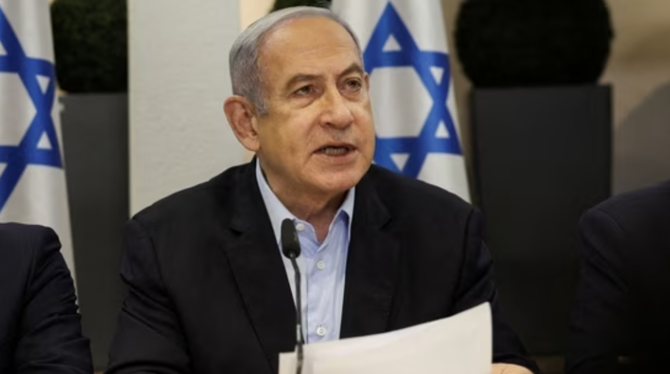
Netanyahu says ceasefire would only delay ‘somewhat’ Israeli military offensive in Rafah
https://arab.news/w9h9f
Netanyahu says ceasefire would only delay ‘somewhat’ Israeli military offensive in Rafah

- Israeli PM confirmed to CBS that a deal is in the works, with no details
- Israel developing plans for expanding offensive against Hamas militant group to Rafah


Iran FM criticizes Israel for ‘doctrine of domination’
- Doctrine allows Israel to expand its military arsenal while pressuring other countries in the region to disarm
- His remarks came a day after renewed nuclear talks with Washington in Oman
DOHA: Iran’s Foreign Minister Abbas Araghchi on Saturday criticized what he said was a “doctrine of domination” that allows Israel to expand its military arsenal while pressuring other countries in the region to disarm.
His remarks came a day after renewed nuclear talks with Washington, with previous talks collapsing when Israel launched an unprecedented bombing campaign against Iran last June that triggered a 12-day war.
Araghchi was speaking at the Al Jazeera Forum conference in Qatar but made no reference to Friday’s talks with the United States.
“Israel’s expansionist project requires that neighboring countries be weakened: militarily, technologically, economically and socially,” Araghchi said.
“Under this project Israel is free to expand its military arsenal without limits ... Yet other countries are demanded to disarm. Others are pressured to reduce defensive capacity. Others are punished for scientific progress,” he added.
“This is a doctrine of domination.”
During the 12-day war Israel targeted senior Iranian military officials, nuclear scientists and sites as well as residential areas, with the US later launching its own attacks on key nuclear facilities.
Iran responded at the time with drone and missile attacks on Israel, as well as by targeting the largest US military base in the Middle East, located in Qatar.
On Friday, Araghchi led the Iranian delegation in indirect nuclear talks with US Middle East envoy Steve Witkoff in Muscat.
The top Iranian diplomat later described the atmosphere as having been “very positive,” while US President Donald Trump said the talks were “very good,” with both sides agreeing to proceed with further negotiations.
The talks followed threats from Washington and its recent deployment of an aircraft carrier group to the region following Iran’s deadly crackdown on anti-government protests last month.
The United States has sought to address Iran’s ballistic missile program and its support for militant groups in the region — issues which Israel has pushed to include in the talks, according to media reports.
Tehran has repeatedly rejected expanding the scope of negotiations beyond the nuclear issue.


