

Eight in hospital after reports of ‘odor’ at Sweden intel service

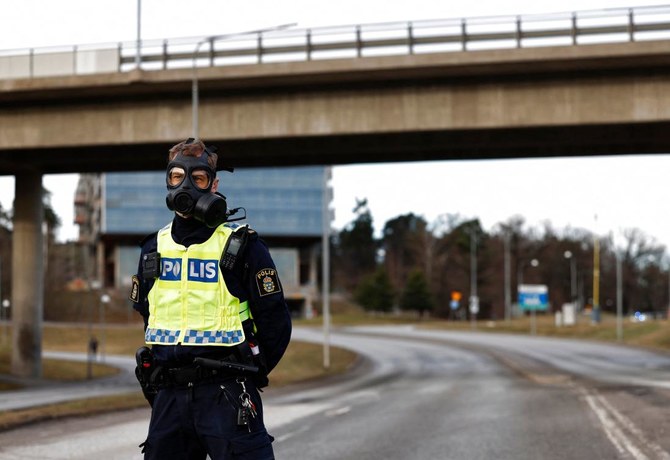
A Police officer wearing a gas mask stands guard at the scene after emergency services were alerted to Sweden’s Security Service’s (Sapo) headquarters in Solna, north of Stockholm, because of a suspected gas leak at the premises on Feb. 23, 2024. (AFP)
Short Url
Updated 24 February 2024
Follow

Eight in hospital after reports of ‘odor’ at Sweden intel service

  • Images from the scene showed police wearing gas masks alongside several ambulances and emergency vehicles
  • After ending their emergency operation, police said they had started an investigation into ‘causing bodily harm’ but did not have any suspects

STOCKHOLM: Police opened an investigation Friday after a suspicious odor at Sweden’s Security Service office left eight people needing hospital treatment with respiratory symptoms.

Images from the scene showed police wearing gas masks alongside several ambulances and emergency vehicles as an area around the office of the agency, known as Sapo, was closed off.

“Around 1:00 p.m. today, there were indications that there was a dangerous substance at Sapo’s offices,” Patrik Soderberg, chief physician at the local health care authority Region Stockholm, said.

“A total of eight people with symptoms have been treated at hospital,” Region Stockholm said in a statement, adding that the “cause of the leak was still unclear.”

After ending their emergency operation, police said they had started an investigation into “causing bodily harm” but did not have any suspects.

Police said an area of “a couple of hundred meters” around the building had been closed off after “a potential gas leak.”

Some of those taken to hospital were officers who had “smelled an odor when they arrived,” the service added in a statement.

Sapo spokeswoman Karin Lutz said the intelligence agency had called emergency services after receiving an alarm.

Lutz said the building had been “partly evacuated” during the emergency but declined to give further details or comment on whether they suspected foul play.

In a later statement, Sapo said “emergency services ended the operation after confirming that there was no gas inside the premises or outside the building.”

The Nordic country is on high alert as it is expecting to clear the final hurdle to its bid to join NATO on Monday, with the last holdout Hungary scheduled to vote on ratifying its membership.

The Aftonbladet newspaper said witnesses had reported smelling something that reminded them of paint, and that locals had been told to close their windows.

Swedish media also reported that a gas sensor on the roof of the building had alerted the presence of phosgene, but these reports have not been confirmed.

The gas was used as a chemical warfare agent during World War I, but is also widely used in industry for the production of plastics and pesticide.


Northern Japan hit by deadly snowfall, as warnings issued on more heavy snow

Updated 3 sec ago
Follow

Northern Japan hit by deadly snowfall, as warnings issued on more heavy snow

  • The biggest number of snow-related fatalities, at 12 people, was reported in Niigata Prefecture
  • Various task forces were set up to respond to the heavy snow in Niigata and nearby regions
TOKYO: Heavy snow battering northern Japan in the last two weeks has been blamed in 35 deaths nationwide so far, including people suffering sudden heart attacks or slipping while shoveling snow, government officials said Wednesday.
As of Wednesday, 15 prefectures have been affected, with the amount of snow piled up in the worst hit areas estimated to have reached 2 meters (6.5 feet).
The biggest number of snow-related fatalities, at 12 people, was reported in Niigata Prefecture, a rice-growing region in northern Japan, including a man in his 50s who was found collapsed on the roof of his home in Uonuma city on Jan. 21.
In Nagaoka city, a man in his 70s was spotted collapsed in front of his home and rushed to the hospital where he was pronounced dead. He is believed to have fallen from the roof while raking snow, according to the Niigata government.
Japan’s chief government spokesperson warned that, although the weather was getting warmer, more danger could lie ahead because snow would start melting, resulting in landslides and slippery surfaces.
“Please do pay close attention to your safety, wearing a helmet or using a lifeline rope, especially when working on clearing snow,” Chief Cabinet Secretary Minoru Kihara told reporters.
Various task forces were set up to respond to the heavy snow in Niigata and nearby regions, which began Jan. 20. Seven snow-related deaths have been reported in Akita Prefecture and five in Yamagata Prefecture.
Injuries nationwide numbered 393, including 126 serious injuries, 42 of them in Niigata. Fourteen homes were damaged, three in Niigata and eight in Aomori Prefecture.
The reason behind the heavy snowfall is unclear. But deaths and accidents related to heavy snow are not uncommon in Japan, with 68 deaths reported over the six winter months the previous year, according to the Fire and Disaster Management Agency.
More heavy snow is forecast for the coming weekend.