Sweden ends Nord Stream sabotage probe, hands evidence to Germany

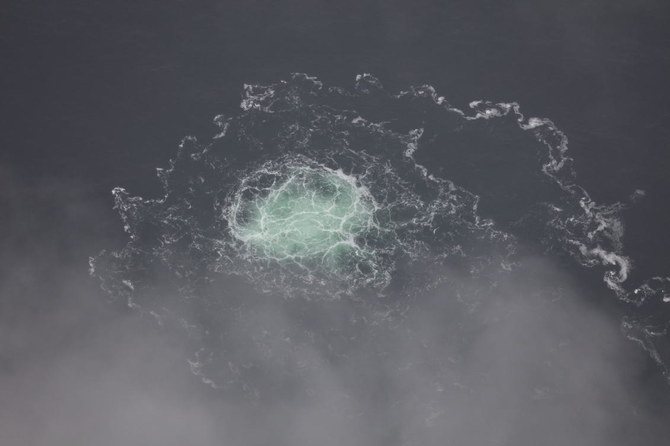
Danish police have said the the Nord Stream 1 and 2 gas pipelines were hit by powerful explosions and Swedish investigators have confirmed that traces of explosives found on site conclusively showed that sabotage had taken place. (Swedish Coast Guard via AP)
Short Url
Updated 07 February 2024
Follow

Sweden ends Nord Stream sabotage probe, hands evidence to Germany

  • Nord Stream pipelines transport Russian gas to Germany under the Baltic Sea
  • Sweden, Denmark and Germany launched separate investigations into the blasts, each tightly controlling information

STOCKHOLM: Swedish prosecutors said on Wednesday they would drop their investigation into explosions on the Nord Stream 1 and 2 gas pipelines and hand evidence uncovered in the probe over to German investigators.
“The conclusion of the investigation is that Swedish jurisdiction does not apply and that the investigation therefore should be closed,” the Swedish Prosecution Authority said in a statement.
The multi-billion-dollar Nord Stream pipelines transporting Russian gas to Germany under the Baltic Sea were ruptured by a series of blasts in the Swedish and Danish economic zones in September 2022, releasing vast amounts of methane into the air.
Danish police have said the pipelines were hit by powerful explosions and Swedish investigators have confirmed that traces of explosives found on site conclusively showed that sabotage had taken place.
Sweden, Denmark and Germany launched separate investigations into the Nord Stream blasts, each tightly controlling information. The Danish and German probes are still ongoing.
“Within the framework of this legal cooperation, we have been able to hand over material that can be used as evidence in the German investigation,” the Swedish prosecution authority said.
Following an extensive investigation, the Swedish prosecutors concluded that nothing had emerged to indicate that Sweden or Swedish citizens were involved in the attack which took place “in international waters.”
“Against the background of the situation we now have, we can state that Swedish jurisdiction does not apply,” Public Prosecutor Mats Ljungqvist said in a statement.
Russia has blamed the United States, Britain, and Ukraine for the blasts which largely cut it off from the lucrative European market. Those countries have denied involvement.
If no conclusive evidence is found by either of the remaining investigations, the mystery behind one of the most significant acts of infrastructure sabotage in modern history could remain unsolved.


Al-Shabab extremists are greatest threat to peace in Somalia and the region, UN experts say

Updated 5 sec ago
Follow

Al-Shabab extremists are greatest threat to peace in Somalia and the region, UN experts say

  • The UN Security Council on Tuesday voted unanimously to extend authorization for the African Union’s “support and stabilization” force in Somalia until Dec. 31, 2026

UNITED NATIONS: The Al-Shabab extremist group remains the greatest immediate threat to peace and stability in Somalia and the region, especially Kenya, UN experts said in a report released Wednesday.
Despite ongoing efforts by Somali and international forces to curb operations by Al-Qaeda-linked Al-Shabab, “the group’s ability to carry out complex, asymmetric attacks in Somalia remains undiminished,” the experts said.
They said the threat comes not only from Al-Shabab’s ability to strike — including within the capital, Mogadishu, where it attempted to assassinate the president on March 18 — but from its sophisticated extortion operations, forced recruitment and effective propaganda machine.
The UN Security Council on Tuesday voted unanimously to extend authorization for the African Union’s “support and stabilization” force in Somalia until Dec. 31, 2026. The force includes 11,826 uniformed personnel, including 680 police.
The extremist group poses a significant threat to neighboring Kenya “by conducting attacks that vary from attacks with improvised explosive devices, which predominantly target security personnel, to attacks on infrastructure, kidnappings, home raids and stealing of livestock,” the experts said.
This year, Al-Shabab averaged around six attacks a month in Kenya, mostly in Mandera and Lamu counties, which border Somalia in the northeast, the panel said.
The experts said Al-Shabab’s goal remains to remove Somalia’s government, “rid the country of foreign forces and establish a Greater Somalia, joining all ethnic Somalis across east Africa under strict Islamic rule.”
The panel of experts also investigated the Islamic State’s operations in Somalia and reported that fighters were recruited from around the world to join the extremist group, the majority from east Africa. At the end of 2024, they said the group known as ISIL-Somalia had a fighting force of over 1,000, at least 60 percent of them foreign fighters.
“Although small in terms of numbers and financial resources compared with Al-Shabab, the group’s expansion constituted a significant threat to peace and security in Somalia and the broader region,” the panel said.