

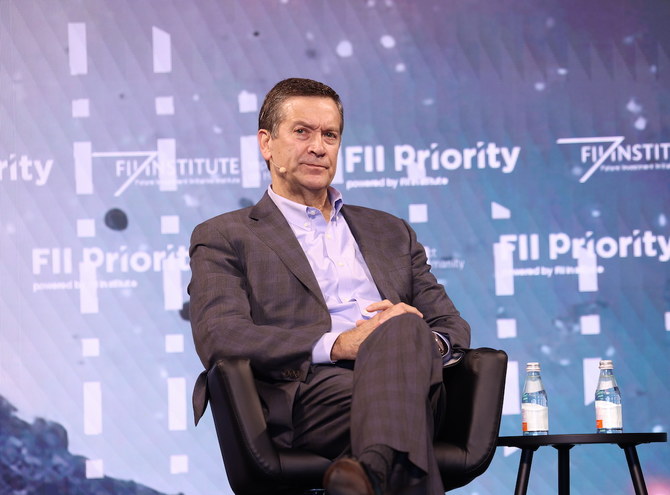
‘We go to space for the benefit of the many,’ Sierra Space CEO tells FII Summit

‘The reason we’re building a platform in space is to literally benefit life on Earth,’ said Tom Vice, CEO of Sierra Space at the FII Priority Summit on Friday. (Supplied)
Short Url
Updated 23 February 2024
Follow

‘We go to space for the benefit of the many,’ Sierra Space CEO tells FII Summit

  • Company’s efforts are concentrated in biotech and industrial tech during the transition to commercial-led space

MIAMI: Sierra Space, a commercial space company that has built more than 4,000 space subsystem components and run more than 500 missions, including 14 to Mars, is building technology for “the benefit of the many, not the few,” CEO Tom Vice told the audience at the FII Priority Summit in Miami on Friday.

Addressing the ambitions of countries including the US, China and Russia, and the global space race, Vice said that the days of space being a “sanctuary domain” are over. 

“It is a warfighting domain,” he said. “This is a (time) in which space is a domain just like every other, where adversaries are really very aggressive in terms of holding the US (in) some kind of position where our freedom of action isn’t guaranteed.” 

Therefore, Sierra Space is investing its “time, ingenuity and technology to make sure that we defend space,” Vice said. 

The company is focused on developing technologies to ensure that assets in space are protected in order for the US to carry out its missions both defensively and offensively, he added. 

Vice said that, in comparison to other aerospace and defensive companies, which have a more cautious approach toward defense acquisitions, Sierra Space is “a high-tech, high-speed innovator that’s very focused on bringing capability very quickly.”

The company’s efforts have paid off, said Vice, with Sierra Space receiving $1.3 billion in new satellite constellations in the areas of missile classification, missile detection, missile warning, missile tracking, and fire control.

With NASA’s International Space Station set to be retired by the end of 2030, space exploration is entering a new era.

“We are transitioning to the full commercialization of Low Earth orbit,” Vice said, referring to Earth-centered orbits with an altitude of 2,000 km or less, which NASA classifies as near enough to Earth for convenient transportation, communication, observation, and resupply.

The area is ripe for the creation of an “entire new field of products” in the areas of biotech, industrial tech, and clean energy, Vice claimed, adding that his company is already producing drugs that have an effect on longevity, and is also focused on discovering new sources of clean energy and battery technology, he added. 

The space race isn’t only about asset security, but also economic security, Vice explained.

“The reason why we want to drive the economics is (that) we’re after terrestrial markets, and biotech, and industrial tech. That’s the whole premise of the company,” he said. 

Sierra Space, according to its CEO, is forging relationships with countries across the Middle East, India, Africa, and Latin America, as well as with global companies in the fields of biotech and industrial tech.

Vice believes that “space is an element of diplomacy,” prompting the company to ensure it has “great economic ties, and great country-to-country bilateral and multilateral ties.”

He added: “It’s really important to think about this transition from a government-run International Space Station to a commercial-led International Space Station.”

Vice was part of the team that designed the James Webb Space Telescope, which can “see back in time 13 and a half billion years, and we still have not found life beyond Earth. This is a very special place.”

Sierra Space is not aiming to be “multiplanetary,” Vice stressed. 

“The reason we’re building a platform in space is to literally benefit life on Earth,” he said. “We don’t go to space for the benefit of the few. We go to space for the benefit of the many.”


Global trade isn’t deglobalizing — it’s reshuffling, Harvard economist says

Updated 09 February 2026
Follow

Global trade isn’t deglobalizing — it’s reshuffling, Harvard economist says

ALULA: Global trade is not retreating into deglobalization despite geopolitical shocks, but is instead undergoing a structural reshuffling led by US-China tensions, according to Harvard University economist Pol Antras. 

Presenting research at the AlUla Emerging Market Economies Conference, Antras said there is no evidence that countries are systematically turning inward. Instead, trade flows are being redirected across markets, creating winners and losers depending on export structure and exposure to Chinese competition. 

This comes as debate intensifies over whether supply-chain disruptions, industrial policy and rising trade barriers signal the end of globalization after decades of expansion. 

Speaking to Arab News on the sidelines of the event, Antras said: “I think the right way to view it is more a reorganization, where things are moving from some countries to others rather than a general trend where countries are becoming more inward looking, in a sense of producers selling more of their stuff domestically than internationally, or consumers buying more domestic products than foreign products.”  

He said a change of that scale has not yet happened, which is important to recognize when navigating the reshuffling — a shift his research shows is driven by Chinese producers redirecting sales away from the US toward other economies. 

He added that countries are affected differently, but highlighted that the Kingdom’s position is relatively positive, stating: “In the case of Saudi Arabia, for instance, its export structure, what it exports, is very different than what China exports, so in that sense it’s better positioned so suffer less negative consequences of recent events.” 

He went on to say that economies likely to be more negatively impacted than the Kingdom would be those with more producers in sectors exposed to Chinese competition. He added that while many countries may feel inclined to follow the United States’ footsteps by implementing their own tariffs, he would advise against such a move.  

Instead, he pointed to supporting producers facing the shock as a better way to protect and prepare economies, describing it as a key step toward building resilience — a view Professor Antras underscored as fundamental. 

Elaborating on the Kingdom’s position amid rising tensions and structural reorganization, he said Saudi Arabia holds a relative advantage in its economic framework. 

“Saudi Arabia should not be too worried about facing increased competitive pressures in selling its exports to other markets, by its nature. On the other hand, there is a benefit of the current situation, which is when Chinese producers find it hard to sell in US market, they naturally pivot to other markets.” 

He said that pivot could benefit importing economies, including Saudi Arabia, by lowering Chinese export prices. The shift could increase the Kingdom’s import volumes from China while easing cost pressures for domestic producers.