

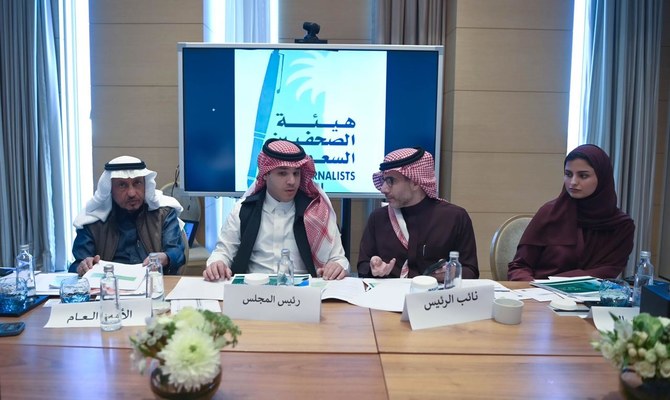
Saudi Journalists Association’s newly elected board adopts executive strategy

The board discussed forming a Riyadh-based club for journalists. (AN Photo)
Short Url
Updated 22 February 2024
Follow

Saudi Journalists Association’s newly elected board adopts executive strategy

  • New committee for press freedoms established
  • 100-day plan endorsed, several proposals to start immediately

RIYADH: The Saudi Journalists Association’s newly elected board approved on Wednesday an executive strategy which will see several new committees established and a number of proposals fast tracked over the next 100 days.

The move came during the board’s second meeting, led by Adhwan Al-Ahmari, the association’s chairman, which took place on the sidelines of the Saudi Media Forum, held at the Riyadh Hilton Hotel.
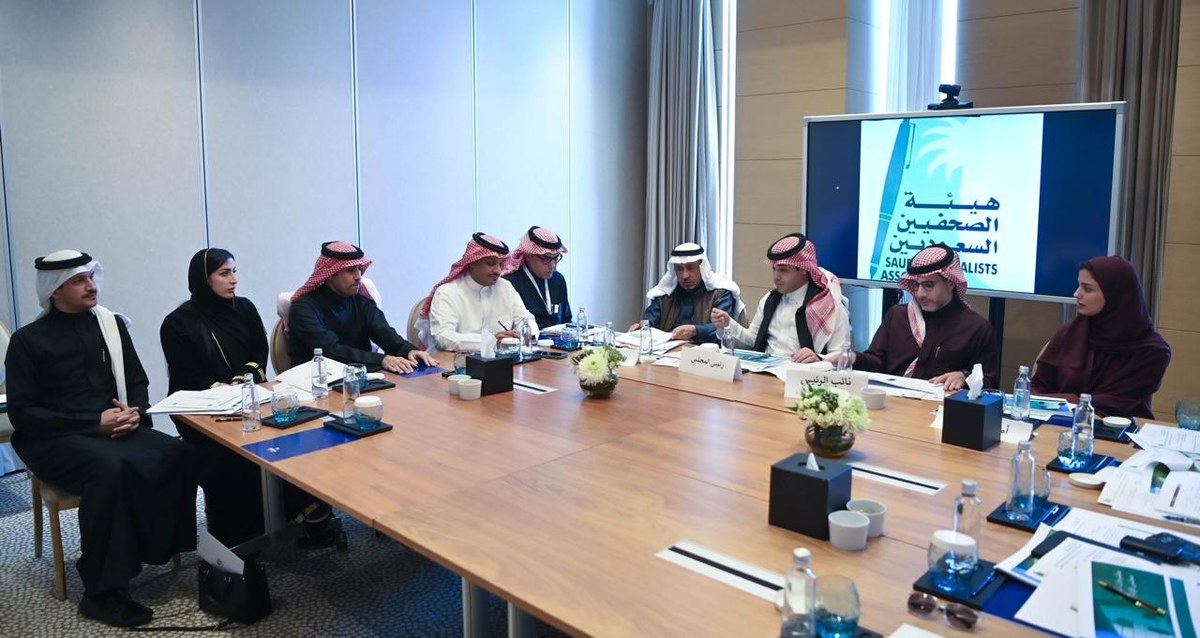
Newly established dedicated committees will oversee the implementation of the association’s approved plan. These include an Executive Committee, responsible for setting interim targets and addressing urgent issues, and the Review and Performance Committee, tasked with monitoring performance, assessing committee effectiveness, and ensuring target fulfillment.

The Press Freedoms Committee will establish frameworks, implement plans, and collaborate with international media organizations to safeguard press freedoms.

In order to provide the association with a more robust foundation for its operations, the board has also decided to form a Committee for Developing Financial Resources, which will explore methods to generate income and ensure sustainability.

The Members and Relations Committee will manage the members’ affairs, while the Training Committee is tasked with crafting short-term and long-term training programs, as well as fostering partnerships with local and international universities and training centers.

The Events Committee will create executive plans for the association’s events and will develop a standardized criteria for internal and external activities, while the Content Committee is responsible for establishing a comprehensive editorial policy for all postings, as well as overseeing and improving the association’s website.

The board of directors endorsed a 100-day plan for the implementation of all proposals. The plan will be revised during the board’s next meeting.

The meeting of the board also discussed forming a club for journalists, which will be headquartered in Riyadh and operated by the association.

The board examined legal protection for media workers who are members of the association, in line with its regulations.

The board members emphasized the significance of expanding membership to include media students and trainees, providing them with a special membership to learn from professional journalists.

The meeting also discussed securing funding sources and establishing governance for the association’s fund for supporting journalists.

Saudi Arabia ‘ideal partner’ in shaping next wave of intelligent age, communication minister tells WEF

Updated 23 January 2026
Follow

Saudi Arabia ‘ideal partner’ in shaping next wave of intelligent age, communication minister tells WEF

  • Abdullah Al-Swaha said aim was to “help the world achieve the next $100 trillion by energizing the intelligence age”

DAVOS: Saudi Arabia has accelerated efforts in “energizing the intelligent age,” making the Kingdom the world’s ideal partner in shaping the next wave of the technological age, said the minister of communication and information technology.

Speaking during a panel discussion at the World Economic Forum in Davos, Abdullah Al-Swaha said the aim was to “help the world achieve the next $100 trillion by energizing the intelligence age.”

He said the Kingdom was expanding global partnerships for the benefit of humanity and highlighted both local and international achievements.

“We believe the more prosperous the Kingdom, the Middle East, is, the more prosperous the world is. And it is not a surprise that we fuel 50 percent of the digital economy in the kingdom or the region,” he told the audience. He added the Kingdom fueled three times the tech force of its neighbors and, as a result, 50 percent of venture capital funding.

Al-Swaha said Saudi Arabia was focused both on artificial intelligence acceleration and adoption. At home, he said, the Kingdom was doubling the use of agentic AI in the public and private sector to increase worker productivity tenfold. He also cited the world’s first fully robotic heart transplant, which was conducted in Saudi Arabia.

“If we double down on talent, technology, and build trust with partners, we can achieve success,” he said. “And we are following the same blueprint for the intelligence age.”

He said the Kingdom aimed to be a “testbed” for innovators and investors. Rapid technological adoption and investment have boosted Saudi Arabia’s non-oil economy, with non-oil activities accounting for 56 percent of GDP and surpassing $1.2 trillion in 2025, ahead of the Vision 2030 target.

In terms of adoption, Al-Swaha said the Kingdom had introduced the Arabic-language AI model, Allam, to be adopted across Adobe product series. It has also partnered with Qualcomm to bring the first hybrid AI laptop and endpoints to the world.

“These are true testimonies that the kingdom is not going local or regional; we are going global,” he said.