How Saudi artists and calligraphers interpret the significance of Founding Day

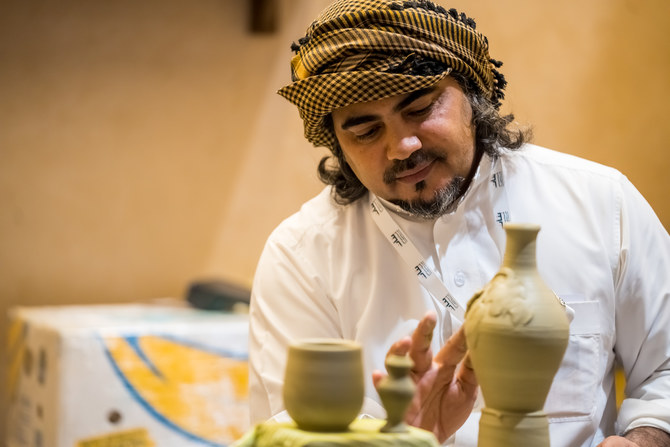
Many artists and creatives across the region have been working to preserve legacies. Above, a pottery artist demonstrating the intricacies of the craft at Handicrafts Week. (AN photo)
Short Url
Updated 21 February 2024
Follow

How Saudi artists and calligraphers interpret the significance of Founding Day

  • Vision, hard work and dedication of leaders praised at exhibition to commemorate the founding of the First Saudi State
  • Saudi artists welcome opportunity to reflect on the values and principles that guide the nation and unite its people

RIYADH: In 1727, the foundation stones of the First Saudi State were placed by Imam Mohammed ibn Saud. Centuries later, under the leadership of King Salman and Crown Prince Mohammed bin Salman, the Kingdom is currently undergoing the most significant cultural renaissance in the modern Arab world.

Founding Day was first officially observed in 2022 and has become a great source of pride for Saudi Arabia’s citizens. With the holiday just around the corner, Saudi Arabia’s creatives took time to acknowledge the importance of commemorating such a momentous day.

For Ghofran Alsaeed, an interior designer and CEO of architect and design studio GWDESIGN, the annual celebration is a time to reflect on Saudi Arabia’s establishment and its significance in history.

“It allows us to honor the sacrifices and contributions of the nation’s founders, celebrate progress and achievements of Saudi Arabia, and reaffirm our commitment to the country’s development and prosperity. It’s also an opportunity to reflect on the values and principles that guide the nation and unite its people,” she told Arab News.

Last year, Alsaeed celebrated by participating in community events, and spending time with her family making green rice and dressing in the national color. She plans to continue the tradition this year by attending official ceremonies and cultural events.

INNUMBER

* 1727 Foundation stones of First Saudi State laid by Imam Mohammed ibn Saud.

“As a Saudi, I feel immense pride and gratitude witnessing the growth and prosperity of the Kingdom since its establishment centuries ago. It’s a testament to the vision, hard work, and dedication of our leaders and people,” said Alsaeed.

“However, it also reminds us of our responsibility to continue contributing to the progress of our beloved country,” she added.

The Kingdom has been celebrating its traditions and heritage with events including Handicraft Week and annual date festivals throughout the country. Other events held are the equestrian Saudi Cup and national holidays including Flag Day on March 11 and Saudi National Day on Sept. 23.

Noha A. Raheem, a calligraphy artist and interior designer, believes these annual celebrations play a vital role in reminding citizens of their shared history.

“This fosters a sense of national pride, unity, and belonging, ultimately strengthening social cohesion and solidarity across the country,” she told Arab News.

As a creative, she feels immense pride in seeing the remarkable growth and prosperity achieved over the years on the economic and cultural fronts. This includes the Kingdom’s advancements in design, education, healthcare, infrastructure and technology, to becoming a global player in various industries.

“Commemorating founding day is important as it allows us to acknowledge and appreciate the struggles, sacrifices, and achievements,” she said.


Under the leadership of King Salman and Crown Prince Mohammed bin Salman, the Kingdom is currently undergoing the largest cultural renaissance in the modern Arab world. (AN photo)

The founding day has a special place in designer Amar Alamdar’s heart because of his familial contributions in the third Saudi state. He shared that his grandfather, Khalid Mustafa Alamdar, served in King Abdulaziz’s first Saudi Army due to his knowledge on artillery.

“Founding Day is to bring the people together to create a foundation — unite them. Any Arab or Muslim living there at the time became Saudi Arabian,” he said.

His grandfather made sure that all his children, Alamdar’s uncles, also served in the army, carrying on the legacy of their family.

Alamdar said he wants to encourage his peers to create artwork that incorporates Saudi Arabia’s historical roots. “What if they were celebrating this day at the time? What would our elders have done?”

Alamdar plans to put on an art exhibition in honor of the day that started it all, featuring 22 Saudi artists.
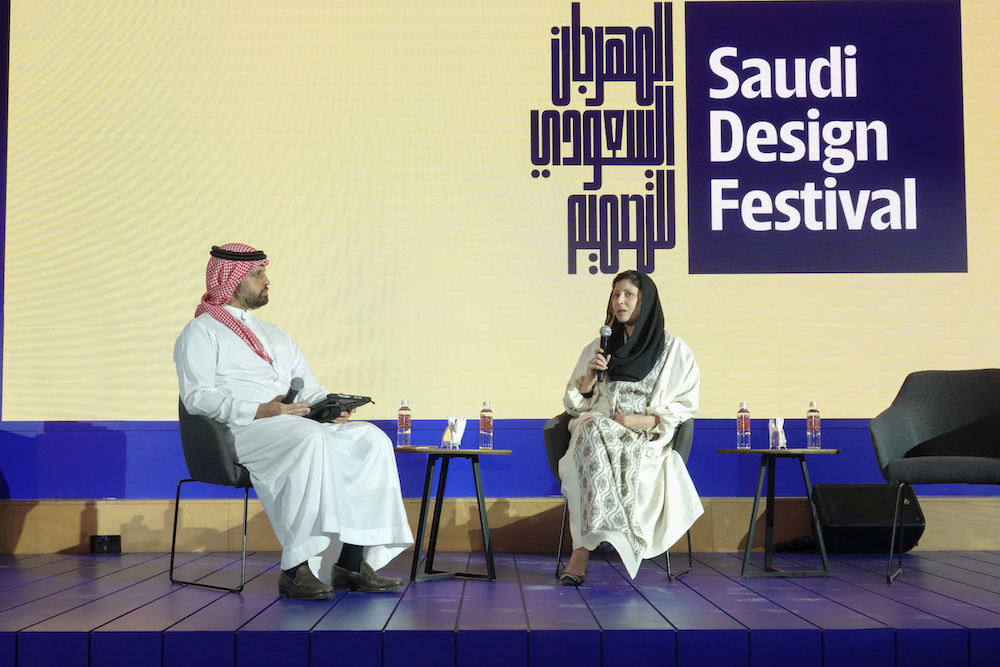


Entrepreneur and designer Princess Nourah AlFaisal highlights the efforts of her research-based design consulting firm Adhlal. (AN photo)

“We have an obligation to platform the country’s rich history that dates back to the 18th century. We have a unique opportunity to show our heritage and our unique history that was sometimes even doubted.”

“God bless the times that we are living in now under King Salman and the crown prince in our movement towards technology and adaptation to the future (which) is a phenomenon,” Alamdar said.

“We used to run, then speed up, and now we have to learn to fly. We need this technology to empower ourselves as much as we can,” he added.

In addition, Alamdar advised young people to open up their arms and embrace people of every nation.


National program identifies 165 native plants for afforestation efforts in Asir

Updated 29 December 2025
Follow

National program identifies 165 native plants for afforestation efforts in Asir

  • The survey is part of broader plans focused on restoring degraded land, using native vegetation 

JEDDAH: Saudi Arabia’s National Afforestation Program has identified more than 165 species of native plants suitable for afforestation in the Asir region, highlighting the ecological diversity of one of the Kingdom’s most environmentally varied areas, the Saudi Press Agency reported.

The findings form part of broader national efforts to expand vegetation cover, address land degradation, and support sustainability goals linked to the Saudi Green Initiative and Vision 2030.

According to the program, the identified species are distributed across a wide range of natural environments in Asir, including mountainous terrain, highlands, slopes, valleys, plains, rocky landscapes, and coastal areas stretching from the Red Sea to Tihama.

The species belong to numerous plant families, including Fabaceae, Anacardiaceae, Burseraceae, Capparaceae, Ebenaceae, Euphorbiaceae, Malvaceae, Myrtaceae, Oleaceae, and Primulaceae, among others.

Plants suitable for afforestation range from large and small trees to perennial and annual shrubs, herbs, succulents, bulbs, and climbing plants. 

Among the most notable species identified are the grey mangrove, mastic tree, mooring or ben tree, juniper, sycamore fig, wild olive, henna, wild jasmine, hawthorn, and arak.

The Saudi Arabian Botanical Society described the announcement as an important step in protecting plant diversity and strengthening the ecosystem conservation in the Kingdom. 

Munirah bin Hamad Al-Hazani, founder and president of the society, said that prioritizing native species is central to sustainable afforestation.

“Focusing on the cultivation of native plants adapted to diverse environments forms the cornerstone of sustainable afforestation projects, as it plays a pivotal role in enhancing vegetation cover, combating land degradation, and conserving natural and financial resources,” she told Arab News.

Al-Hazani added that long-term success depends on cooperation between government bodies and the nonprofit sector, alongside community involvement and environmental awareness programs.

The National Afforestation Program has increasingly emphasized community participation, working with government agencies, private companies, and nonprofit organizations to support planting initiatives and environmental education. Its approach includes promoting volunteerism and discouraging harmful environmental practices, while focusing on the use of native plants adapted to local conditions.

Parallel efforts are underway in other regions of the Kingdom to support vegetation restoration through research and infrastructure development. In Jouf, often referred to as the Kingdom’s food basket, the King Salman bin Abdulaziz Royal Reserve Development Authority has established a Central Nursery and a Wild Seeds Research and Production Station to address the growing demand for reliable sources of native seeds and seedlings.

The project was launched in 2023 under the directive of Prince Abdulaziz bin Saud bin Naif, the minister of interior and chairman of the authority’s board of directors. 

Since then, the facilities has become a key component of vegetation restoration efforts within the reserve.

The authority has focused on building operational capacity by recruiting and training specialists to manage cultivation and research activities. The research and production station includes 14 mother-seed production fields containing over 400,000 trees and shrubs. 

Planting began in late 2024, with more than 30 native plant species represented, selected for their role in the reserve’s natural ecosystem. 

The facility also includes two seed storage units with a combined capacity of 3,000 kilograms. Seeds are collected annually from multiple sites within the reserve and used for seedling production habitat rehabilitation.

The Central Nursery spans 6,000 square meters and includes 30 greenhouses spanning 1,500 square meters, as well as two shade houses used during summer months. A plant hardening facility, designed to prepare seedlings for natural environmental conditions, covers 10,000 square meters and is divided into seven sections. The nursery’s annual production capacity reaches 1.5 million seedlings, representing more than 15 native plant species. 

Together, these initiatives underscore the growing role of native plant research and propagation in Saudi Arabia’s afforestation strategy, particularly as the Kingdom works to balance environmental restoration with long-term sustainability goals.