

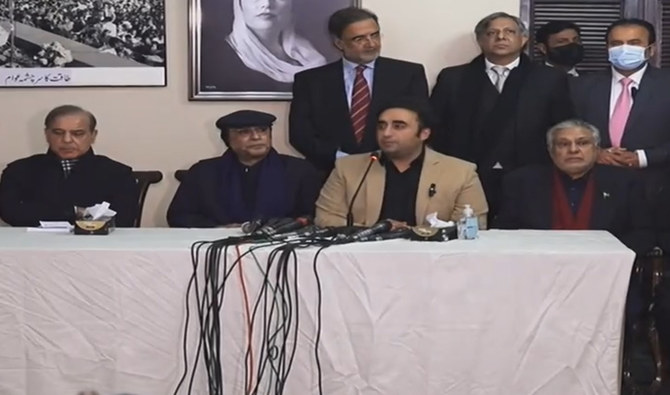

ISLAMABAD: Former foreign minister Bilawal Bhutto-Zardari announced on Tuesday that his Pakistan Peoples Party (PPP) had reached an agreement with three-time former prime minister Nawaz Sharif’s Pakistan Muslim League-Nawaz (PML-N) to form a coalition government after this month’s national election in Pakistan failed to present a clear winner.
The PML-N bagged 75 seats in the National Assembly, lower house of Pakistan parliament, while the PPP managed to grab 54 seats in the Feb. 8 national election, according to official results.
The agreement between the two major political parties is expected to end days of political uncertainty in the South Asian country that is facing an economic meltdown and security challenges.
Speaking at a press conference in Islamabad, Bhutto-Zardari confirmed that Shehbaz Sharif, the PML-N president and a former premier, would be their joint candidate for prime minister, and his father, Asif Ali Zardari, will be the candidate for president.
“The numbers of Pakistan Peoples Party and Muslim League-Nawaz have been completed and God willing, we will now act on government formation,” he said. “It is hoped that God willing, Shehbaz Sharif sahib will soon become the prime minister of the country once again.”
He said they all prayed for the success of the new government, which faces a daunting task of reviving the struggling $350 billion South Asian economy.
Pakistan is currently treading a tricky path to economic recovery under a caretaker government after it narrowly escaped a default in June last year, thanks to a last-gasp $3 billion International Monetary Fund (IMF) bailout.
However, the current IMF program expires next month and the new government will have to quickly secure another bailout to keep the economy afloat.
Speaking on the occasion, Shehbaz thanked the PPP for its support for the government formation.
“With the help of the PPP, we have the required numbers to form the government,” he said, promising to support Zardari in his bid for the presidency.
To a question, Shehbaz said decisions regarding appointments on different constitutional positions like the Senate chairman, speaker and provincial governors would be made after consultation.
In his brief comments, Zardari said they made the alliance for the sake of the country and its future generations.
“We reassure everyone our struggle is for Pakistan and future generations,” he said.
While the announcements are expected to end political uncertainty regarding the government formation, fears still loom large of some political instability in the future as independent candidates, most loyal to jailed former premier Imran Khan, have the highest 101 seats in the National Assembly, but they cannot form the government on their own, having run as individuals and not a party.
To form the government, a party or a coalition needs at least 169 members in the 336-member National Assembly to elect a prime minister.
To keep its chances of returning to power alive, Khan’s Pakistan Tehreek-e-Insaf (PTI) party this week said that independent candidates backed by it would join the minority Sunni Ittehad Council (SIC) party to secure reserved seats for women and minorities in Pakistan parliament, which are only allotted to political parties based on their representation in the assembly.
Since his ouster, Khan, who remains in jail on a slew of charges, has waged an unprecedented campaign of defiance against the country’s powerful military, which he blames for his removal in a parliamentary no-trust vote in April 2022. The ex-premier has lately refused to share power with Sharif’s PML-N and the Bhutto-Zardari-led PPP.
Speaking at the presser, Bhutto-Zardari said the Sunni Ittehad Council party would not have the required numbers in parliament to form the government. The assertion was echoed by PM’s candidate Shehbaz.
According to Pakistan’s constitution, a session of parliament has to be called by Feb. 29 after which a vote for the new prime minister will take place.


