Jordanian king meets Algerian assembly president

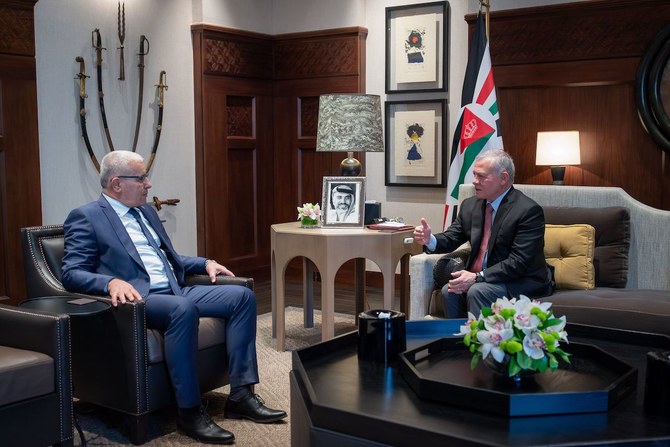
Jordan’s King Abdullah and Ibrahim Boughali, president of Algeria’s People’s National Assembly. (File/AFP)
Short Url
Updated 20 February 2024
Follow

Jordanian king meets Algerian assembly president

  • Jordanian monarch voiced his country’s backing for Algeria’s role as a non-permanent member of the UNSC

AMMAN: Jordan’s King Abdullah on Tuesday met Ibrahim Boughali, president of Algeria’s People’s National Assembly, in Amman, Jordan News Agency reported.

The meeting underscored the longstanding historical ties between the two countries, with King Abdullah expressing a desire to bolster cooperation in various sectors, particularly at the legislative level.

The Jordanian monarch voiced his country’s backing for Algeria’s role as a non-permanent member of the UN Security Council, emphasizing support for Arab initiatives, notably the Palestinian issue, and efforts to uphold global peace and security.

Additionally, King Abdullah praised Algeria’s endeavors to facilitate a ceasefire in Gaza and its provision of humanitarian assistance to the region. He also stressed the urgency of intensifying efforts to implement an immediate ceasefire, safeguard civilians and guarantee the delivery of humanitarian aid.

Boughali later met Abdullah Ensour, acting president of the Jordanian Senate, to discuss cooperation and regional developments.

The meeting touched on the significance of fostering Jordan-Algeria relations, highlighting King Abdullah’s visit to Algiers in 2022 as a crucial step in strengthening ties.

Ensour also commended Algeria for its advocacy for the Palestinian cause, its diplomatic efforts within the African Union, and its role in the recent African summit declaration in Addis Ababa, which called for a ceasefire in Gaza and compliance with the International Court of Justice’s decisions.

During the meeting, Ensour also demanded an independent international investigation into Israeli violations of international humanitarian law.


Israel police to deploy around Al-Aqsa for Ramadan, Palestinians report curbs

Updated 17 February 2026
Follow

Israel police to deploy around Al-Aqsa for Ramadan, Palestinians report curbs

  • The Al-Aqsa compound is a central symbol of Palestinian identity and also a frequent flashpoint

JERUSALEM: Israeli police said Monday that they would deploy in force around the Al-Aqsa Mosque during the Muslim holy month of Ramadan, which begins this week, as Palestinian officials accused Israel of imposing restrictions at the compound.
Over the course of the month of fasting and prayer, hundreds of thousands of Palestinians traditionally attend prayers at Al-Aqsa — Islam’s third-holiest site, located in east Jerusalem, which Israel captured in 1967 and later annexed.
Arad Braverman, a senior Jerusalem police officer, said forces would be deployed “day and night” across the compound, known to Jews as the Temple Mount, and in the surrounding area.
He said thousands of police would also be on duty for Friday prayers, which draw the largest crowds of Muslim worshippers.
Braverman said police had recommended issuing 10,000 permits for Palestinians from the occupied West Bank, who require special permission to enter Jerusalem.
He did not say whether age limits would apply, adding that the final number of people would be decided by the government.
The Palestinian Jerusalem Governorate said in a separate statement it had been informed that permits would again be restricted to men over 55 and women over 50, mirroring last year’s criteria.
It said Israeli authorities had blocked the Islamic Waqf — the Jordanian?run body administering the site — from carrying out routine preparations, including installing shade structures and setting up temporary medical clinics.
A Waqf source confirmed the restrictions and said 33 of its employees had been barred from entering the compound in the week before Ramadan.
The Al-Aqsa compound is a central symbol of Palestinian identity and also a frequent flashpoint.
Under long?standing arrangements, Jews may visit the compound — which they revere as the site of their second temple, destroyed by the Romans in 70 AD — but they are not permitted to pray there.
Israel says it is committed to maintaining this status quo, though Palestinians fear it is being eroded.
Braverman reiterated Monday that no changes were planned.
In recent years, a growing number of Jewish ultranationalists have challenged the prayer ban, including far?right politician Itamar Ben-Gvir, who prayed at the site while serving as national security minister in 2024 and 2025.