Indian farmers reject government offer and say they will carry on marching to New Delhi

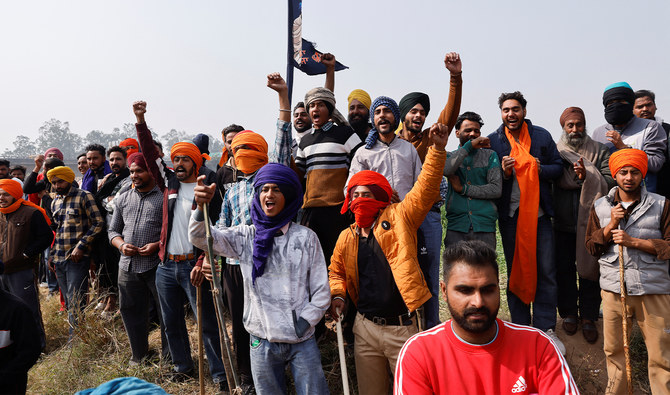
Farmers gesture at the police, at the protest site of farmers, who are marching towards New Delhi to press for the better crop prices promised to them in 2021, at Shambhu Barrier, a border crossing between Punjab and Haryana states, India, February 19, 2024. (REUTERS)
Short Url
Updated 20 February 2024
Follow

Indian farmers reject government offer and say they will carry on marching to New Delhi

  • Farmers began their march last week, but their efforts to reach the city have been blocked by authorities
  • Farmers have refused government’s offer of a five-year contract for guaranteed prices for a set of crops

NEW DELHI: Indian farmers who have been protesting for a week to demand guaranteed crop prices have rejected a proposal from the government, and say they will continue their march to the capital New Delhi.

The protesting farmers began their march last week, but their efforts to reach the city have been blocked by authorities, who have used tear gas and heavily barricaded entry points into the capital to avoid a repeat of 2021 farmer protests when they camped on the outskirts for over a year.

Late Monday night, farm leaders said they refused the government’s offer of a five-year contract for guaranteed prices for a set of crops, including pulses, maize and cotton.

The government’s proposal made Sunday was “not in the interest of farmers,” Jagjit Singh Dallewal, one of the leaders spearheading the protest, told the Press Trust of India news agency.

He added that the farmers — tens of thousands of whom have been camping out some 200 kilometers (120 miles) from the capital as they waited for the government offer — will resume their march to New Delhi on Wednesday.

“We appeal to the government to either resolve our issues or remove barricades and allow us to proceed to Delhi to protest peacefully,” Dallewal said.

The protests renewed a movement from over two years ago, in which tens of thousands of farmers hunkered down on the edges of New Delhi for over a year against agriculture laws which the government ended up repealing.

This time, the farmers who rode on tractors from neighboring Haryana and Punjab states say the government has failed to make progress on other key demands from the previous protests.

At the heart of the latest protests is a demand for legislation that would guarantee minimum support prices for all farm produce.

Currently, the government protects agricultural producers against any sharp fall in farm prices by setting a minimum purchase price for certain essential crops, a system that was introduced in the 1960s to help shore up food reserves and prevent shortages.

The farmers say a guaranteed minimum support price for their crops would stabilize their incomes. They are also pressing the government to follow through on promises to double their income, waive their loans and withdraw legal cases brought against them during the earlier 2021 protests.

Several meetings between farm leaders and the government have failed to end the deadlock. Piyush Goyal, one of the ministers negotiating with the farmers, told PTI that some of the demands of the farmers were “deep and policy-driven,” which made it more difficult to find a resolution.

The protests come at a crucial time for India, where national elections are expected in the coming months and Prime Minister Narendra Modi’s party is widely expected to secure a third successive term.

Farmers are particularly important to Modi’s base. Northern Haryana and a few other states with substantial farmer populations are ruled by his Bharatiya Janata Party.


Thousands in Kosovo march against war crimes trials on 18th anniversary of independence declaration

Updated 2 sec ago
Follow

Thousands in Kosovo march against war crimes trials on 18th anniversary of independence declaration

  • Protesters, many wrapped in red and black Albanian flags, braved cold and snowy weather in the capital, Pristina, to voice their opposition to the proceedings in The Hague
  • PM Albin Kurti added that ‘the KLA-led war was pure, liberation (struggle) and an anti-colonial war ... a just struggle of an occupied and oppressed people under apartheid’
PRISTINA, Kosovo: An air of defiance marked Kosovo’s independence celebrations on Tuesday as thousands of people joined a march in support of former fighters who are facing trial at a Netherlands-based court for alleged war crimes during a 1998-1999 separatist war from Serbia.
Protesters, many wrapped in red and black Albanian flags, braved cold and snowy weather in the capital, Pristina, to voice their opposition to the proceedings in The Hague against former president and rebel leader Hashim Thaci and three others accused of atrocities during and after the conflict that killed some 13,000 people.
Earlier on Tuesday, Kosovo’s security forces paraded in Pristina as part of the independence ceremonies, and Parliament held a special session.
The war started in 1998 when the rebel Kosovo Liberation Army launched its struggle for independence and Serbia responded with a brutal crackdown. The war ended after NATO bombed Serbia for 78 days in 1999, eventually forcing it to pull out its troops from the territory.
Serbia still does not recognize the 2008 declaration of independence of Kosovo and this has been a source of persistent tension in the volatile Balkan region. As both Kosovo and Serbia seek European Union membership, they have been told they must normalize ties before joining.
Prosecutors at the Kosovo Specialist Chambers in The Hague — which formally is part of Kosovo’s judicial system although seated abroad — have asked for a maximum 45-year prison sentence for Thaci and the other defendants. Thaci also faces a separate trial on charges of intimidating witnesses that will begin later this month.
Officials and protesters in Kosovo have criticized the proceedings as political and designed to strike a false balance with Serbia whose political and military leaders previously had been tried and convicted of war crimes in Kosovo by a separate UN court.
Protesters at Tuesday’s march held banners reading “History cannot be rewritten” and “Freedom for the liberators.” They arranged metal fences around a landmark independence monument and placed a sign reading ”Kosovo in Prison” on top of it.
President Vjosa Osmani said in a statement that “truth cannot be changed by attempts to rewrite history or to tarnish and devalue the struggle of Kosovo’s people for freedom.”
Prime Minister Albin Kurti added that “the KLA-led war was pure, liberation (struggle) and an anti-colonial war ... a just struggle of an occupied and oppressed people under apartheid.”
In Belgrade, a Serbian government liaison office for Kosovo described the independence declaration 18 years ago as a “flagrant violation of international law.” The statement alleged “systematic terror” and persecution against minority Serbs in Kosovo.
The United States and most EU countries are among more than 100 nations that have recognized Kosovo’s independence while Russia and China have backed Serbia’s claim on the territory.
Thaci resigned from office in 2020 to defend himself against the 10 charges of crimes against humanity and war crimes.
The court and an associated prosecutor’s office were created after a 2011 report by the Council of Europe, a human rights body, following allegations that KLA fighters trafficked human organs taken from prisoners and killed Serbs and fellow ethnic Albanians. The organ harvesting allegations haven’t been included in indictments issued by the court.