China says Philippines ‘stirs up trouble’ in South China Sea with joint air patrol
China says Philippines ‘stirs up trouble’ in South China Sea with joint air patrol/node/2463036/world
China says Philippines ‘stirs up trouble’ in South China Sea with joint air patrol
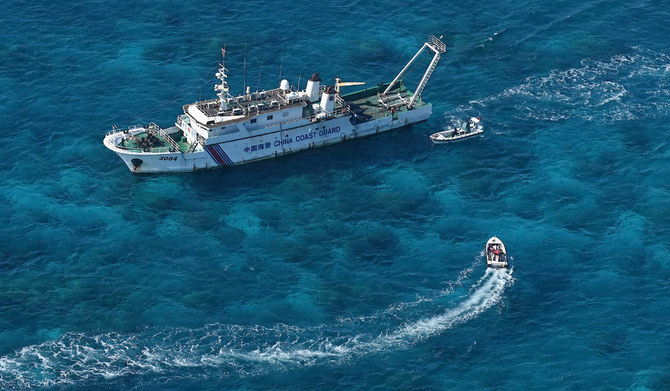
This photo taken on February 15, 2024, shows an aerial view of an China Coast Guard vessel (upper) and China Coast Guard personnel on a rubber boat at Scarborough Shoal in the disputed South China Sea. (AFP)
China says Philippines ‘stirs up trouble’ in South China Sea with joint air patrol
China’s Southern Theater Command said it organized front-line naval and air forces to closely monitor the Philippines’ joint air patrol
Updated 20 February 2024
Reuters
BEIJING: China’s military said the Philippines has “stirred up trouble” in the South China Sea by conducting a joint air patrol with “extraterritorial countries” and then openly hyping it up.
China’s Southern Theater Command said it organized front-line naval and air forces to closely monitor the Philippines’ joint air patrol on Monday, and that troops “maintained a high degree of vigilance to resolutely defend national sovereignty.”
Pakistan is latest Asian country to step up checks for deadly Nipah virus
Vietnam, Thailand, Singapore, Hong Kong, Malaysia and Indonesia have also tightened screening
Nipah has high mortality rate but not easily transmitted; there is also no vaccine for it
Updated 2 sec ago
Reuters
LAHORE/HANOI: Authorities in Pakistan have ordered enhanced screening of people entering the country for signs of infections of the deadly Nipah virus after India confirmed two cases, adding to the number of Asian countries stepping up controls. Thailand, Singapore, Hong Kong, Malaysia, Indonesia and Vietnam have also tightened screening at airports. The Nipah virus can cause fever and brain inflammation and has a high mortality rate. There is also no vaccine. But transmission from person to person is not easy and typically requires prolonged contact with an infected individual. “It has become imperative to strengthen preventative and surveillance measures at Pakistan’s borders,” the Border Health Services department said in a statement. “All travelers shall undergo thermal screening and clinical assessment at the Point of Entry,” which includes seaports, land borders and airports, the department added. The agency said travelers would need to provide transit history for the preceding 21-day period to check whether they had been through “Nipah-affected or high-risk regions.” There are no direct flights between Pakistan and India and travel between the two countries is extremely limited, particularly since their worst fighting in decades in May last year. In Hanoi, the Vietnamese capital’s health department on Wednesday also ordered the screening of incoming passengers at Noi Bai airport, particularly those arriving from India and the eastern state of West Bengal, where the two health workers were confirmed to have the virus in late December. Passengers will be checked with body temperature scanners to detect suspected cases. “This allows for timely isolation, epidemiological investigation,” the department said in a statement. That follows measures by authorities in Ho Chi Minh City, Vietnam’s largest city, who said they had tightened health controls at international border crossings. India’s health ministry said this week that authorities have identified and traced 196 contacts linked to the two cases with none showing symptoms and all testing negative for the virus. Nipah is a rare viral infection that spreads largely from infected animals, mainly fruit bats, to humans. It can be asymptomatic but it is often very dangerous, with a case fatality rate of 40 percent to 75 percent, depending on the local health care system’s capacity for detection and management, according to the World Health Organization. The virus was first identified just over 25 years ago during an outbreak among pig farmers in Malaysia and Singapore, although scientists believe it has circulated in flying foxes, or fruit bats, for thousands of years. The WHO classifies Nipah as a priority pathogen. India regularly reports sporadic infections, particularly in the southern state of Kerala, regarded as one of the world’s highest-risk regions for Nipah. As of December 2025, there have been 750 confirmed Nipah infections globally, with 415 deaths, according to the Coalition for Epidemic Preparedness Innovations, which is funding a vaccine trial to help stop Nipah.