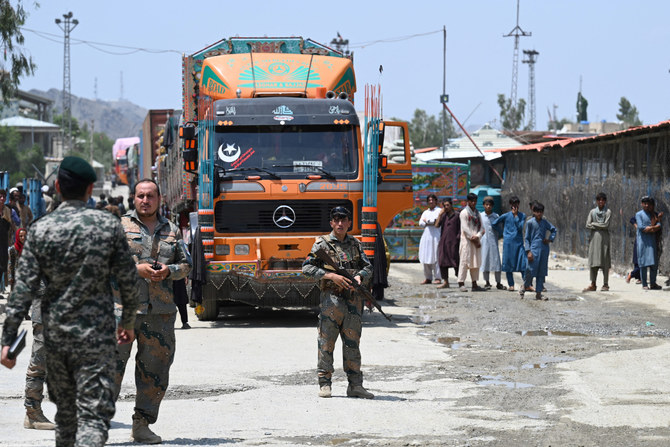

LONDON: Elite Afghan soldiers who served alongside coalition forces against the Taliban were rejected from relocating to the UK by British special forces personnel, the BBC reported on Monday.
Documents leaked to the national broadcaster reveal that despite compelling evidence of involvement in the anti-Taliban campaign — a prerequisite of the British relocation scheme — many Afghan commando applications were axed by UK special forces reviewers.
The former commandos were eligible to apply for relocation under the Afghan Relocation and Assistance Policy, but dozens have since been attacked or killed by the Taliban after being rejected.
The CF 333 and ATF 444 units, dubbed the “Triples,” fought alongside British special forces in some of the most dangerous campaigns of the war.
Their relocation applications appear to have been sent to their former colleagues in Britain for approval or rejection as part of a new standard operating procedure.
But the designated chain of command has been criticized over an apparent conflict of interest, with special forces units in the UK, including the SAS, long facing controversy over war crimes allegations.
The Afghan soldiers applying for relocation may have been able to add crucial eyewitness accounts of war crimes, threatening the reopening of an official investigation that was shut down in 2019.
One British former special forces officer said: “It’s a clear conflict of interest. At a time when certain actions by UK special forces are under investigation by a public inquiry, their headquarters also had the power to prevent former Afghan special forces colleagues and potential witnesses to these actions from getting safely to the UK.”
Armed Forces Minister James Heappey recently pledged to review about 2,000 Triples applications after discovering that the reasoning behind some rejections was “not robust.”
Internal emails from the UK’s Ministry of Defence demonstrate the power of special forces reviewers to make or break relocation applications.
In some cases, civil servants tried to challenge rejections made by the special forces but were rebuffed.
Former Triples members told the BBC from Afghanistan that they now face significant danger and are unable to stay with their families or work.
One was beaten and interrogated by Taliban authorities before going on the run. He said: “I’m living in a very bad situation. I am in hiding and mostly my family can’t live together and we cannot go out and we cannot work.
“I was sure that my British colleagues and friends, who we worked for several years alongside, would help me to evacuate to safety.
“Now I feel that the sacrifices I made have been forgotten. I feel I have been left alone in the midst of hell.”
In another case, a former Triples member, at the time of the group’s joint operations with the SAS, complained to British military authorities over alleged war crimes perpetrated by his Western colleagues.
Pending an investigation, he forbade his men from taking part in supporting operations for SAS missions, alleging that extrajudicial killings of Afghan civilians were taking place.
An MoD spokesperson said: “We are conducting an independent, case-by-case review of all applications from former members of Afghan specialist units, which includes applications from the Triples.
“This review will consider all available evidence, including that provided by third parties. The review is being carried out by independent staff who have not previously worked on these applications.”