

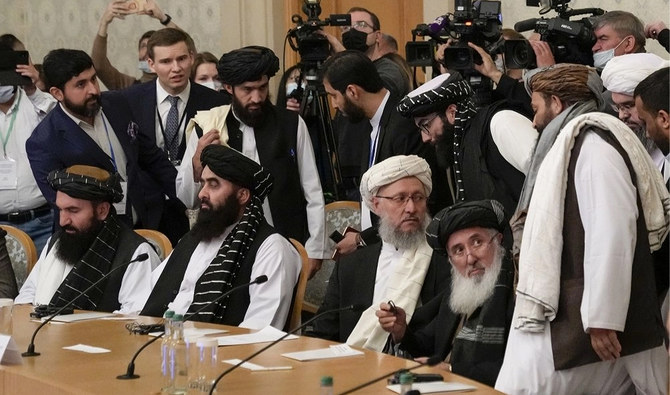

DOHA: National and regional special envoys to Afghanistan convened in Doha Sunday in the second UN meeting of its kind in less than a year, though it remained unclear whether Taliban authorities would join the closed-session event.
The two-day meeting, hosted by the UN secretary-general, was due to discuss increasing engagement with Afghanistan and a more coordinated response to the Central Asian nation.
In the aftermath of the Taliban’s return to power in Afghanistan in 2021, the international community has wrestled with its approach to the country’s new rulers.
At the close of the conference’s first day in gas-rich Qatar, which hosted the Taliban during years of peace talks with the United States, the Kabul government’s participation remained unclear.
A list shared by the UN detailed participants including the US, China, Pakistan and the European Union but did not include the Taliban authorities.
The UN also detailed that Afghan civil society participants, including women, were taking part in the meeting but did not categorically say the Taliban had refused to attend.
A senior diplomatic source told AFP ahead of the meeting the Taliban government had said it would only attend as sole representative of Afghanistan at the convention — excluding civil society representatives.
A second demand was that the Taliban government delegation meet with the UN secretary-general and be given an opportunity to present its position, the source said on condition of anonymity because of the sensitivity of discussions.
Though the Afghan foreign ministry did not immediately respond to requests for comment on plans to attend, the secretary-general of the Norwegian Refugee Council wrote on X, formerly Twitter, it was “disappointing that the Taliban declined to attend the special envoy meeting.”
“We urge all sides to do more to hammer out deals that can benefit the long suffering Afghan people,” Jan Egeland said.
The UN had extended an invitation to the Taliban authorities to participate, following their exclusion from the first meeting in May.
On Saturday Taliban authorities said they had reiterated their conditions to the United Nations, emphasising that their participation in the UN-convened talks would be “unbeneficial” if those conditions were not met.
The Taliban’s government in Kabul has not been officially recognized by any other government since it took power and the administration has imposed a strict interpretation of Islam, with women subjected to laws characterised by the UN as “gender apartheid.”
Many governments, international organizations and aid agencies cut off or severely scaled back their funding for Afghanistan in response — causing a serious knock to the already struggling economy.
The meeting in Qatar will also consider the recommendations of a UN independent assessment on Afghanistan, which has suggested recognition of the Taliban authorities be tied to the removal of restraints on women’s rights and access to education.
The assessment, backed by Western nations, also recommends the appointment of a UN special envoy, which the Taliban government has also rejected.
UN special rapporteur on human rights in Afghanistan Richard Bennett said he hoped the meeting in Doha “leads to a series of meaningful and inclusive meetings among key stakeholders” that would “prioritize discussions about human rights, particularly women’s rights.”
Ahead of the gathering in Doha, Tomas Niklasson, EU special envoy for Afghanistan, said the meeting offered a “significant opportunity... to hold meaningful discussions” and “engage on a way forward... in a UN-led process.”
The UN’s Working Group on Women, Peace and Security said the meeting in Doha “offers an important opportunity for the UN, the Security Council and the international community to reaffirm that the rights of Afghan women are not negotiable.”
“Respect for women’s rights must be a core objective of the international community’s engagement on Afghanistan, and a priority agenda item for discussions in Doha,” it added in a statement.


