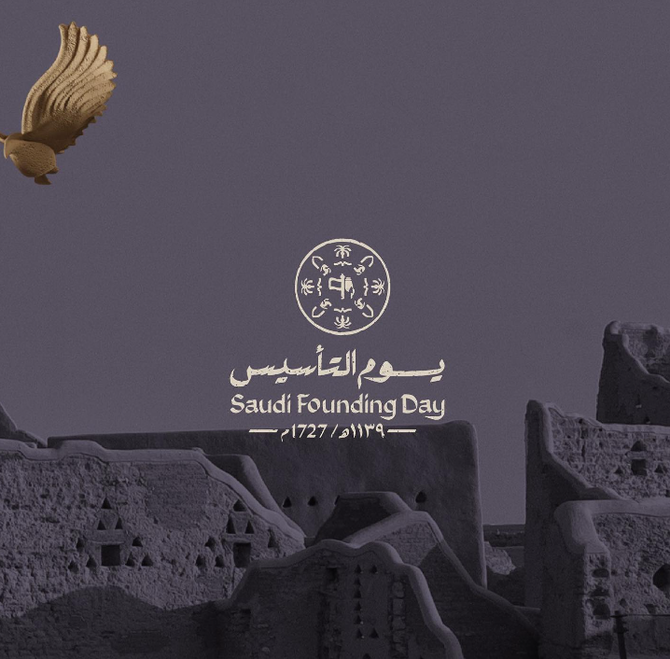
JEDDAH: Saudi Arabia’s Ministry of Culture is set to host cultural and historical celebrations across the country from Feb. 21 to 26 in honor of Founding Day, observed annually on Feb. 22, to mark the state’s foundation by Imam Mohammed bin Saud in 1727 CE.
Spanning various cities across the Kingdom, the ministry’s curated events will present a diverse cultural feast, with “Founding Nights” billed as a main attraction.
Scheduled for Feb. 21 and 22 at the Abu Bakr Salem Stage in Boulevard City, Riyadh, this event promises a “nostalgic voyage through time with an evening of poetry and music.”
Attendees will be treated to poetry and melodies performed by esteemed poets and artists, bringing to light important facets of Saudi heritage.
Another event, “Symphony of the Beginning,” will take place on Feb. 25 and 26 at the same venue. It features an orchestral performance that melds traditional Saudi instruments with contemporary ones, and tells the tale of the nation’s founding through music. Prominent Saudi poets, composers, and the National Music Band will be performing.
The “Path of History” experience at King Abdullah Financial District in Riyadh invites visitors to make their way through “an engaging display” of 19 scenes that chronicle the Saudi state’s evolution from its inception in 1727 to the present day. It consists of three distinct zones — The Gathering, The Journey, and The Celebration — each of which is designed to immerse visitors in the Kingdom’s history through cultural performances, art displays, and interactive installations.
Meanwhile, the “Founding Village,” which will be held in 14 locations from Feb. 22 to 24, aims to “resurrect the Kingdom’s historical narratives through immersive experiences that spotlight the country’s cultural legacy.”
This event will take visitors on a journey through 300 years of history, and includes traditional crafts, cultural stories, interactive children’s areas, digital innovations, family entertainment, authentic Saudi culinary delights and other cultural activities across various domains, including heritage and oral traditions.
These celebratory events underscore the Ministry of Culture’s dedication to commemorating a pivotal moment in Saudi history — the establishment of the Saudi state, and celebrating “the deep-rooted pride in national heritage, the solid bond between the citizenry and leadership, and the enduring legacy of progress and prosperity,” according to a ministry statement.
For tickets, visit: https://dc.moc.gov.sa/home/ar/founding-day/

Culture Ministry hosts Foundation Day celebrations across Saudi Arabia
https://arab.news/w2zf6
Culture Ministry hosts Foundation Day celebrations across Saudi Arabia
- ‘Founding Village’ event to showcase Kingdom’s cultural legacy
- Attendees will be treated to poetry and melodies performed by esteemed poets and artists, bringing to light important facets of Saudi heritage
Capturing the Kingdom a frame at a time
- Photographer and publisher Mohamed Babelli has spent a lifetime documenting Saudi Arabia’s landscapes
RIYADH: Long before Saudi Arabia’s cultural and archeological treasures were known to the world, Mohamed Babelli had already developed an instinct for uncovering its archaeological gems.
Consultant engineer by profession and photographer by passion, Babelli’s journey into visual documentation began at an early age and evolved into a publishing project.
“I received my first camera as a gift from my father before a summer trip to Cyprus in 1978. Since then, photography was associated with travel,” Babelli told Arab News.
That early exposure shaped a lifelong habit of seeing places through a photographer’s lens. In the early 1990s, Babelli began exploring the outskirts of Riyadh with colleagues from around the world, documenting landscapes rarely photographed at the time.
His interest deepened in the mid-1990s when he collaborated with an Australian photographer on books focused on Saudi Arabia’s natural environment.
“I returned from that trip with some good photographs and a decision to work on a book about Mada’in Saleh, AlUla and the Hejaz Railway,” Babelli said.
HIGHLIGHTS
• Mohammed Babelli’s work led to the founding of Desert Publisher in Riyadh in 2008, a publishing house specializing in high-quality visual publications about the Kingdom.
• ‘Antiquity of Saudi Arabia’ began in 2009 and took 15 years to complete, with support from the Cultural Development Fund enabling its final stages.
It took five years to complete “Mada’in Saleh,” which was published in English in 2003, with text researched and written by his brother, Ibrahim Babelli. The book was among the first visual works to document Hegra, AlUla and the historic railway in a single volume.
His work led to the founding of Desert Publisher in Riyadh in 2008, a publishing house specializing in high-quality visual publications about the Kingdom.
Babelli said the name reflected the publisher’s strong connection to the desert and Saudi heritage, a theme evident in both the design and content of its books. The name is also inspired by a transformative expedition earlier that year across the Empty Quarter.
“The expedition had a great impression on me,” said Babelli.
“Saudi Arabia,” published in 2007, is a visually rich volume that takes readers on a journey across the Kingdom, covering cities, traditions, architecture, people, heritage, religion, archaeology, nature and daily life.
What set the book apart was its multilingual format. From its first edition, it was published in four languages — English, French, German and Spanish — in order to reach an international audience.
“Since a young age, I had the opportunity to travel to different countries, east and west,” said Babelli. “In Europe, and in Germany in particular, I found cultural books include at least three languages.
“My goal was to provide the viewer or reader with a beautiful picture of Saudi Arabia, along with correct information in their language, so that they can enjoy and learn about (it),” he added.
Over time, his books expanded to feature nine languages, including Arabic, English, French, German, Spanish, Russian, Chinese, Japanese and Korean. This made them a natural choice for Saudi embassies, international conferences and major global events, including conferences in Senegal and Spain, as well as Expo Shanghai in China.
In 2019, the Saudi Ministry of Foreign Affairs selected several of the publisher’s titles for distribution to the Kingdom’s diplomatic missions worldwide to mark Saudi National Day.
Having witnessed every major phase of photography, Babelli’s work reflects both technical evolution and artistic discipline.
“Photography evolved greatly since I started taking photos,” he said. “I remember I started with negative films. My first use of positive films was not successful; I came back with a film I could not develop from a visit to the Alhambra Palace in Spain in 1983.”
From manual film cameras to slide photography, medium format systems and eventually digital platforms, Babelli adapted.
“When digital cameras came into the market, I immediately started using the best of the line available,” he said. “I never went back to film.”
Despite advances in technology, Babelli remains firm in his belief that equipment alone does not define success.
“What is important is the eye of the photographer,” he said, advising young photographers to start with what they could afford and upgrade as their knowledge expands.
To date, Babelli’s most ambitious project to date is “Antiquity of Saudi Arabia.” The project began in 2009 and took 15 years to complete, with support from the Cultural Development Fund enabling its final stages.
The book, which presents Saudi Arabia’s archeological heritage in a structured chronological sequence, was published in September 2025 and unveiled at the Riyadh International Book Fair.
The 384-page volume documents antiquities from across the Kingdom, from the Stone Age and early human presence on the Arabian Peninsula to the unification of Saudi Arabia in the 1950s.
It was developed with the contribution of leading academics and archeology specialists, including university professors and former museum directors, some of whom remain actively involved in excavation work. This ensured the accuracy of the material and the correct contextual linking of images to their original archaeological sites.
“We started with the arrival of the ancient human into the Arabian Peninsula over 1.3 million years ago,” Babelli said. “The book covers the Stone Age, ancient civilizations, ancient Arab kingdoms, the Islamic era and the Saudi state.”
The volume combines art and visual storytelling with texts written by specialists and links to academic references, with photographs carefully selected from Babelli’s extensive archive.
“I took all opportunities to photograph as many objects as I was able to,” he said. “Selection of the photos was done jointly with Dr Awad Al-Zahrani and Abdulaziz Al-Omari to ensure the best representation of the subject.”
While most of Babelli’s work centers on Saudi heritage, one publication stands apart — a book dedicated to Al-Aqsa Mosque in Palestine. Published in 2017, it evolved through collaborations with international scholars and photographers.
Seeing his books reach global audiences and feature at official events remains deeply meaningful: “It is the ultimate success,” he said.
Babelli believes documenting places and history through photography is both a responsibility, legacy and faith, yet his guiding philosophy remains unchanged: “Do the best work you can to the highest quality level,” he said, quoting a verse from the Qur’an: “And say: ‘Work (righteousness): Soon will Allah observe your work, and (so will) His Messenger, and the Believers’.”


