Britain says it will take action over Navalny death

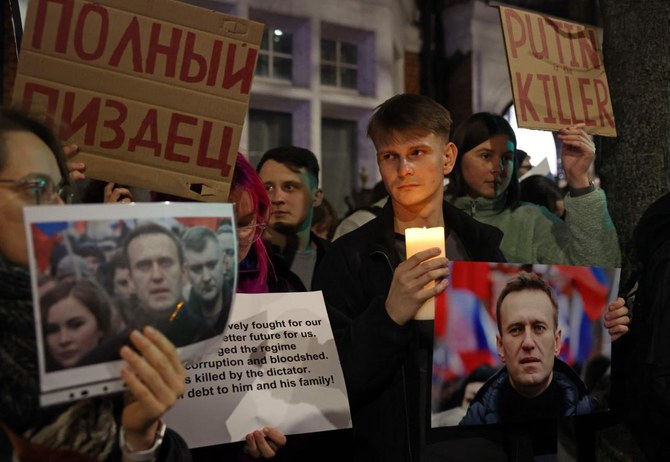
People hold up photographs of Russian opposition leader Alexei Navalny at a gathering outside the Russian Embassy in London on Feb. 16, 2024, following the news of his death. (AFP)
Short Url
Updated 17 February 2024
Follow

Britain says it will take action over Navalny death

  • “There should be consequences when appalling human rights outrages like this take place,” Cameron told Sky News
  • Western leaders and officials have expressed outrage over the death of Navalny

LONDON: Britain will take action over the death in prison of Russian opposition leader Alexei Navalny and it is calling on other countries to do likewise, British foreign minister David Cameron said on Saturday.
“There should be consequences when appalling human rights outrages like this take place,” Cameron told Sky News.
“What we do is we look at whether there are individual people that are responsible and whether there are individual actions that we can take.”
Russia’s prison service said that Navalny, 47, fell unconscious and died on Friday after a walk at the Arctic penal colony where he was detained. Navalny’s spokeswoman Kira Yarmysh on Saturday confirmed his death, citing an official notice given to his mother, Lydumila.
Western leaders and officials have expressed outrage over the death of Navalny, the most prominent critic of Russian President Vladimir Putin. Kremlin spokesman Dmitry Peskov called the reaction unacceptable on Friday.
Russia said on Saturday that it was unacceptable for Britain to interfere in its internal affairs after London told a top embassy official that it held Russian authorities responsible for Navalny’s death.
Russia said a diplomat from the embassy had been “invited” to a conversation at the Foreign Office.
The British government said on Friday it was summoning an official from the Russian embassy to make clear it held Russian authorities “fully responsible” for the death.
Cameron declined to give details about possible action and said he would raise the issue with his counterparts from Group of Seven countries and other nations at an annual meeting of defense and diplomatic officials taking place in Munich.
“We will have the discussions with them. I am clear we will be taking action and I would urge others to do the same,” he said.


Kosovo, Serbia ‘need to normalize’ relations

Updated 5 sec ago
Follow

Kosovo, Serbia ‘need to normalize’ relations

  • Kosovo, which hopes to join NATO, has also been cultivating relations with Washington in recent months, by removing tariffs on American products

PRISTINA: Kosovo and Serbia need to “normalize” their relations, Kosovo’s Prime Minister Albin Kurti said, several days before legislative elections where he is seeking to extend his term with more solid backing.

Kurti has been in office since 2021 and previous accords signed with Serbia — which does not recognize the independence of its former province — have yet to be respected.

“We need to normalize relations with Serbia,” said Kurti. “But normalizing relations with a neighboring authoritarian regime that doesn’t recognize you, that also doesn’t admit to the crimes committed during the war, is quite difficult,” he added.

Tensions between the two neighbors are regularly high.

“We do have a normalization agreement,” Kurti said, referring to the agreement signed under the auspices of the EU in 2023.

“We must implement it, which implies mutual recognition between the countries, at least de facto recognition.”

But to resume dialogue, Serbia “must hand over Milan Radoicic,” a Serb accused of plotting an attack in northern Kosovo in 2023, Kurti asserted, hoping that “the EU, France, and Germany will put pressure” on Belgrade to do so.

Kosovo, which hopes to join NATO, has also been cultivating relations with Washington in recent months, by removing tariffs on American products and agreeing to accept up to 50 migrants from third countries extradited by the US. So far, only one has arrived.

“We are not asking for any financial assistance in return,” Kurti emphasized. “We are doing this to help the US, which is a partner, an ally, a friend,” added the prime minister, who did not rule out making similar agreements with European countries.

Unable to secure enough seats in the February 2025 parliamentary elections, Kurti was forced to call early elections on Sunday, after 10 months of political deadlock during which the divided parliament failed to form a coalition.

“We need a decisive victory. In February, we won 42.3 percent, and this time we want to exceed 50 percent,” he said.