

Palestinian spillover into Sinai would be ‘disaster’

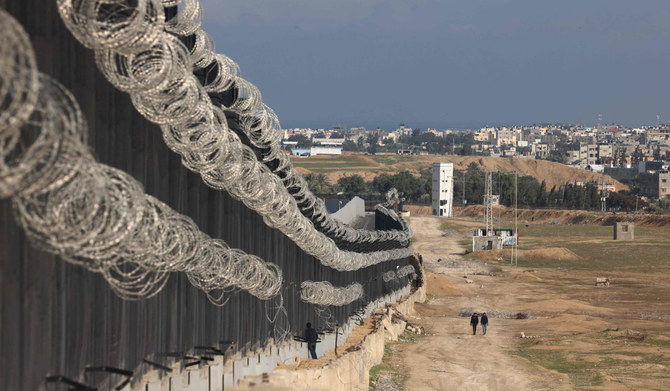
Displaced Palestinians walk next to the border fence between Gaza and Egypt in Rafah, southern Gaza Strip. (AFP)
Short Url
Updated 17 February 2024
Follow

Palestinian spillover into Sinai would be ‘disaster’

  • Exodus could be ‘nail in the coffin’

MUNICH, GENEVA: The UN’s High Commissioner for Refugees said on Friday that a spillover of refugees from Gaza’s Rafah into Egypt’s Sinai would be a disaster and that Egyptian authorities had made clear that Palestinians should be assisted in the enclave.

“It would be a disaster for the Palestinians ... a disaster for Egypt and a disaster for the future of peace,” Filippo Grandi said on the sidelines of the Munich Security Conference, an annual gathering in the southern German city.
When asked whether Egyptian authorities had contacted the UNHCR about possible contingency plans he said: “The Egyptians said that people should be assisted inside Gaza and we are working on that.”
An exodus of Gazans into Egypt must be “avoided at all costs,” and could be the “nail in the coffin” of a future peace process, he said.

Like many observers, the UN high commissioner for refugees believes that once Palestinians leave Gaza they will no longer be able to return — as happened in 1948 — something which would ruin the possibility of a two-state solution between Israel and the Palestinians.

Filippo Grandi, The UN High Commissioner for Refugees

Nearly 1.5 million displaced Palestinians — more than half of Gaza’s population — are trapped in Rafah, seeking shelter in a sprawling makeshift encampment near the Egyptian border.
“The position of Egypt has been very clear. People should not go across the border. I think Egypt has very valid reasons,” Grandi told BBC television from Munich.
“It would be catastrophic for Palestinians ... to be displaced again.
“It would be catastrophic for Egypt from all points of view, and more important than anything else, a further refugee crisis would be almost the nail in the coffin of a future peace process already.”
Like many observers, the UN high commissioner for refugees believes that once Palestinians leave Gaza they will no longer be able to return — as happened in 1948 — something which would ruin the possibility of a two-state solution between Israel and the Palestinians.
The war accompanying the creation of Israel in 1948 saw 760,000 Palestinians flee or forced from their homes. Millions of their descendants continue to live as refugees in neighboring countries.
“The old 1948 refugee crisis is an unresolved problem; if you add a dimension to that, you can say goodbye to a meaningful peace process,” said Grandi.
Pressure has grown on Egypt to open its border to Palestinian civilians, as Israel plans to push ahead with a military operation in Rafah, seeking complete victory over the Hamas militant group.
Grandi said his Geneva-based UNHCR agency was not involved in any preparations that Egypt might be making if people cross the border.
But in any case, a Gazan refugee surge into Egypt “needs to be avoided and it can only be avoided if humanitarian aid can enter Gaza in significant quantities — but more important, if hostilities cease,” he said.
Grandi said the plight of displaced people in Gaza’s Rafah city was “absolutely dramatic.”
“So I hope that the appeals by the entire international community for a ceasefire and access of humanitarian aid and the liberation of hostages are heeded by the parties; by Israel, by Hamas.”
Egypt has repeatedly raised the alarm over the possibility that Israel’s devastating Gaza offensive could displace Palestinians into Sinai — something Cairo says would be completely unacceptable — echoing warnings from Arab states such as Jordan.
The US has repeatedly said it would oppose any displacement of Palestinians out of Gaza.
A source told Reuters that Egypt was optimistic talks to clinch a ceasefire can avoid any such scenario, but is establishing the area at the border as a temporary and precautionary measure.
Three security sources said Egypt had begun preparing a desert area with some basic facilities which could be used to shelter Palestinians, emphasizing this was a contingency step.
The sources preferred anonymity because of the sensitivity of the matter.
Israel has said it will mount an offensive to take out Hamas’s “last bastion” in Rafah, where well over 1 million Palestinians have sought sanctuary from its devastating Gaza offensive.
Israel has said its army is drawing up a plan to evacuate civilians from Rafah to other parts of the Gaza Strip.
But UN aid chief Martin Griffiths said on Thursday it was an “illusion” to think people in Gaza could evacuate to a safe place and warned of the possibility of Palestinians spilling into Egypt if Israel launches a military operation in Rafah. He called this scenario “a sort of Egyptian nightmare.”
The first source said construction of the camp began three or four days ago and it would offer temporary shelter in any scenario of people crossing the frontier “until a resolution is reached.”


West Bank Bedouin community driven out by Israeli settler violence

Updated 4 sec ago
Follow

West Bank Bedouin community driven out by Israeli settler violence

  • With heavy hearts, Bedouins in a West Bank village dismantle their sheep pens and load belongings onto trucks, forced from their homes in the Israeli-occupied territory by rising settler violence
Ras ‘Ein al ‘Auja, Palestinian Territories: With heavy hearts, Bedouins in a West Bank village dismantle their sheep pens and load belongings onto trucks, forced from their homes in the Israeli-occupied territory by rising settler violence.
While attacks by Israeli settlers affect communities across the West Bank, the semi-nomadic Bedouins are among the territory’s most vulnerable, saying they suffer from forced displacement due in large part to a lack of law enforcement.
“What is happening today is the complete collapse of the community as a result of the settlers’ continuous and repeated attacks, day and night, for the past two years,” Farhan Jahaleen, a Bedouin in the village of Ras Ein Al-Auja, told AFP.
Since Israel took control of the West Bank in 1967, Israeli outposts have steadily expanded, with more than 500,000 settlers now living in the territory, which is also home to three million Palestinians.
A minority of settlers engage in violence toward the locals aimed at coercing them to leave, with the UN recording an unprecedented 260 attacks in October last year.
The threat of displacement has long hung over Jahaleen’s community, but the pressure has multiplied in recent months as about half of the hamlet’s 130 families decided to flee.
Among them, 20 families from the local Ka’abneh clan left last week, he said, while around another 50 families have been dismantling their homes.
’We can’t do anything’
The trailers of settlers dot the landscape around the village but are gradually being replaced by houses with permanent foundations, some built just 100 meters (300 feet) from Bedouin homes.
In May last year, settlers diverted water from the village’s most precious resource — the spring after which it is named.
Nestled between rocky hills to the west and the flat Jordan Valley that climbs up the Jordanian plateau to the east, the spring had allowed the community to remain self-sufficient.
But Bedouin families have been driven away by the constant need to stand guard to avoid settlers cutting the power supply and irrigation pipes, or bringing their herds to graze near Bedouin houses.
“If you defend your home, the (Israeli) police or army will come and arrest you. We can’t do anything,” lamented Naif Zayed, another local.
“There is no specific place for people to go; people are acting on their own, to each their own.”
Most Palestinian Bedouins are herders, which leaves them particularly exposed to violence when Israeli settlers bring their own herds that compete for grazing land in isolated rural areas.
It is a strategy that settlement watchdog organizations have called “pastoral colonialism.”
Israel’s military chief Lt. Gen. Eyal Zamir said in November that he wanted to put a stop to the violence. This month the army announced new monitoring technology to enforce movement restrictions on both Israelis and Palestinians, with Israeli media reporting the move was largely aimed at reining in settler attacks.
Asked for comment, the Israeli military said: “Incidents in the Ras Al-Ain are well known. (Israeli military) forces enter the area in accordance with calls and operational needs, aiming to prevent friction between populations and to maintain order and security in the area.”
It said it had increased its presence in the area “due to the many recent friction incidents.”
’Bedouin way of life’
Naaman Ehrizat, another herder from Ras Ein Al-Auja, told AFP he had already moved his sheep to the southern West Bank city of Hebron ahead of his relocation.
But Jahaleen said moving to other rural parts of the territory risks exposing the herders to yet more displacement in the future.
He pointed to other families pushed out of the nearby village of Jiftlik, who were again displaced after moving to a village in the Jordan Valley.
Slogans spray-painted in Arabic have appeared along major roads in the West Bank in recent months that read: “No future in Palestine.”
For Jahaleen, whose family has lived in Ras Ein Al-Auja since 1991, the message sums up his feelings.
“The settlers completely destroyed the Bedouin way of life, obliterated the culture and identity, and used every method to change the Bedouin way of life in general, with the complete destruction of life,” he said.