NEW YORK: Donald Trump must pay $354.9 million in penalties for fraudulently overstating his net worth to dupe lenders, a New York judge ruled on Friday, handing the former US president another legal setback in a civil case that imperils his real estate empire.
Justice Arthur Engoron also banned Trump from serving as an officer or director of any New York corporation for three years.
Engoron canceled his prior ruling from September ordering the “dissolution” of companies that control pillars of Trump’s real estate empire, saying on Friday that this was no longer necessary because he is appointing an independent monitor and compliance director to oversee Trump’s businesses
The lawsuit brought by New York Attorney General Letitia James accused Trump and his family businesses of overstating his net worth by as much $3.6 billion a year over a decade to fool bankers into giving him better loan terms.
Trump has denied wrongdoing and called the case a political vendetta by James, an elected Democrat. Trump is expected to appeal Friday’s ruling by Engoron.
The civil fraud case could deal a major blow to Trump’s real estate empire as the businessman turned politician leads the race for the Republican nomination to challenge Democratic President Joe Biden in the Nov. 5 US election.
Engoron had previously ruled in September that Trump had engaged in fraud and ordered his business empire be partially dissolved.
Friday’s ruling came after a contentious three-month trial in Manhattan.
During defiant and meandering testimony in November, Trump conceded that some of his property values were inaccurate but insisted banks were obligated to do their own due diligence.
He used his occasional court appearances as impromptu campaign stops, delivering incendiary remarks to reporters and insisting his enemies are using the courts to prevent him from retaking the White House.
Trump is cruising to the Republican nomination despite a host of other legal troubles.
He is under indictment in four criminal cases, including one in New York related to hush money payments he made to a porn star ahead of the 2016 election. The judge overseeing that case on Thursday set a March 25 trial date over the objections of Trump’s lawyers, who sought to delay it due to Trump’s crowded legal and political schedule.
Trump has also been charged in Florida for his handling of classified documents upon leaving office and in Washington and in Georgia for his efforts to overturn his 2020 election loss.
Trump has pleaded not guilty in all four cases.
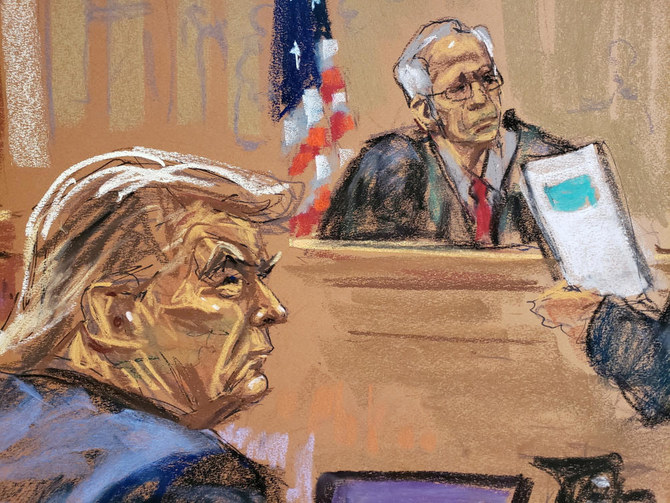
During the New York civil case, Trump lashed out in the courtroom on Jan. 11 against both the judge and James while proclaiming his innocence. “You have your own agenda,” Trump scolded Engoron, who told Trump’s lawyer “control your client.” The judge during the trial had fined Trump $15,000 for twice violating a gag order against disparaging court staff.
Engoron ruled in September that Trump’s financial statements were fraudulent, leaving the focus of the trial on how much Trump should pay in penalties. James sought $370 million in penalties and a New York commercial real estate ban on Trump and his two adult sons, Donald Jr. and Eric Trump.
The trial featured some dramatic testimony. Trump during a defiant appearance on the witness stand boasted about his business acumen and accused James and Engoron of partisanship. Trump’s former lawyer and “fixer” Michael Cohen testified for the state.
Cohen testified that he manipulated the values of Trump’s real estate properties to match “whatever number Mr. Trump told us.” Trump afterward called Cohen a “disgraceful fellow.” His lawyers grilled Cohen on his criminal record and accused him of lying to boost his book sales and podcast traffic.
Donald Jr., Eric and Trump’s daughter Ivanka Trump also testified. They said they had little to no involvement in their father’s financial statements while running the Trump Organization, an umbrella company for Trump’s many business ventures. Unlike her brothers, Ivanka Trump was not a defendant.


![]()

Donald Trump must pay $354.9 million, barred from NY business for 3 years, judge rules
Short Url
https://arab.news/wtpds
Donald Trump must pay $354.9 million, barred from NY business for 3 years, judge rules
- Justice Arthur Engoron also banned Trump from serving as an officer or director of any New York corporation for three years
- Trump has denied wrongdoing and called the case a political vendetta by James, an elected Democrat


Latest updates


© 2026 SAUDI RESEARCH & PUBLISHING COMPANY, All Rights Reserved And subject to Terms of Use Agreement.