

Biden again tells Netanyahu that Rafah civilians must be protected

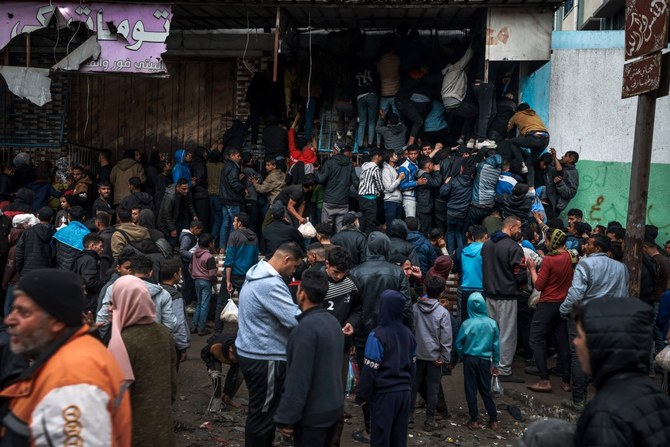
Palestinians crowd oustide a bakery to buy bread in Rafah on the southern Gaza Strip (AFP)
Short Url
Updated 16 February 2024
Follow

Biden again tells Netanyahu that Rafah civilians must be protected

  • US President Joe Biden warned Netanyahu by phone on Thursday against launching an operation in Rafah without a plan to keep civilians safe
  • Israel sent troops into a hospital in war-torn Gaza on Thursday
  • Health ministry in Hamas-ruled Gaza called the situation at Nasser hospital “catastrophic,”

Gaza Strip: US President Joe Biden on Thursday again told Israel’s Prime Minister Benjamin Netanyahu that he should not proced with military action in Rafah without a credible and executable plan to protect Palestinian civilians, the White House said.
The call between the two leaders on Thursday was the second time in less than a week that Biden warned Netanyahu about moving into the southern part of the Gaza Strip without a plan to ensure the safety of some 1 million people sheltering there.
They also spoke about ongoing hostage negotiations and Biden pledged to continue to work around the clock to help free the hostages, who have spent 132 days in Hamas captivity, according to the White House read out of the call.
Earlier this month, Biden said Israel’s military response in the Gaza Strip had been “over the top“ and expressed grave concern over the rising civilian death toll in the Palestinian enclave.
The war began on Oct. 7 when Iran-backed Hamas sent fighters into Israel, killing 1,200 people, mostly civilians, and seizing 253 hostages according to Israeli tallies.
Israel’s air and ground offensive has since devastated tiny, crowded Gaza, killing 28,663 people, also mostly civilian, according to health authorities, and forcing nearly all its more than 2 million inhabitants from their homes.

Israel sends troops into 'besieged' Gaza hospital

Israel sent troops into a hospital in war-torn Gaza on Thursday where it said hostages may have been held, as medics warned the key medical facility was operating in “near impossible” conditions.
The raid came after days of intense fighting between troops and Hamas militants around the Nasser Hospital in Khan Yunis — one of the largest medical sites in southern Gaza, and one of the territory’s few hospitals that are still operational.
Israel, which has accused Hamas militants of using hospitals for military purposes, said it was carrying out a “precise and limited operation” at the facility with “no obligation” for patients or staff to evacuate.
Israeli army spokesman Daniel Hagari said there was “credible intelligence from a number of sources, including released hostages, indicating that Hamas held hostages at the Nasser Hospital in Khan Yunis and that there may be bodies of our hostages” there.
The health ministry in Hamas-ruled Gaza reported that thousands of people who had sought refuge in the complex, including patients, have been made to leave in recent days.
It has called the situation at Nasser “catastrophic,” with staff unable to move bodies to the morgue because of the risks involved.
Medical charity Doctors Without Borders (MSF) described a “chaotic situation” in the hospital after it was shelled early Thursday, killing and wounding multiple people.
“Our medical staff have had to flee the hospital, leaving patients behind,” MSF said, with one employee unaccounted for and another detained by Israeli forces.
The World Health Organization has described Nasser Hospital as a critical facility “for all of Gaza,” where only a minority of hospitals are even partly operational.

Netanyahu insist for a “powerful” operation into Rafah

Roughly 130 hostages are still believed to be in Gaza after the October 7 attack on Israel by Hamas militants, which resulted in the deaths of about 1,160 people, mostly civilians, according to an AFP tally based on official Israeli figures.
Dozens of the estimated 250 hostages seized during the attack were freed in exchange for Palestinian prisoners during a week-long truce in November. Israel says 30 of those still in Gaza are presumed dead.
At least 28,663 people, mostly women and children, have been killed in Israel’s assault on the Palestinian territory, according to the health ministry.
Israel launched more deadly strikes on southern Gaza on Thursday after Prime Minister Benjamin Netanyahu insisted it would push ahead with a “powerful” operation in the overcrowded city of Rafah for “complete victory.”
Hundreds of thousands of people have been driven into Rafah, seeking shelter in a sprawling makeshift encampment near the Egyptian border.
The city now hosts more than half of Gaza’s population, with displaced people “crammed” into less than 20 percent of the territory, according to UN humanitarian agency OCHA.
“We were displaced from Gaza City to the south,” said Ahlam Abu Assi. “(Then) they told us to go to Rafah, so we went to Rafah.
“We can’t keep going and coming,” she added. “There is no safe place for us.”
US President Joe Biden warned Netanyahu by phone on Thursday against launching an operation in Rafah without a plan to keep civilians safe, the White House said.
Britain, meanwhile, joined Australia, Canada and New Zealand in warning Israel not to launch a ground offensive in the city.
Prime Minister Rishi Sunak told Netanyahu in a telephone call that Britain was “deeply concerned about... the potentially devastating humanitarian impact of a military incursion into Rafah,” his office said.


Arab Coalition announces ‘limited’ airstrike targeting two ships that smuggled weapons to Yemen

Updated 30 December 2025
Follow

Arab Coalition announces ‘limited’ airstrike targeting two ships that smuggled weapons to Yemen

  • Coalition urges evacuation of the Port of Mukalla, signaling that a major military operation to force an STC withdrawal could be imminent
  • Spokesman says the two ships transported weapons from the UAE port of Fujairah to Mukalla without getting permission from Coalition command

RIYADH: The Coalition to Support Legitimacy in Yemen on Tuesday said it conducted a “limited” airstrike targeting two ships that smuggled weapons and other military hardware into Mukalla in southern Yemen.

In a statement carried by the Saudi Press Agency (SPA), the Coalition Forces spokesman, Major General Turki Al-Maliki, said that two ships coming from the port of Fujairah in the United Arab Emirates entered the Port of Mukalla in Hadramaut without obtaining official permits from the Joint Forces Command of the Coalition. 

“The crews of the two ships disabled the tracking systems of the two ships and unloaded a large quantity of weapons and combat vehicles to support the Southern Transitional Council forces in the eastern governorates of Yemen (Hadramawt, Al-Mahra) with the aim of fueling the conflict. This is a clear violation of imposing a truce and reaching a peaceful solution, as well as a violation of UN Security Council Resolution No. (2216) of 2015 AD,” said the spokesman.

The coalition urged civilians and fishermen to evacuate the Port of Mukalla, signaling that a major military operation to force an STC withdrawal could be imminent.

Google map showing the location of Mukalla in southern Yemen

Al-Maliki said the Coalition Forces acted on a request by Rashad Al-Alimi, the president of the Yemeni Presidential Leadership Council, “to take all necessary military measures to protect civilians in the governorates of Hadramawt and Al-Mahra.”

Al-Alimi, the president of the Yemeni Presidential Leadership Council, warned last week that unilateral actions by the STC were pushing the country toward a dangerous tipping point.

“Given the danger and escalation posed by these weapons, which threaten security and stability, the Coalition Air Forces conducted a limited military operation this morning targeting weapons and combat vehicles unloaded from the two ships at the port of Al-Mukalla. This was done after documenting the unloading, and the military operation was carried out in accordance with international humanitarian law and its customary rules, ensuring no collateral damage occurred,”  spokesman Al-Maliki said on Tuesday.


READ MORE: Analysis: The risks of carving up Yemen


He affirmed the Coalition’s "continued commitment to de-escalation and enforcing calm in the governorates of Hadramawt and Al-Mahra, and to prevent any military support from any country to any Yemeni faction without coordination with the legitimate Yemeni government and the Coalition. This is aimed at ensuring the success of the Kingdom and the Coalition’s efforts to achieve security and stability and prevent the conflict from spreading.”

Disregarding previous agreements with the Coalition, the group calling itself Southern Transitional Council, or STC, launched a sweeping military campaign early in December, seizing the governorates of Hadramaut along the Saudi border and the eastern governorate of Al-Mahra in Yemen’s border with Oman.

The UAE-backed STC forces captured the city of Seiyun, including its international airport and the presidential palace. They also took control of the strategic PetroMasila oilfields, which account for a massive portion of Yemen’s remaining oil wealth.

CaptioYemenis members of the Sabahiha tribes of Lahj, who live along the strip between the south and north of the country, gather during a rally in the coastal port city of Aden on December 14, 2025, to show their support for the UAE-backed Southern Transitional Council (STC), which wants to revive an independent South Yemen. (AFP)

This prompted Saudi Arabia to issue a firm demand for the STC to withdraw and hand over the seized areas to the National Shield Forces, a Saudi-backed unit.

The coalition warned that any military movements undermining de-escalation efforts would be dealt with immediately to protect civilians, according to the Saudi Press Agency.

On Dec. 26, the UAE issued a statement welcoming Saudi Arabia’s efforts to support security and stability in Yemen.

The statement carried by state news agency WAM praised Saudi Arabia’s constructive role in advancing the interests of the Yemeni people and supporting their legitimate aspirations for stability and prosperity.